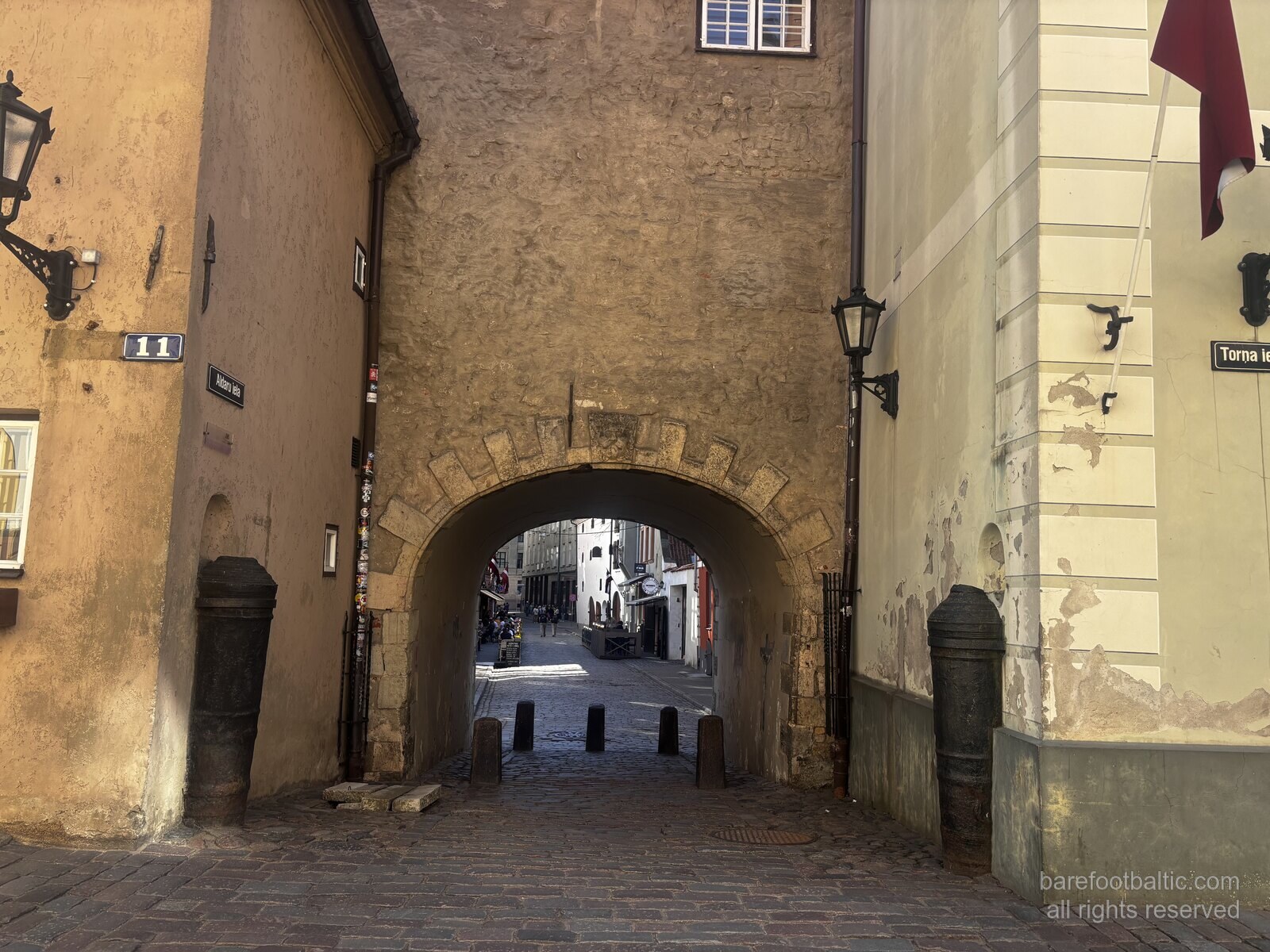
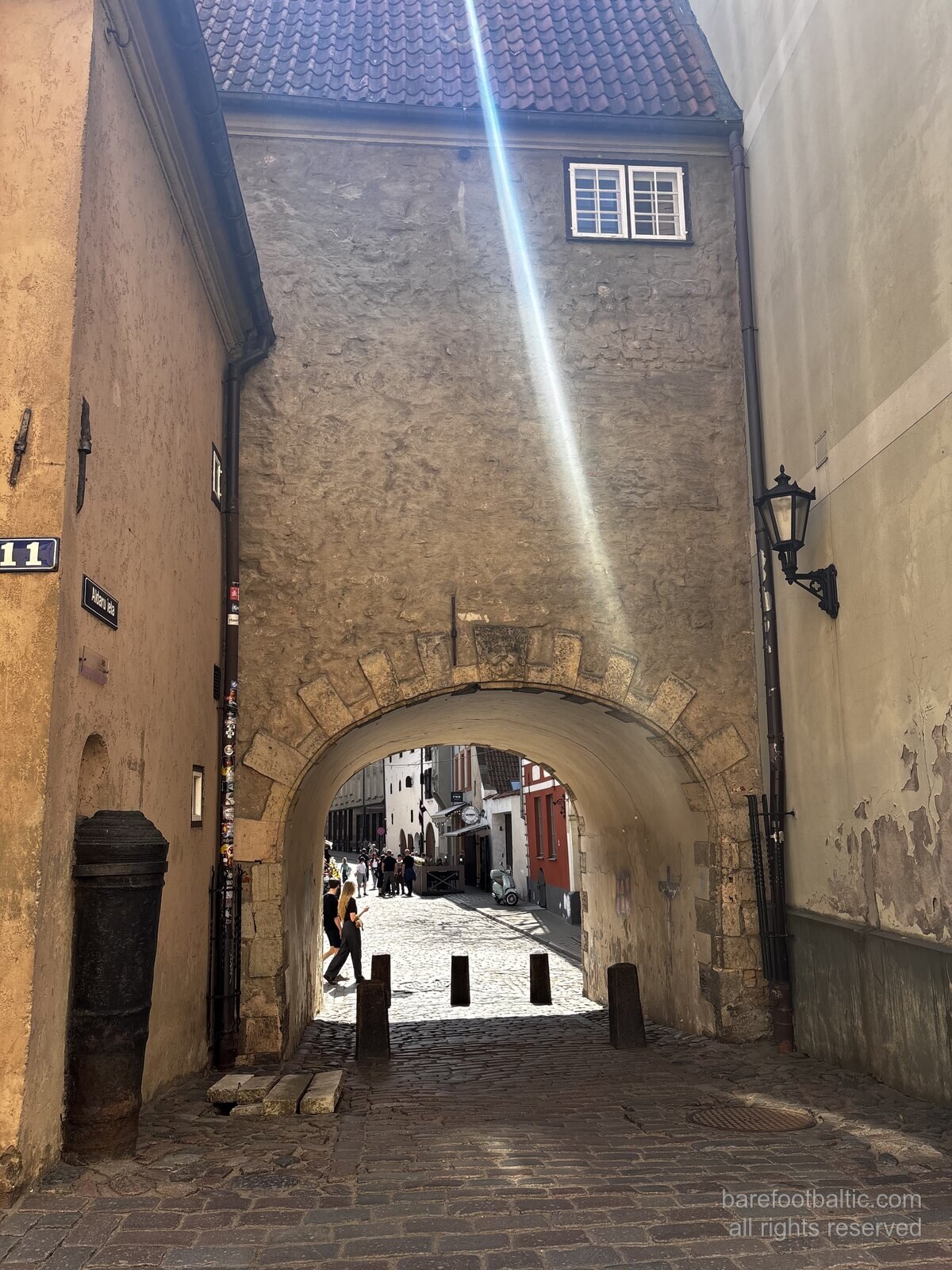
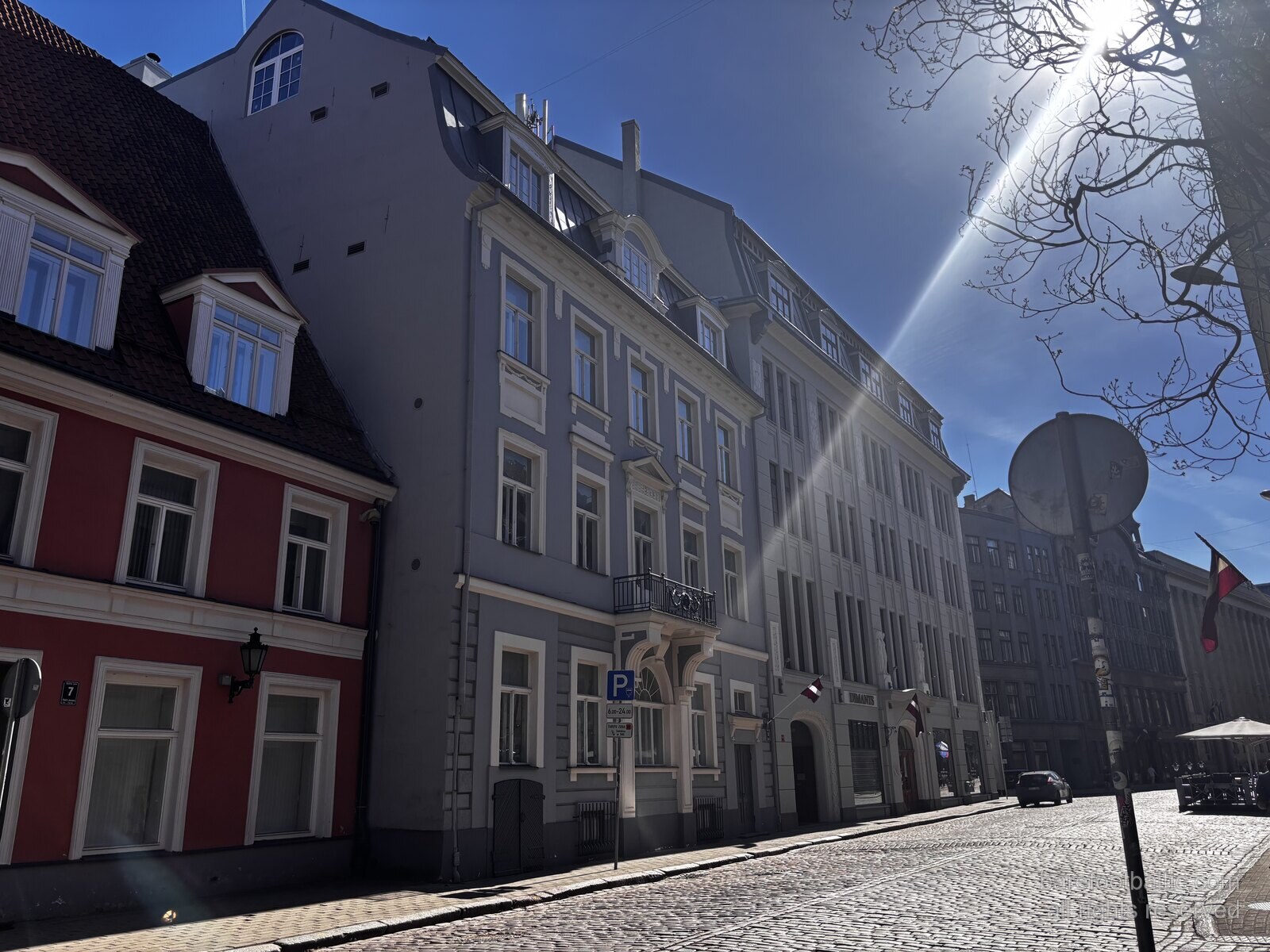
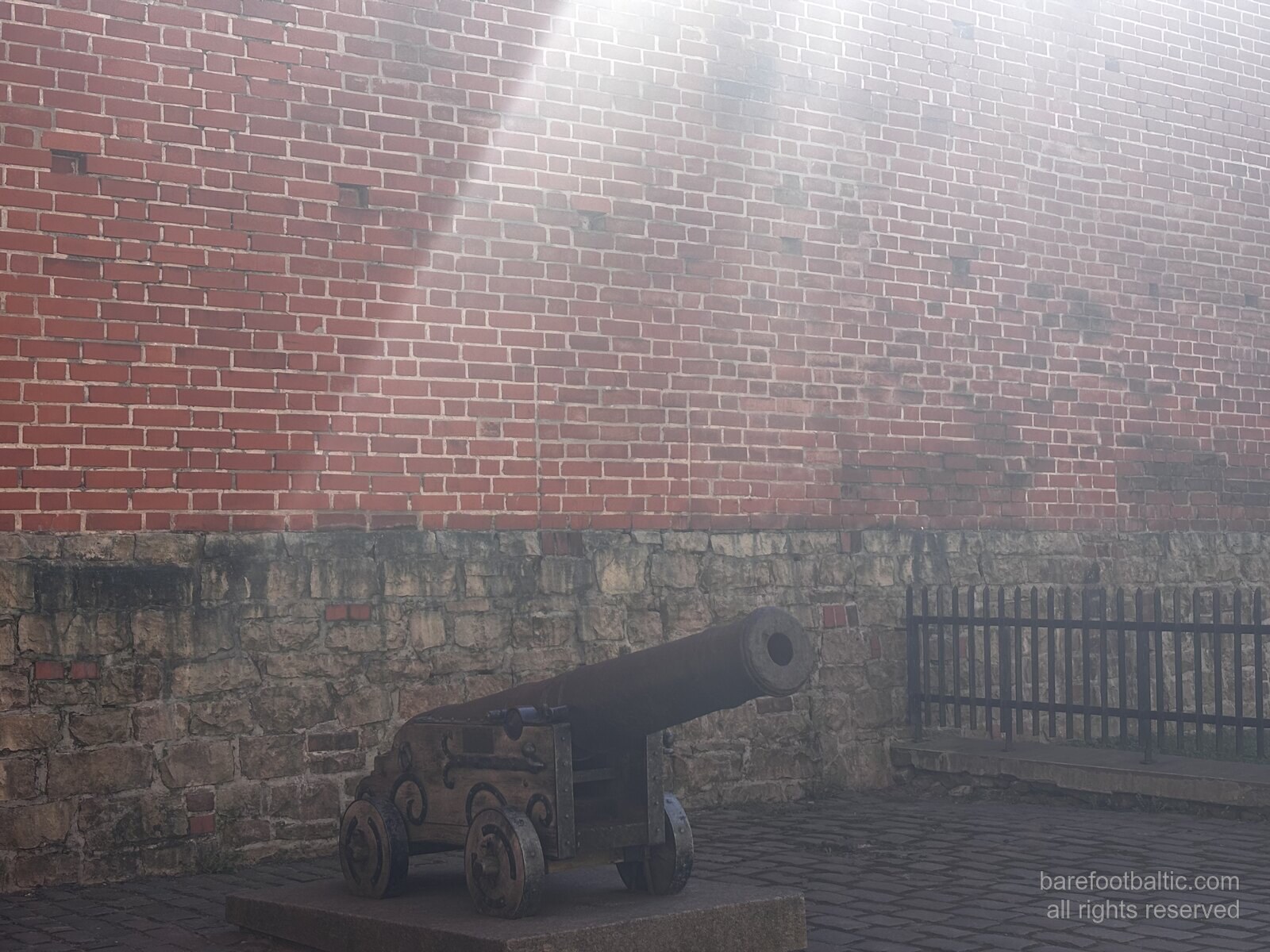
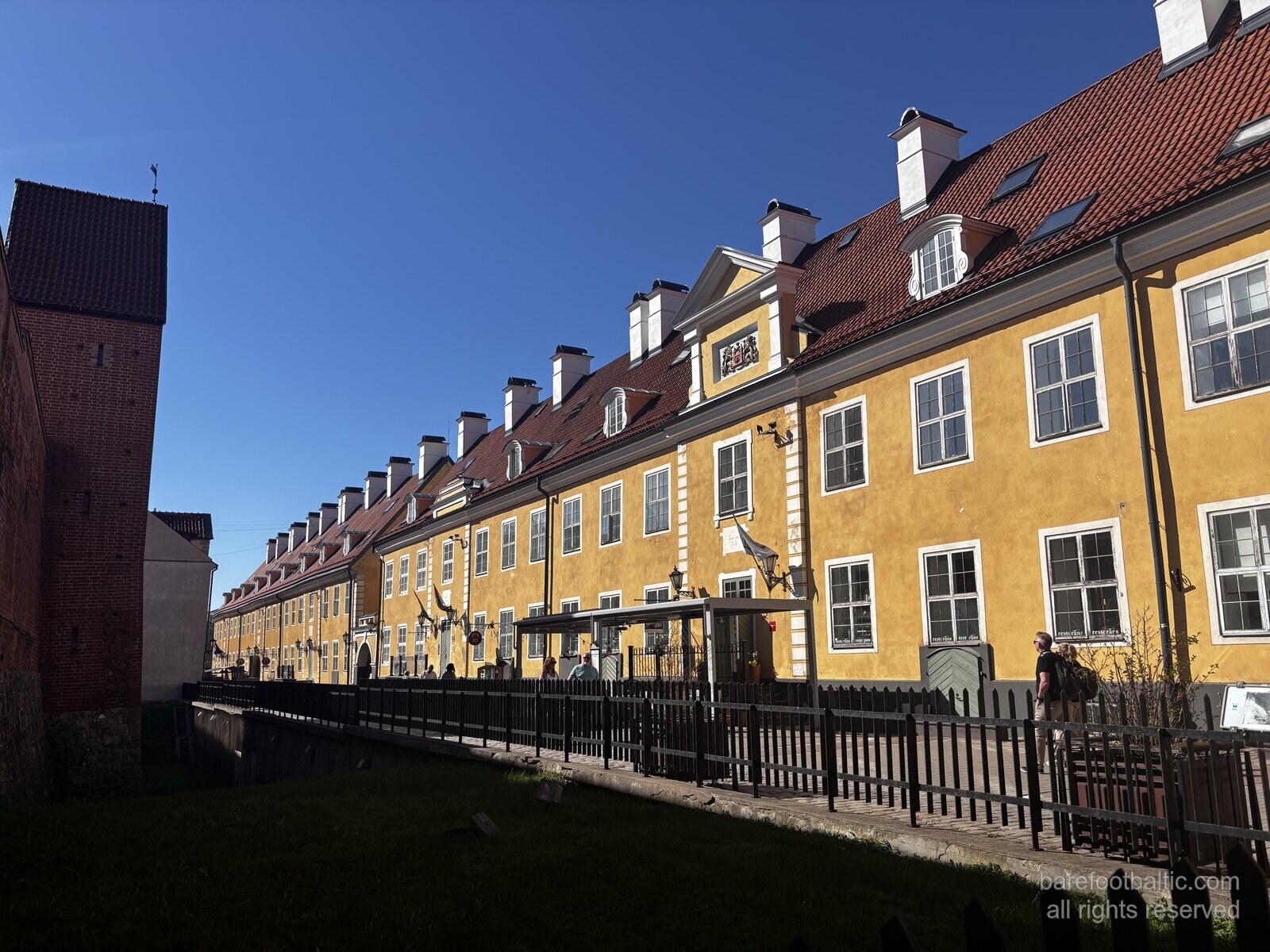
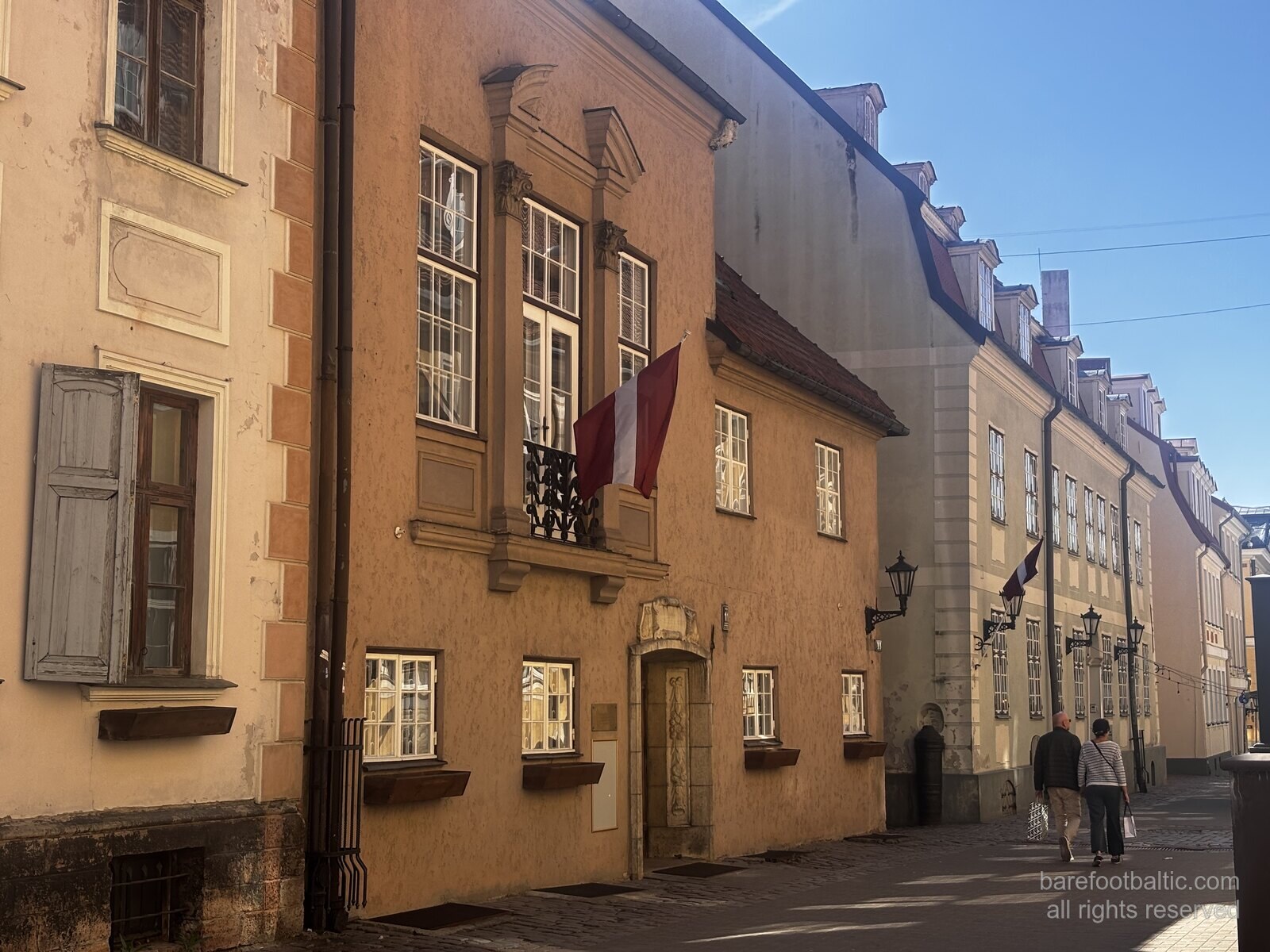
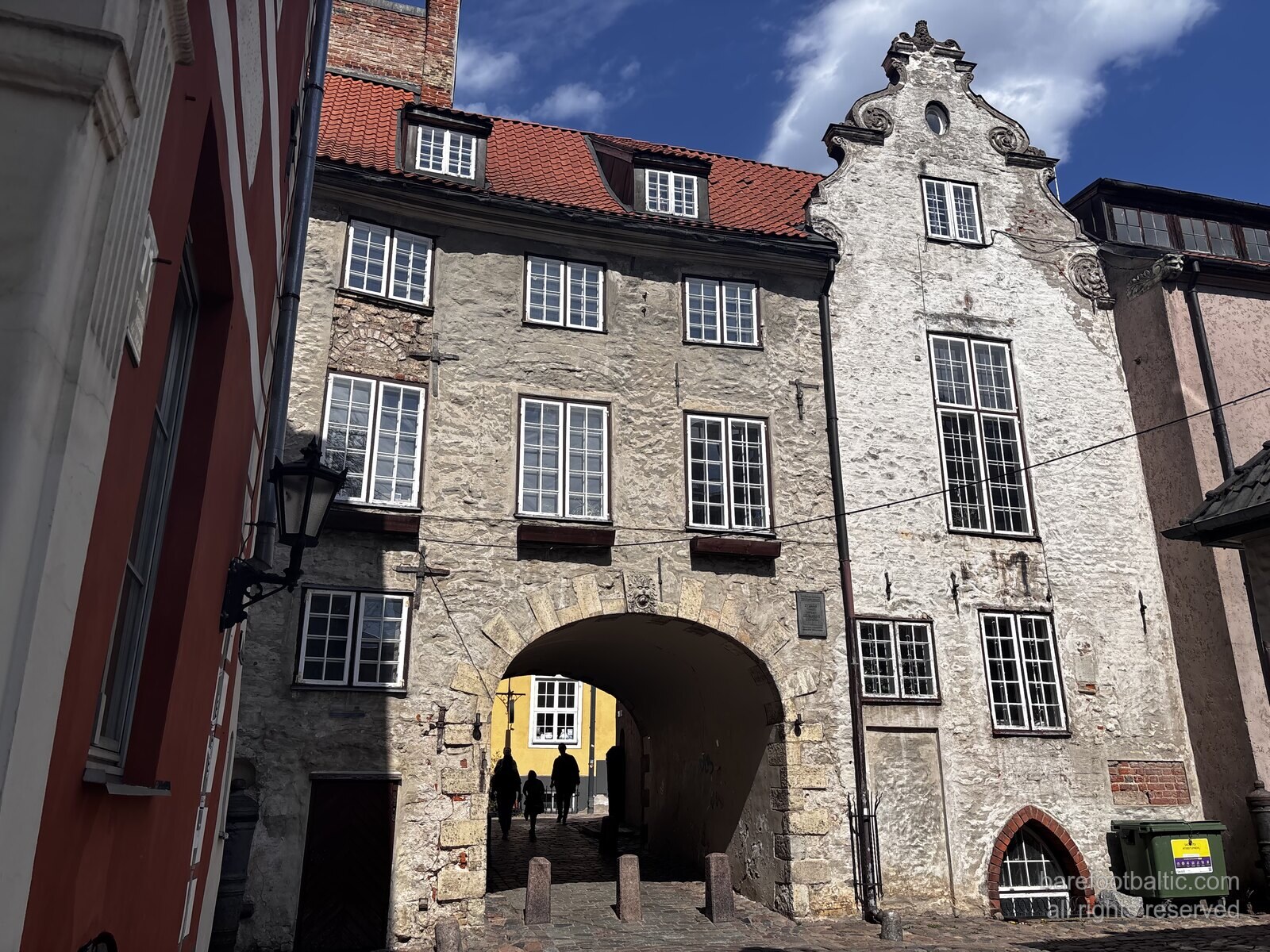
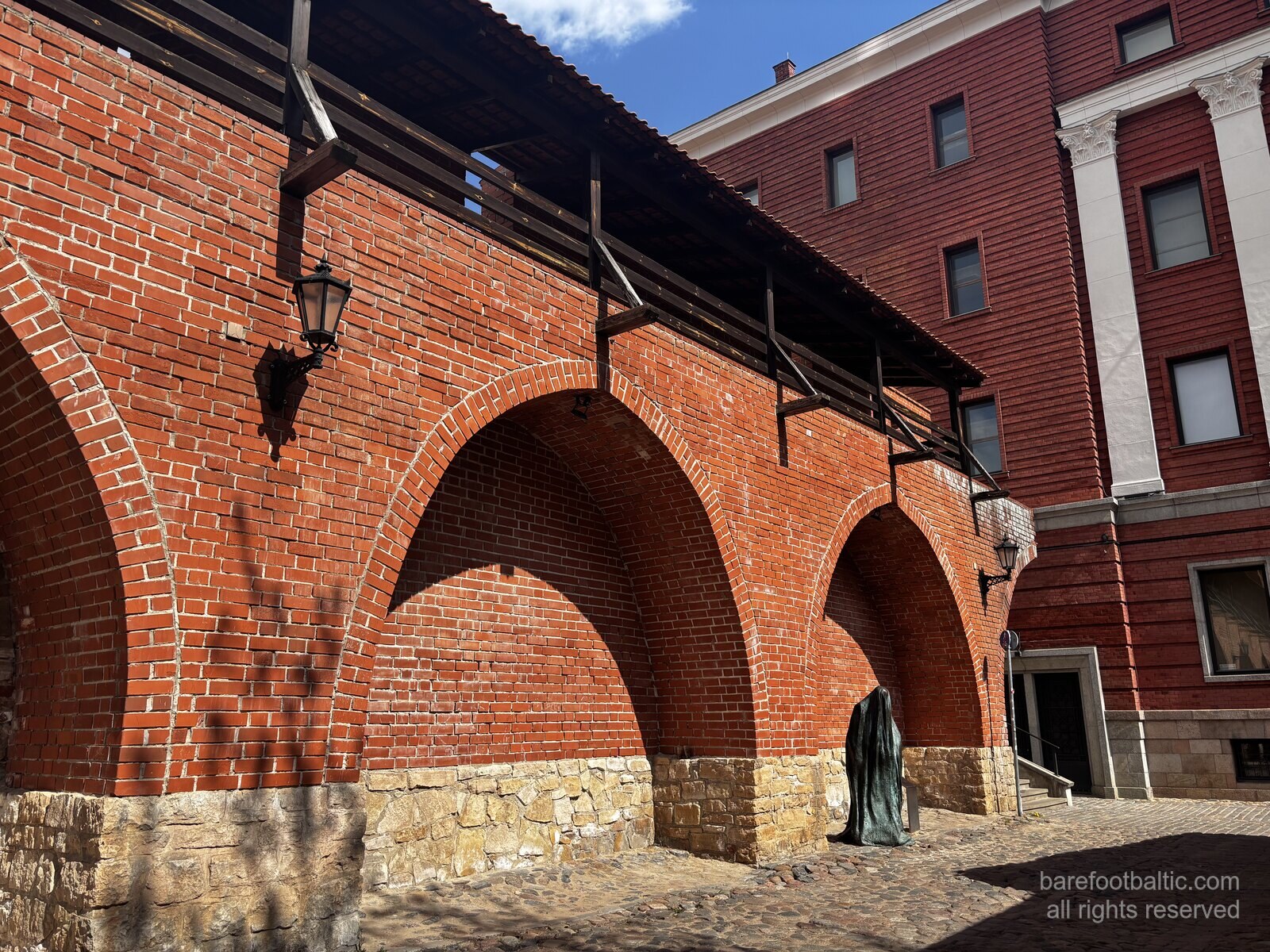
The gate, the lane, the wall, and the row of barracks behind it. Click any image for the full-size view.
Short answer, what the Swedish Gate is
The Swedish Gate (in Latvian, Zviedru vārti) is a small stone archway cut through a building on Torņa iela 11, on the northern edge of Riga’s Old Town. It is the only surviving city gate of the medieval Old Town, which once had eight. The gate dates from 1698, when Riga was under Swedish administration, and was made for a single merchant who wanted private direct access from his house inside the walls to a warehouse outside them.
It’s small. It’s easy to miss. You walk up Torņa iela, you see the archway in the middle of a yellow building, and you walk through. Five seconds in a hurry, or five minutes if you stop and look at the wall section beside it, the cannon, and the row of barracks running south. The cobbles here are a particularly handsome stretch.
Free, on a public street, open 24/7. Three minutes from the Three Brothers, four from the Powder Tower.
1698, one merchant, one gate
Riga had been a Hanseatic city for four centuries by the time the Swedish Crown took it in 1621. Under Swedish rule, from 1621 to 1721, the city was quiet, prosperous, and increasingly cramped. The medieval walls that ringed it had eight gates and were locked at sunset, which was inconvenient for anyone trying to run a business that required moving goods at unpredictable hours.
Here is the story I tell on tours. A wealthy Riga merchant owned a house inside the walls on Torņa iela, and a warehouse on the other side of the wall. Every time he wanted to move goods between the two, he had to go the long way through one of the official city gates. Sometimes a fifteen-minute detour. So in 1698 he applied to the Swedish authorities for permission to cut a private archway through the wall directly behind his house. Permission was granted. The archway was cut. The gate has been there ever since.
The name ‘Swedish Gate’ came later, the way most of these names did. In Russian-Imperial Riga (after 1721) the period under Swedish rule was already being remembered as a time when things were better-organised. Calling the only surviving gate ‘Swedish’ was a small civic compliment to the era that built it. The other seven gates of the medieval city were demolished in the 19th century when the Russians took down most of the city walls to build boulevards. The Swedish Gate stayed because it was cut through a private building, not the wall itself.
The wall, the cannon, the barracks
If you have ten minutes here instead of five, the things to look at after the gate.
The wall section. Just south of the gate, along the back of Torņa iela, you can still see a stretch of the medieval city wall. The lower courses are original 13th to 15th century stone. The upper brickwork is 19th- and 20th-century reconstruction. The wall as a whole is partly survival, partly Soviet-era restoration to give the city its medieval line back. The arched arcades you see set into it are a decorative reconstruction. The original wall was solid.
The cannons. A handful of 17th- and 18th-century cannons sit at the base of the wall here, restored as decorative reminders. They wouldn’t fire today. Their carriages are reconstructions. But the barrels are real and date from the period when this wall actually mattered for defence.
Across Torņa iela from the wall, running south for a couple of hundred metres, is a continuous yellow building. This is Jēkaba kazarmas, Jacob’s Barracks. Built in the 18th century to house the Russian Imperial garrison, restored in the 1990s, now mostly cafés, restaurants, and small shops on the ground floor with apartments above. It’s the longest single building in the Old Town and the second-longest baroque-era barracks in northern Europe.
Visi pārējie vārti tika nojaukti. Šie palika, jo bija privāti.
What I tell groups. “All the other gates were demolished. This one survived because it was private.”Torņa iela, the lane
Torņa iela (‘Tower Street’) is named after the medieval defensive towers that once stood along the wall, of which only the Powder Tower at the northern end survives. The lane runs north-south just inside the line of the old wall, and is one of the best-preserved medieval streets in the Old Town. Cobblestoned, narrow, lined with 17th- and 18th-century buildings on the west side and the long yellow run of Jacob’s Barracks on the east. Walk it slowly. The Swedish Gate is roughly halfway along.
If you’re here in summer, several of the small cafés in Jacob’s Barracks put their seating out on the cobbles. There’s a small artisan market that runs intermittently in the courtyard behind. Late afternoon throws the wall section into long shadow and the yellow barracks into golden light. That’s the moment to take the photograph.
Practical answers
Where it is and getting there
Torņa iela 11, on the northern edge of Riga’s Old Town. Three minutes’ walk south of the Powder Tower, three minutes north of the Three Brothers, five minutes from Riga Cathedral. There is no public transport on Torņa iela. It’s a pedestrianised cobblestone lane, so you arrive on foot from any of those neighbours.
Hours and costs
The gate is on a public street and is free, open 24/7. It is a working passageway through a building, and you simply walk through it. Inside the building above the gate is a private apartment that has occasionally been on the holiday-rental market. If you wanted to stay, you can sometimes find ‘the apartment over the Swedish Gate’ listed on the usual platforms.
Combining with the rest of the Old Town
The Swedish Gate is a five-minute stop on the way between two larger sights. The natural pairing runs Powder Tower → Torņa iela → Swedish Gate → Three Brothers, in either direction, taking 30 to 45 minutes with the gate and the wall section. Add a coffee in Jacob’s Barracks and you have a satisfying mid-morning loop. The full Old Town walk is in the pillar guide.
My take
The Swedish Gate is one of those small Old Town stops where the photograph and the visit are the same length. You walk up, take the picture of the archway with the lane visible through it, walk on. The reason to slow down is the context. The wall section beside it is one of the few visible reminders that Riga was once a walled medieval city. The cannons are real artefacts of the period when those walls mattered. Torņa iela itself is the prettiest medieval street in the Old Town. Treat all four as one stop and you get fifteen minutes of city history.
Frequently asked questions about the Swedish Gate
Daiga Taurīte is a licensed Latvian tour guide and co-founder of Barefoot Baltic. She runs small-group day excursions from Riga. She grew up here, spent two decades in London, came home in 2024. Barefoot Baltic is licensed by Latvia’s Consumer Rights Protection Centre (PTAC), holds ATD passenger transport licence PS-01995, and is insured by BTA Baltic for civil liability.
The Swedish Gate is part of every Old Town walk we run. If you’d like a half-day with a licensed Latvian guide that strings the gate, the wall, Torņa iela, the Three Brothers, and the cathedral together, get in touch.