Last updated: 24 October 2026
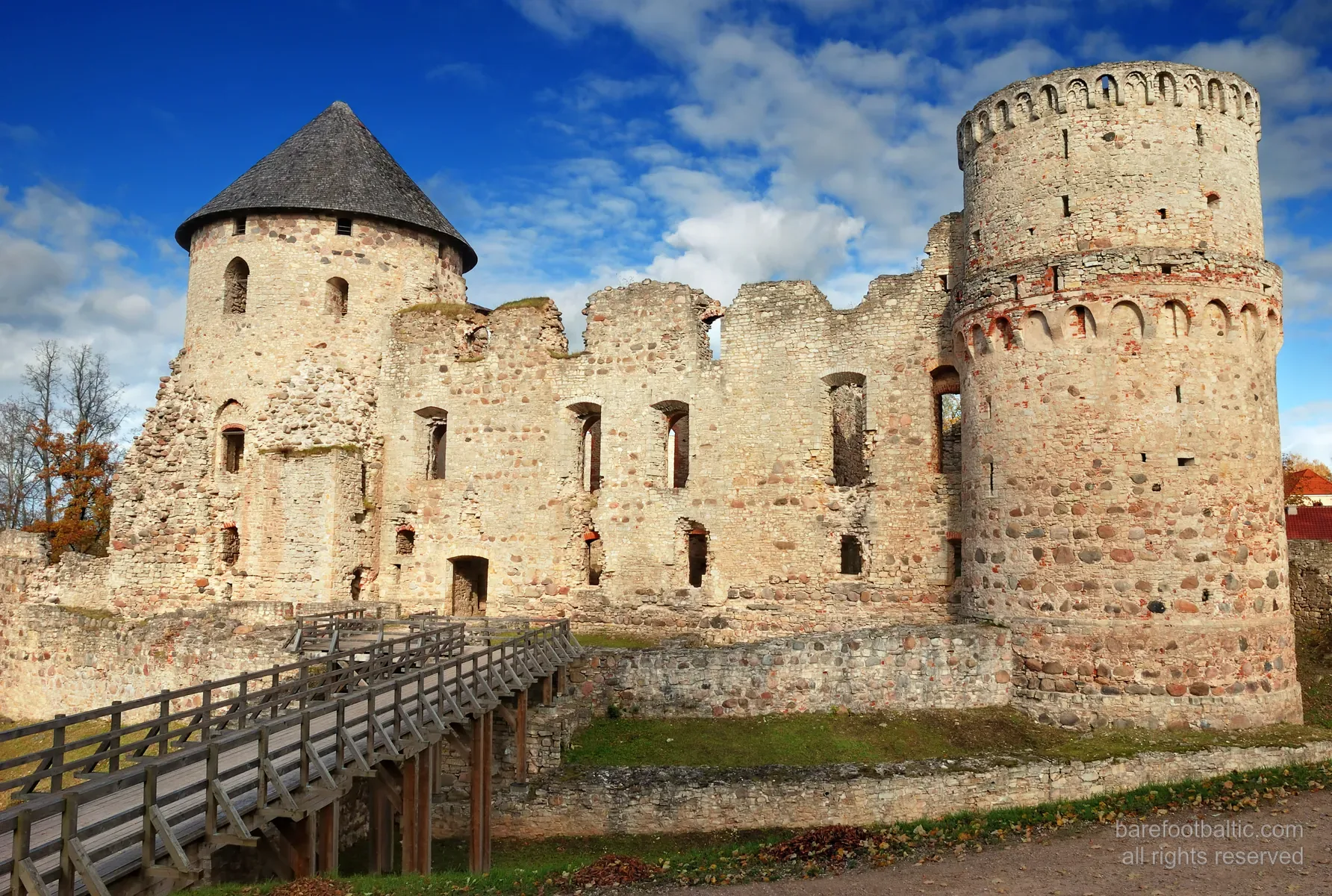
Cēsis is the day trip people don't think to ask for. It's two hours from Riga by direct train, four euros each way, and it has more medieval Latvia per square kilometre than any other town I guide. The castle ruins are real ruins. You walk them by candle lantern, included in the eight-euro ticket. I've guided this loop in August heat that made the stone too hot to lean on, and in October light when the Gauja-valley colours hit Cēsis a week before they peak in Sigulda. That's the week I'd pick if you let me.
What follows is the list, in the order I'd actually walk it from the train station. Nine stops. Realistic pacing on each.
How to use this list
This is ordered the way I'd walk it from Cēsis station. Central square first, then up to the castles, out to the cliffs at Cīrulīši if there's afternoon left in you, and the side trip to Āraiši if you're staying overnight or have a car. Most of Cēsis is walkable. Two stops need transport. I've marked each with how long it actually takes, not what the brown signage suggests. On a half day from Riga, do stops 1 through 4 and have a coffee before the train back. A full day gets you eight of the nine without rushing.
If you'd rather have someone else drive and tell the stories, our Sigulda, Cēsis & the Gauja Valley day trip covers the highlights with a Latvian guide. €94 per adult, year-round, small group up to twelve.
1. Cēsis Castle (Cēsu pils)
Open: 10:00 to 18:00 · Price: €8 adult (the candle lantern is included, not extra) · Time needed: 90 minutes to 2 hours · Best season: year-round, best in late afternoon

The Livonian Order built this castle in 1214, the Knights expanded it for the next three centuries, and the Tsar's army blew most of it apart in 1577. What's left is the second-largest medieval ruin in Latvia, and the only one I know in the Baltics where the chamber rooms are deliberately kept dark. You collect a metal candle lantern at the ticket desk and walk through carrying it. That's the whole interior experience. No spotlights, no museum labels glowing under glass. Just the lantern in your hand and the stone in front of you.
There's a bronze scale model of the whole castle complex in the lobby, and it's the orientation you want before you walk. You can pick out the round defensive tower at the north corner, the residential wing on the west, the chapel ruins inside the courtyard. The spiral staircase up the west tower is original 13th-century stone, narrow, no railing, slick when wet. Worth the climb for the view across the New Castle gardens and over to the church spire.
I'd give it ninety minutes if you're moving, two hours if you read every signboard in the New Castle ticket office on the way in. Skip neither the lower courtyard (where the wedding parties pose, but also where the stonemasons' marks are best preserved) nor the small wooden bridge across the moat at the back. The moat still holds water in spring.
2. Cēsu Jaunā pils (the New Castle)
Open: 10:00 to 18:00 · Price: €4 adult (frequently combined with the castle entry, ask at the ticket window) · Time needed: 45 minutes to 1 hour · Best season: year-round

The New Castle is the 18th-century manor the Sievers family built once the medieval keep had stopped being habitable. The Cēsis History Museum lives there now. Restored panelled rooms on the ground floor, archaeological finds from the medieval castle in the upper galleries, and a small tower with a view back across the Old Town. Four euros to enter on its own, and it often bundles with the castle ticket for a discount. Ask at the ticket window before you pay separately.
It's a shorter, gentler visit than the ruins next door. The reconstructed rooms are well-done but they're rooms. The reason I send guests here is the local-history exhibition on the second floor, which sets out the medieval-trade-route story the castle keeps mostly silent on. How Cēsis was a Hanseatic stop, why German remained the administrative language for six centuries, when the Latvian-language schools opened. That's the context you carry back into the ruined castle if you visit them in this order. If you only have time for one, do the ruin. Ninety minutes spare, do this too.
3. St. John's Church (Sv. Jāņa baznīca)
Open: church entry free year-round · Tower climb: €2, open in the warmer months, check on arrival · Time needed: 30 minutes · Best season: April to October for the tower

St. John's is the church the medieval Livonian masters built in the 13th century for the small town that grew up at the castle gate. The exterior is the original brick-Gothic shape with the steep spire, restored after the fires of the 17th century. The interior is plainer than you might expect from the spire. Whitewashed walls, a 17th-century carved-wood altar, the medieval foundations visible under glass panels in the floor near the chancel.
The reason to come is the tower climb. Two euros at the small desk by the side door, then up the wooden stairs and a narrow stone passage to the bell platform. The view from up there is the best free orientation of Cēsis you'll get. The Old Town's medieval street pattern, the two castles in the same eyeline, the New Castle gardens, the lake to the east. The tower keeper is usually an older woman who'll let you stay up there longer than the queue would suggest.
It's an open church. If a wedding or a memorial is in progress, you wait outside or come back. Sundays before noon usually have a service. The tower closes earlier than the church and shuts entirely for the coldest months. Ask the keeper for the current hours when you arrive.
4. The Old Town walk (Vecpilsēta)
Open: always · Price: free · Time needed: 60 to 90 minutes at a slow pace · Best season: year-round, with October's light the version I'd come back for

The Old Town is the part of the day that surprises people who came for the castle. The medieval street grid is intact in a way Rīga's isn't. Cēsis was a smaller town, didn't get carpet-bombed in the second war, and the German bourgeois houses that line Rīgas iela and Lielā Skolas iela still sit on their 13th-century plot lines. You can walk it in an hour. You'll wish you'd given it two.
Start at the central square, Rožu laukums (Rose Square), which is paved with the original cobblestones plus an inset bronze relief map of the medieval layout. The relief is the best thing you'll find for orienting yourself. The castle gate, the church, the old town walls, the gates that aren't there anymore. From the square, Lielā Skolas iela runs north toward the castle. Rīgas iela runs east toward the church. Take Rīgas first.
The bronze sculptures along Rīgas iela are a quiet little outdoor gallery that nobody photographs. Three of the bronzes are by Aigars Bikše. The pilgrim near number 13 is easiest. Look for the woman with the key around the church corner, and the small detail at knee height by the side gate. There's also a memorial set into the cobblestones near the bus station. Bronze shoes laid in the pavement, marking where Cēsis's Jewish families were assembled for deportation in 1941. It isn't signposted in English. Stop anyway.
Past the church, double back through the Maija parks, the small central park with the Vidzeme Concert Hall at the far end, and you've done a slow Old Town loop. Coffee on the square before the next stop.
5. Cīrulīši nature trails
Open: always, daylight only is sensible · Price: free · Time needed: 90 minutes to 2 hours for the full 6 km loop · Best season: May to October for the best surface conditions
Cīrulīši is the part of the Cēsis day I'd add if you've got legs left after the castles. The walking loop on the east bank of the Gauja takes you past a stretch of red Devonian sandstone outcrops. It's the same stone that builds the cliffs at Sigulda's Velnu klints and Sietiņiezis. Cēsis just has a quieter version, closer to town, signposted in Latvian with English colour-codes on the trail markers, and most of the time you'll have it to yourself.
The full loop is 6 km, gentle ascent, well-marked. There's a short variant about half that length if you want a stretch-the-legs after the castle and not a proper walk. The cliffs themselves are smaller than Sigulda's, but here you can stand at the base of them. At Velnu klints the boardwalks keep you back. Here it's earth and stone.
Surface conditions matter. From late October to early April, the trail surfaces ice up and the sandstone gets greasy under boots. I won't take a group here in deep winter for that reason. The window I'd pick is mid-May to early October, weekdays when possible. The trailhead is a fifteen-minute walk from the central square. Out past the New Castle gardens, down to the river, follow the signs.
6. Vienības laukums and the Unity Monument
Open: always · Price: free · Time needed: 15 to 20 minutes · Best season: year-round
If you only know one battle in Latvian history, it should be the one fought here in June 1919. The newly declared Latvian state had no army worth the name, the German Baltic Landeswehr held Rīga, and a hastily organised force of Latvian and Estonian volunteers pushed them out of Cēsis in three days of fighting. That battle and the armistice that followed are the reason Latvia exists as an independent country in 1920 instead of becoming a German vassal.
The Unity Monument on the square is a 1924 bronze figure that the Soviets dismantled in 1951 and the restored republic put back up in 1998. You can see the joins in the bronze if you look at the base. There are usually fresh wildflowers at the foot of it on national-remembrance days. 11 November (Lāčplēsis Day) is the bigger of them. 23 June, the anniversary of the armistice, is the quieter. Fifteen minutes here, the small information panel in Latvian and English, and you've understood something the castle visit can't tell you.
7. The Cēsis galleries and the contemporary scene
Open: typically Tuesday to Saturday, varies by gallery · Price: most galleries free · Time needed: 30 to 60 minutes · Best season: April to October when the most spaces are open
The Cēsis Concert Hall opened in 2014 and the town's become a small cultural hub for Vidzeme. Chamber music, contemporary dance residencies, the kind of theatre programming that draws audiences out from Rīga on weekends. A handful of artist-run galleries operate around the Old Town, swapping shows every six to eight weeks. The work tends toward Latvian printmaking, ceramics, photography. Quieter than the Rīga commercial-gallery scene, and more grounded.
A niche stop. If you've never bought a print or sat in a tiny gallery to read the artist's statement, skip it. If you love the small-town gallery economy, the kind where the artist is the one sitting at the desk, spend an hour. Ask at the tourist-information office on the square for what's open the week you visit.
8. Āraiši Lake Castle (Āraišu ezerpils)
Open: typically May to October, hours vary · Price: modest adult fee (check before you go) · Time needed: 60 to 90 minutes on site, plus the drive · Best season: late spring through early autumn · Distance from Cēsis: about 20 minutes south by car
This one needs a car or a tour. There's no public transport from Cēsis to Āraiši that I'd inflict on anyone, and the road is small and pleasant and signposted from the A2 south of town. Twenty minutes by car. What you get when you arrive is the reconstructed wooden settlement of an Iron Age Latgalian community, built on stilts in a small lake, on the same archaeological footprint excavated in the 1960s and 1970s.
It's the pre-medieval Latvia that the brick castles tend to crowd out. The longhouses are reconstructed using period materials and tools. So are the woven-stake fences and the small storage huts behind them. Costumed interpreters work the site in the warmer months. You might see weaving, bread-baking on stone, a smith working bog iron. The story it tells is the Latvia before the German missionaries arrived, before the Livonian Order and the brick castles. The same people, two and a half centuries earlier, doing the things their own way.
If you're staying overnight in Cēsis or driving the day from Rīga, this is the extension I'd add. If you're train-and-walking, skip it. The time it takes to arrange the transport eats the day. Save it for a return trip.
9. Where to eat in Cēsis
Open: most kitchens noon to 9pm, smaller spots shut earlier · Price: lunch €10 to 15, dinner €15 to 25 · Time needed: as long as you've got · Best season: year-round
A word on eating in Cēsis. The town is small and the good places shut earlier than you'd expect. Latvian small-town restaurant culture isn't the late-evening continental thing. Lunch is the proper meal. If you're on the train day from Rīga, plan to eat between half-past one and three. You'll have the best of the kitchen and the quietest of the rooms.
What you want for lunch is Pasēdnīca, at Raunas iela 15, two minutes from the central square. Typical Latvian buffet-style. You walk the counter, pick what looks good, weigh your plate, pay by weight. They do the proper pelēkie zirņi, grey peas with bacon and onion, traditionally a Christmas Eve dish but served year-round in Vidzeme. The Cēsis version is heavier than the Rīga restaurant version, the way it should be.
For coffee and something sweet between the castle and the church, there's a quieter cafe a street back from the square, near the side gate of the New Castle gardens. The cake selection rotates. The owner often has the door open onto the courtyard in summer. Ask if you can take coffee outside, and she will say yes.
It's a good last hour of a Cēsis day before the train back.
Getting to Cēsis
By train. The direct Rīga to Valka line stops at Cēsis. The journey is about two hours, the ticket is €4 each way, and trains run several times a day. Buy at the kiosk at Rīga Centrālā stacija, or use the Pasažieru vilciens app on your phone. Both are fine. The Cēsis station is a fifteen-minute walk from the central square. The route is signposted in Latvian, you cross one main road, and the church spire is your landmark.
By bus. Buses from the Rīga international bus station run a few times a day, roughly the same duration as the train, slightly cheaper. Less comfortable. Useful only if the train schedule doesn't fit your morning.
By car. The A2 motorway out of Rīga to the A3 junction at Inčukalns, then north on the A3 to Cēsis. About 1 hour 20 minutes door to door in normal traffic. Free parking in most public lots in the town centre. The lots near the New Castle gardens are the closest to the castle ticket office.
On our Sigulda, Cēsis & the Gauja Valley day trip, we visit a local bread maker.
Cēsis fits inside a wider Rīga-day-trips universe. For the parent decision tree across the day trips I run, see Day Trips from Rīga.
Best time of year
Spring (April to May). Quiet, soft, gradual. The trees come in late, birches first and oaks late May, and the castle ruins look right against new green. Trails at Cīrulīši are muddy through mid-April. The town is awake but unstressed. You'll have the church to yourself most mornings.
Summer (June to August). Peak crowds at the castle, especially weekends. The pluses are long daylight (true dusk after 10pm in June), every seasonal stop open, and the contemporary-music programme at the Concert Hall in full swing. Jāņi (23 to 24 June, the Latvian midsummer) brings out the old folk traditions. If you can be in Cēsis for the weekend before, you'll see oak-leaf crowns and bonfire-prep happening across town.
Autumn (September to October). My favourite window. The colours hit Cēsis the first week of October, a week before they peak further south in Sigulda. Cooler air, fewer day-trippers. The castle stone reads dark and warm at once in the afternoon light.
Winter (December to February). Smaller town, fewer reasons to be outside, the castle interior well suited to short dark afternoons. The candle-lantern walk is better when it's already dim outside at three in the afternoon. Some restaurants shorten hours. Cīrulīši trail surfaces ice up. I wouldn't put a guest on them in deep winter. A January Saturday in Cēsis with snow on the castle walls is a real day if you dress for it.
If I had to pick one week a year, I'd pick the first week of October.
Want a guide? Or doing it alone?
The day works either way. If you're still deciding whether Cēsis earns the trip at all alongside Sigulda or Rundāle, see our read on combining Sigulda and Cēsis in one day. It'll help you decide whether to give Cēsis its own day or share one.
Self-tour. A confident traveller with a smartphone and the Pasažieru vilciens app can do this loop alone without difficulty. The train is easy. The Old Town is small enough to navigate by spire. The castle is signposted in English. The New Castle museum has English labels in every room. You'll miss the medieval-trade-route politics that explain why German remained the administrative language in this part of Latvia for six centuries, and the 1919 Battle-of-Cēsis story at the Unity Monument is best heard with the geography in front of you. Read the linked posts on those before you go and you'll close most of the gap.
On our Sigulda, Cēsis & the Gauja Valley day trip, we visit a local bread maker.
Prefer to DIY the day from Rīga by train? Our hour-by-hour Cēsis day-trip walk-through covers the train timing, the cost breakdown, and the realistic minimum hours.
Frequently asked questions about Cēsis
Is Cēsis worth visiting if I've already been to Sigulda?
Yes, with a caveat. Sigulda is the cable-car-and-cliffs experience. Cēsis is the medieval-town experience. They share a national park and a castle aesthetic but the days feel different. Sigulda spreads you across a valley, Cēsis concentrates you in a walkable centre. If you only have one day from Rīga, Sigulda is usually the better single pick because it stacks more types of experience. If you have two, Cēsis is the second day. If you're doing a Baltic trip with several days in Latvia and you're a castle person, do Cēsis even before Sigulda. The candle-lantern interior is the rarer experience.
How long do you need in Cēsis?
A full day from Rīga gives you the castle, the New Castle museum, St. John's tower, the Old Town walk, and a proper sit-down lunch. That's six or seven hours on the ground, two hours each way on the train, about ten hours door to door. Two days lets you add Cīrulīši and Āraiši, and gives you a chance to see the contemporary scene at the Concert Hall or a gallery. A long weekend lets you slow the castle visit down. The lantern walk rewards going twice. You can drive to Āraiši with afternoon light and eat a proper evening meal in town.
Is the candle-lantern castle tour a tourist trap?
No. It's something the museum management committed to in the 2010s as a way of preserving the unlit medieval feel of the chamber rooms, and the maintenance cost is in the entry ticket. The lantern is a real metal candle lantern with a stub of beeswax candle, given to you at the desk. You carry it through the chambers and hand it back at the exit. There are no spotlights, no glass display cases, no glowing labels. If you've done a medieval ruin in Germany or France with bright museum lighting, this is the opposite call, deliberately so. I've never met a guest who came out of it underwhelmed.
Is Cēsis kid-friendly?
Yes, especially for kids who like castles and stone-and-stair adventures. The candle lantern is the thing they remember. Small children take it very seriously. The spiral tower in the castle's west corner is narrow, no inside railing, slick when damp. Supervise small kids closely. The Cīrulīši cliffs have unguarded drops in spots. Sensible boots and a hand. The Old Town is fully walkable with a stroller, though some of the cobblestones rattle. There's a small park behind the castle with a playground.
Can you visit Cēsis in winter?
Yes, and the candle-lantern walk is even better. Daylight runs out by four o'clock between mid-December and early February, which makes the lantern interior feel like the only way the castle would have looked at that time of year. Some smaller restaurants shorten their hours. Cīrulīši trail surfaces ice up and I won't take groups out there in deep winter. The train runs the full schedule. Bring proper boots and a hat. The wind off the Gauja valley reaches the central square.
How does Cēsis compare to Sigulda?
They're complementary. Sigulda is the bigger natural landscape. A valley, two cable-car stations, the Olympic bobsleigh track, Turaida castle on its red hillside, the cliff viewpoints. The day is more spread out, more open-air. Cēsis is the smaller, denser version. A walkable medieval town with a real ruin at its heart, a church tower, a contemporary gallery scene. Sigulda is the outdoors day, Cēsis the town day. They pair well. They don't substitute. For combining the two into a single day, see our breakdown of whether you can do both in one.
What language is spoken in Cēsis?
Latvian is the everyday language. Russian is widely understood, particularly among older residents (a relic of the Soviet decades, less so than further east). English is fine at the castle, the New Castle museum, and any restaurant aimed at a Rīga-weekend crowd. English signage drops off when you walk further from the Old Town. The tower keeper at St. John's church is unlikely to have more than a few words of English. Ten will be plenty. A pocket phrase or the Google Translate camera covers the gap.
Is Cēsis accessible without a car?
Mostly. The train from Rīga is straightforward (about two hours, €4 one-way, multiple departures), and the town centre is a fifteen-minute walk from the station. Everything in this list except Āraiši and the further reaches of Cīrulīši is comfortably walkable from the central square. The two car-required stops are Āraiši (no public transport that works for a day visit) and the deeper Cīrulīši trail (walkable from town but adds 30 minutes each way to the day). If you're train-and-walking, plan for the eight stops the train and your feet can reach.
One last thing
The Cēsis day I remember most was a wet October Wednesday with a single guest, a retired Australian historian who'd come to Latvia chasing a thesis he'd written in 1978 about Hanseatic trade. We walked the castle in the rain. The lantern flickered out twice in the courtyard. He asked me about a specific German merchant family, the name of which I had to look up at the New Castle museum on a 1612 trade register, and we sat in the Old Town cafe drinking coffee for an hour while he wrote in a small green notebook. He missed the four-thirty train and we caught the five-fifty instead. He sent me a postcard from Sydney in December.
If you find yourself ten minutes into the candle-lantern walk and you want to do it again from the start, do it. The castle won't mind.
When you're ready to book the version of this day with the driving, the medieval politics, and Sigulda thrown in for the other half, our Sigulda, Cēsis & the Gauja Valley day trip is €94 per adult, year-round, small group up to twelve guests, picks up from your Rīga hotel.