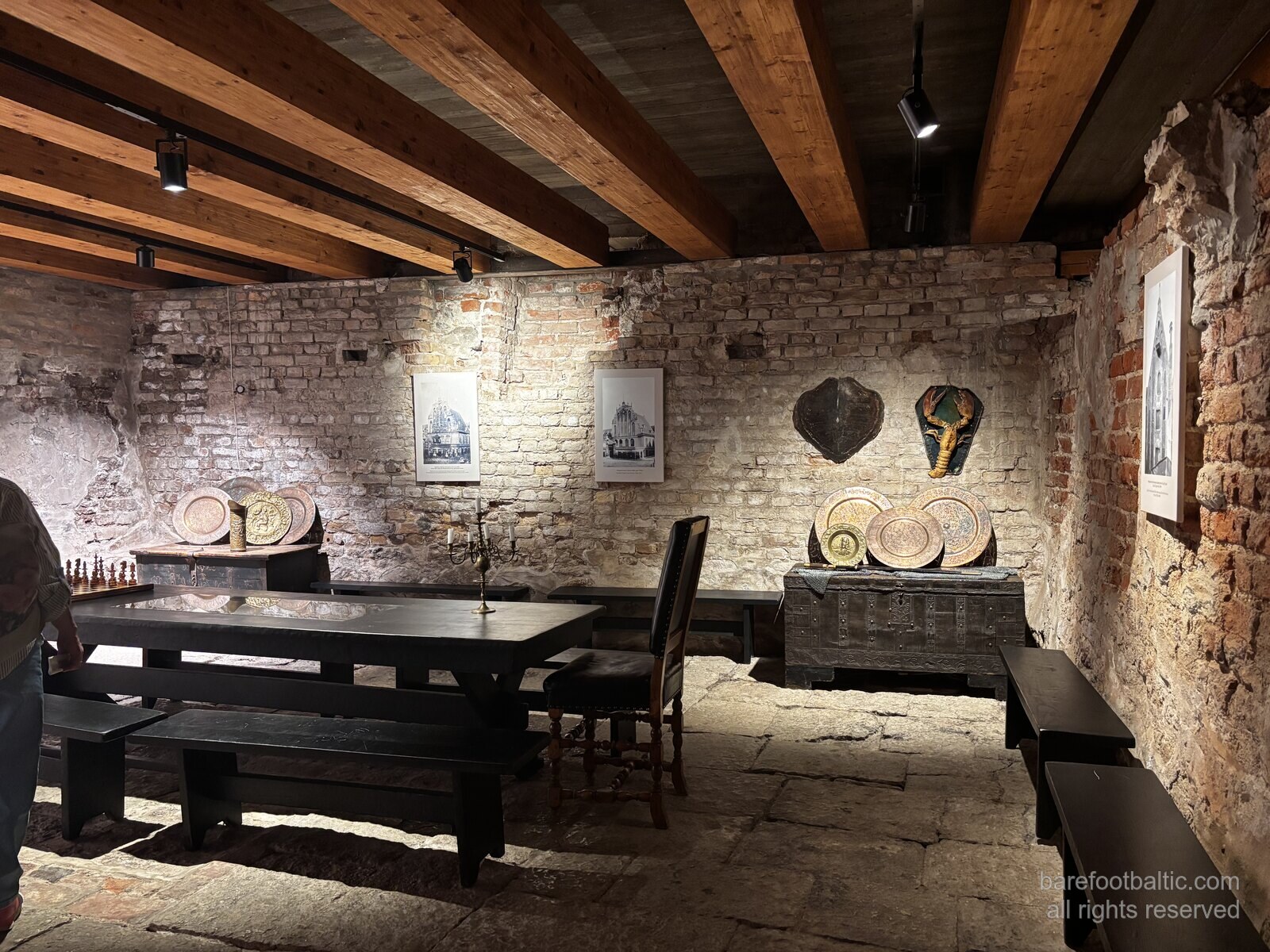
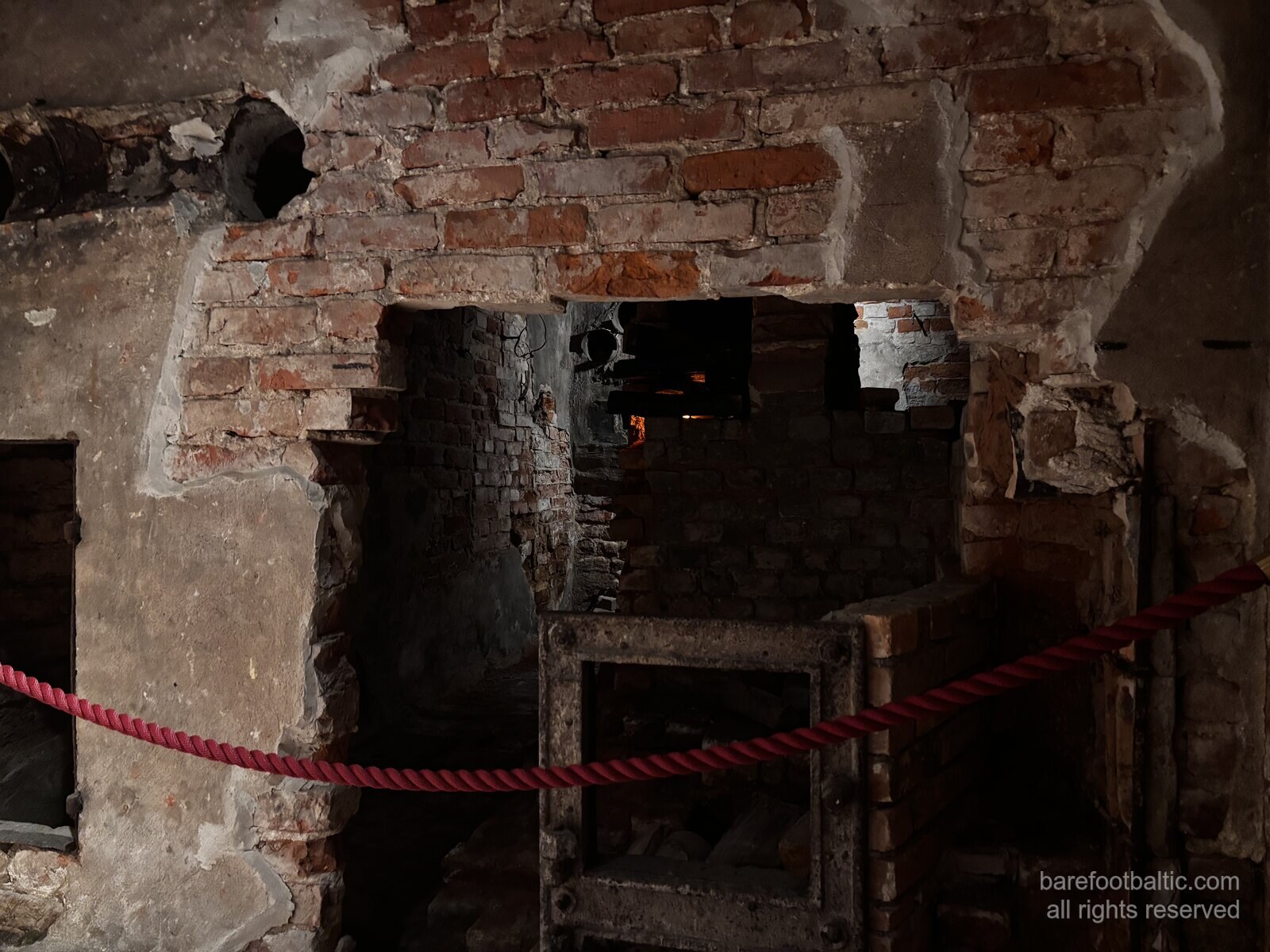
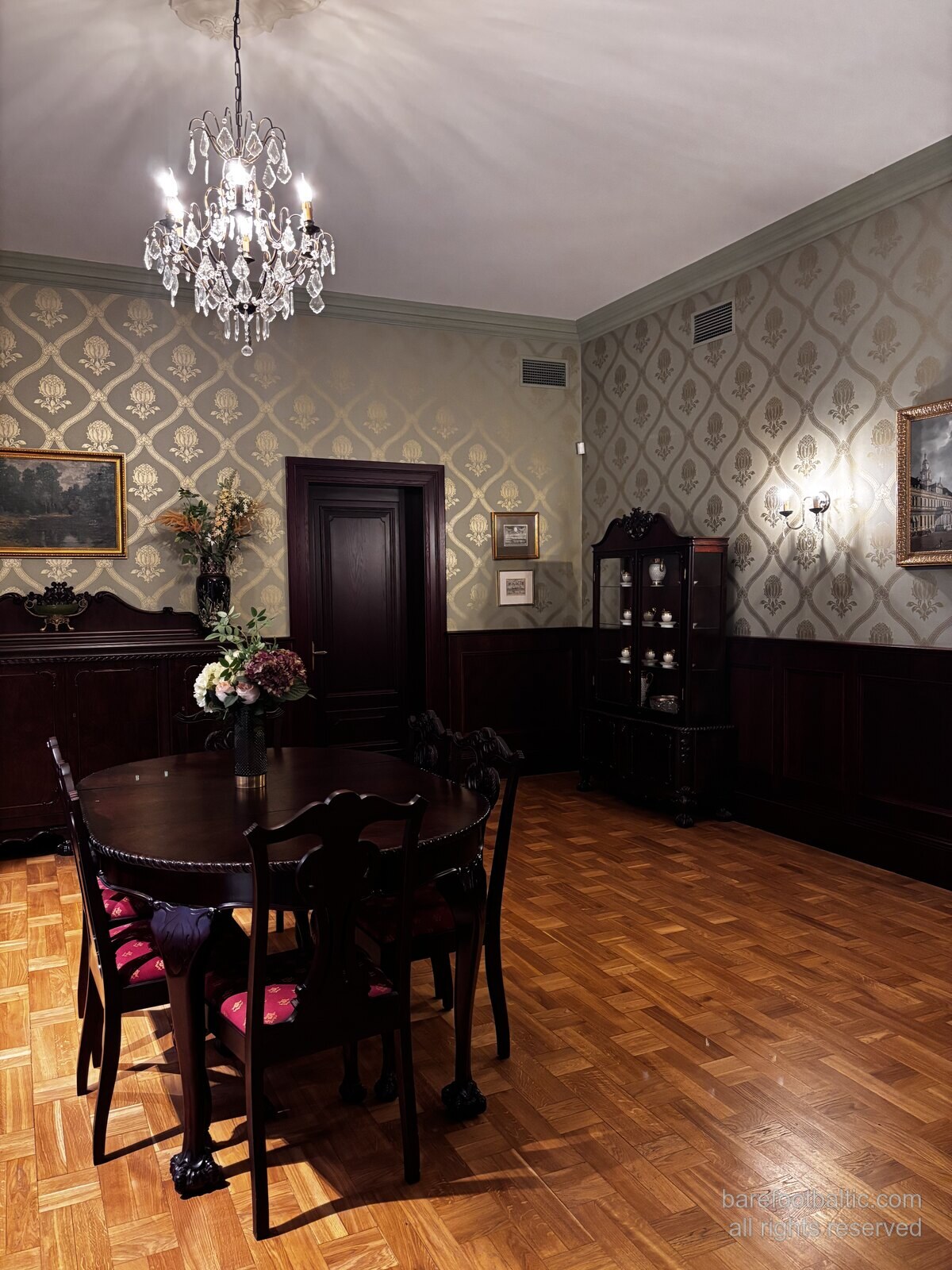
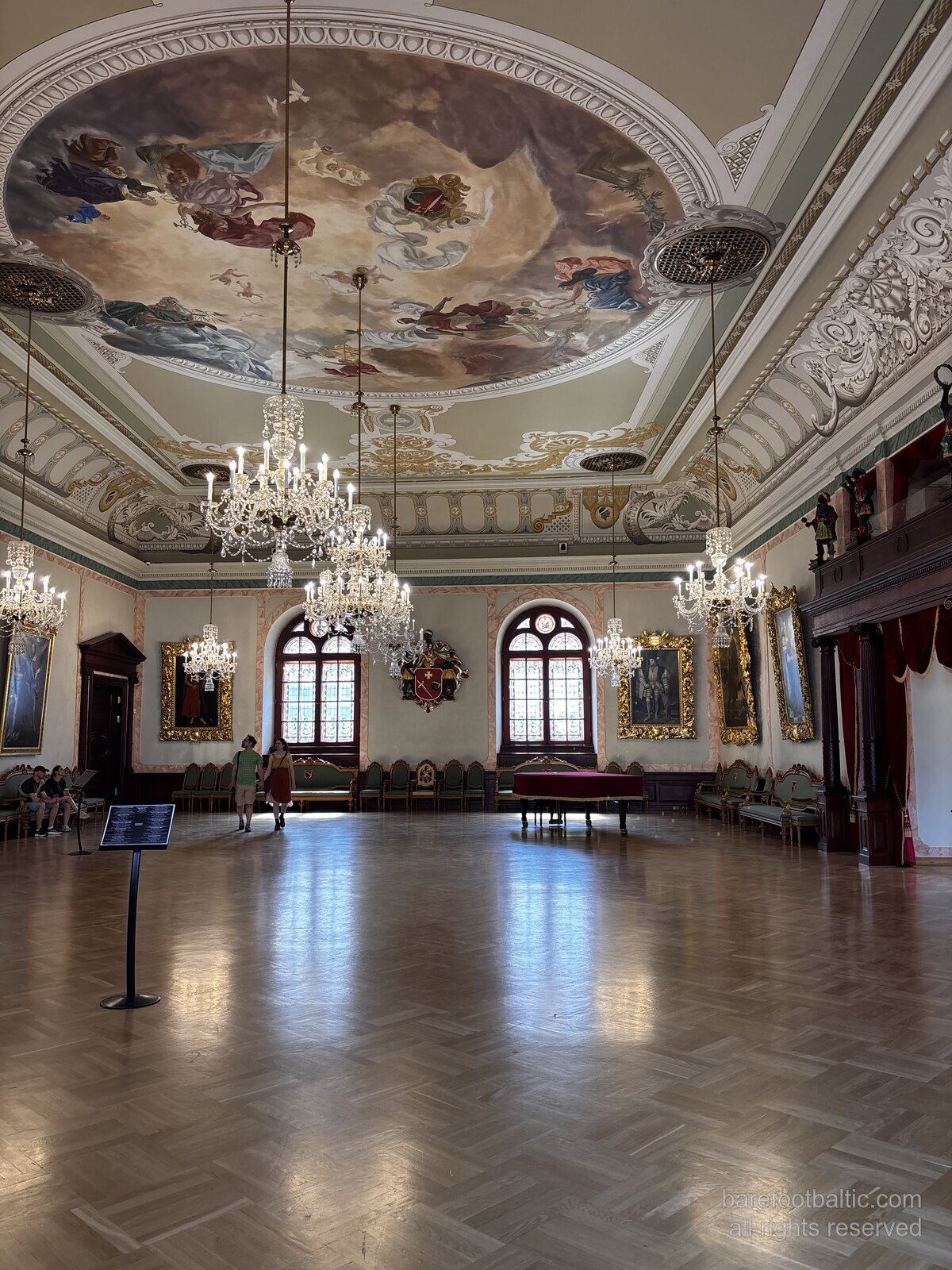
The exterior, the medieval cellar, the hidden chamber, the period rooms, and the Great Hall. Click any image for the full-size view.
Short answer, what the House of the Blackheads is
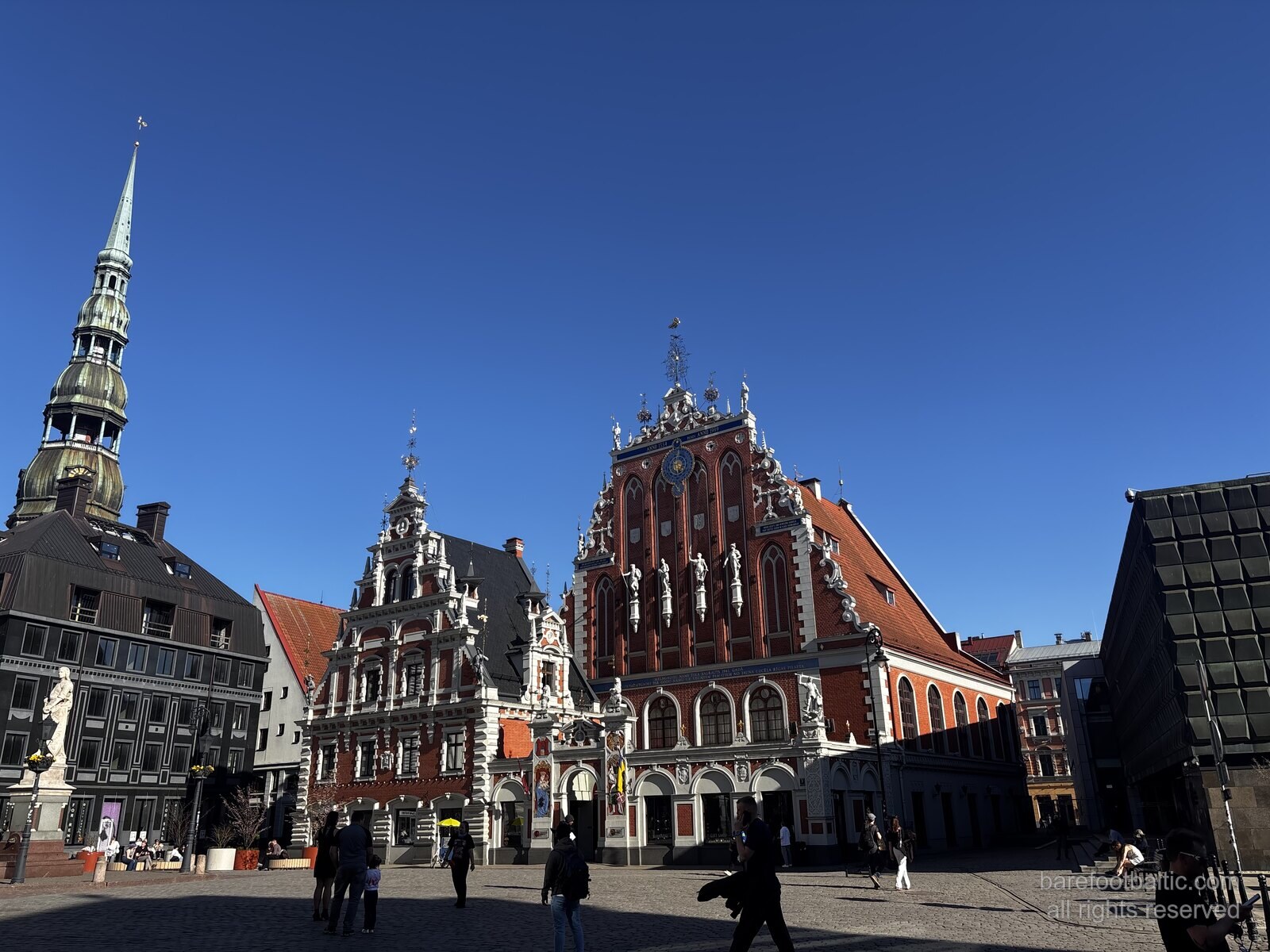
The House of the Blackheads (in Latvian, Melngalvju nams) is the elaborately decorated red-and-white Dutch Renaissance building on Town Hall Square (Rātslaukums) in the southern half of Riga’s Old Town. It ends up on every Riga postcard and every Christmas-market photograph. It is also not the original. The first building went up in 1334. German shelling badly damaged it in 1941, Soviet authorities demolished the ruins in 1948, and the building was reconstructed from 1995 to 1999 using historical drawings, photographs, and salvaged stonework.
The reconstruction is faithful to the old form and openly modern in its fabric. Inside is a small museum (silver, history of the Brotherhood, period rooms), the ceremonial Great Hall (used for state events and concerts), and the medieval cellar, the part that is original. Adjacent to it stands the also-reconstructed Schwabe House, now usually included in the same museum visit. Adult ticket around €7 to €8. Allow 60 to 90 minutes.
Two minutes’ walk south of St Peter’s Church, three minutes south of Riga Cathedral, on the central square of the Old Town.
The Brotherhood of Blackheads
The building’s name comes from the Brotherhood of Blackheads (in Latvian, Melngalvju brālība), a guild of unmarried German merchants in Riga, founded around 1400. The Brotherhood’s patron saint was St Maurice, a Roman-era Christian martyr who was, in the iconography that came down to medieval Europe, depicted as Black. The ‘Blackheads’ in the guild’s name comes from his head, in heraldry. The Brotherhood’s coat of arms shows St Maurice’s head in profile.
The Blackheads were the younger merchants’ guild. You joined as a single man entering the trade, and once you married you graduated to the senior Great Guild. The Brotherhood worked as both a professional association and a social club, running trade events, banquets, dancing, and the occasional spell of militia-style civic defence. They occupied this building from the late 15th century onward, gradually rebuilding it in the architectural fashion of each successive period, and using it for major civic events. The Russian Tsars Peter the Great and Catherine the Great are both supposed to have danced in the Great Hall here. The Brotherhood was dissolved by the Soviet occupation in 1940, restored in independent Latvia in 1995, and exists today as a small ceremonial society.
Destroyed in 1941, rebuilt 1995 to 1999
This is the part of the story the postcard never tells. In June 1941, in the opening weeks of Operation Barbarossa, the centre of Riga came under heavy German artillery and Luftwaffe bombing. The House of the Blackheads, the medieval Riga Town Hall opposite it, and most of Town Hall Square were destroyed. The façade of the Blackheads survived as a damaged shell into 1948, when the Soviet authorities ordered the ruin demolished. The Latvian SSR built a wide open square here for parades. The bombed building site became a flat plaza for fifty years.
The reconstruction was approved as a project for the 800th anniversary of Riga in 2001, and built between 1995 and 1999. Architects worked from a full set of historical sources. There were detailed drawings from the 19th-century restorations, photographs from the 1930s, and salvaged stonework that Soviet-era museum staff had catalogued before the 1948 demolition. Some of the salvaged elements (decorative stones, sandstone reliefs, parts of the staircases) were re-incorporated into the new building. The cellars are the original 1334 stonework. Most of what you see above ground is new fabric in old form.
Some Riga locals object on principle to a reconstructed historic building, the ‘is it real?’ question that haunts every Eastern European post-war restoration project. The original is gone. The reconstruction stands faithfully where it stood, and the fact of destruction is part of the building’s biography now. Visit it as both at once.
What you’re looking at on the facade
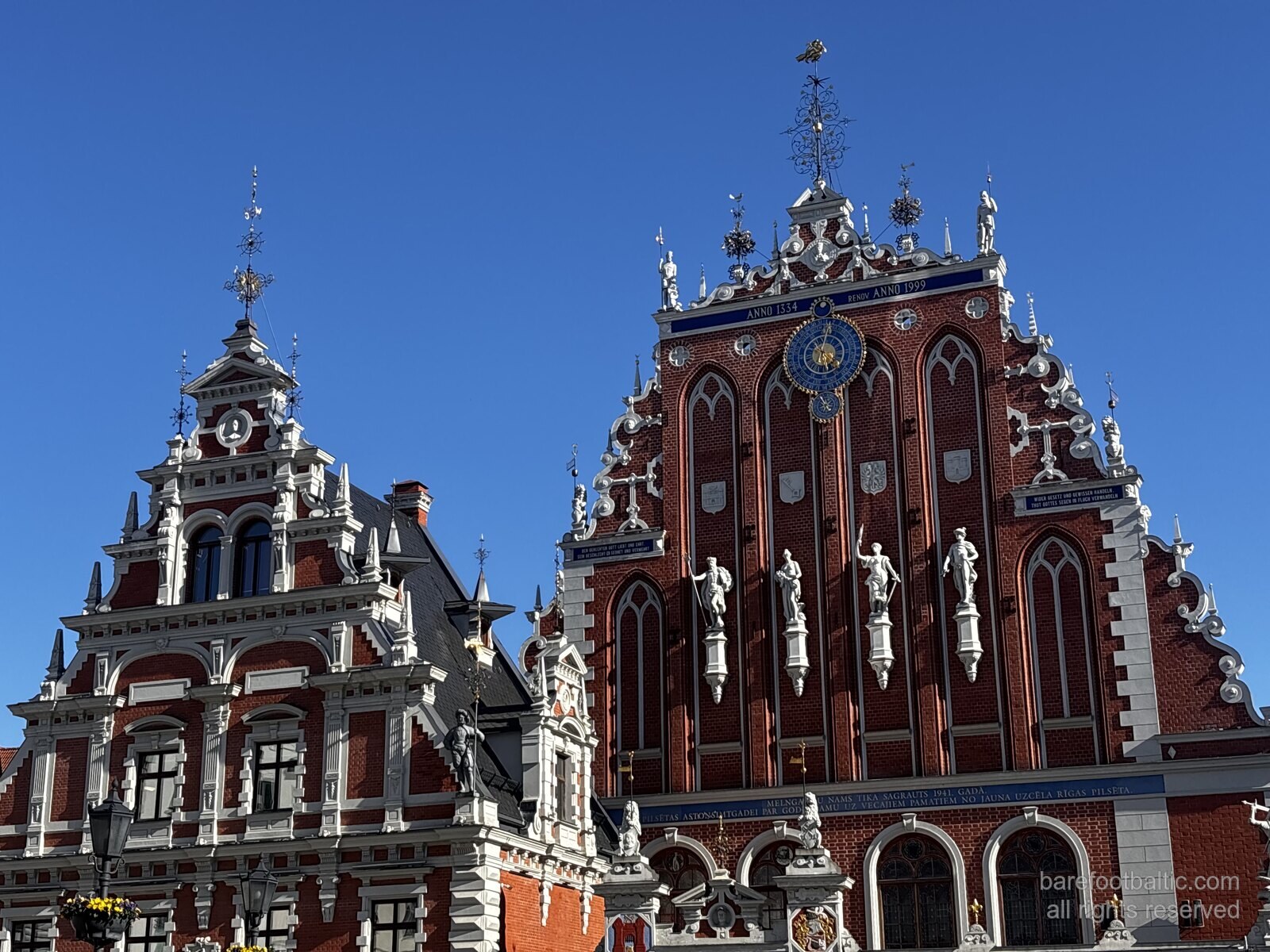
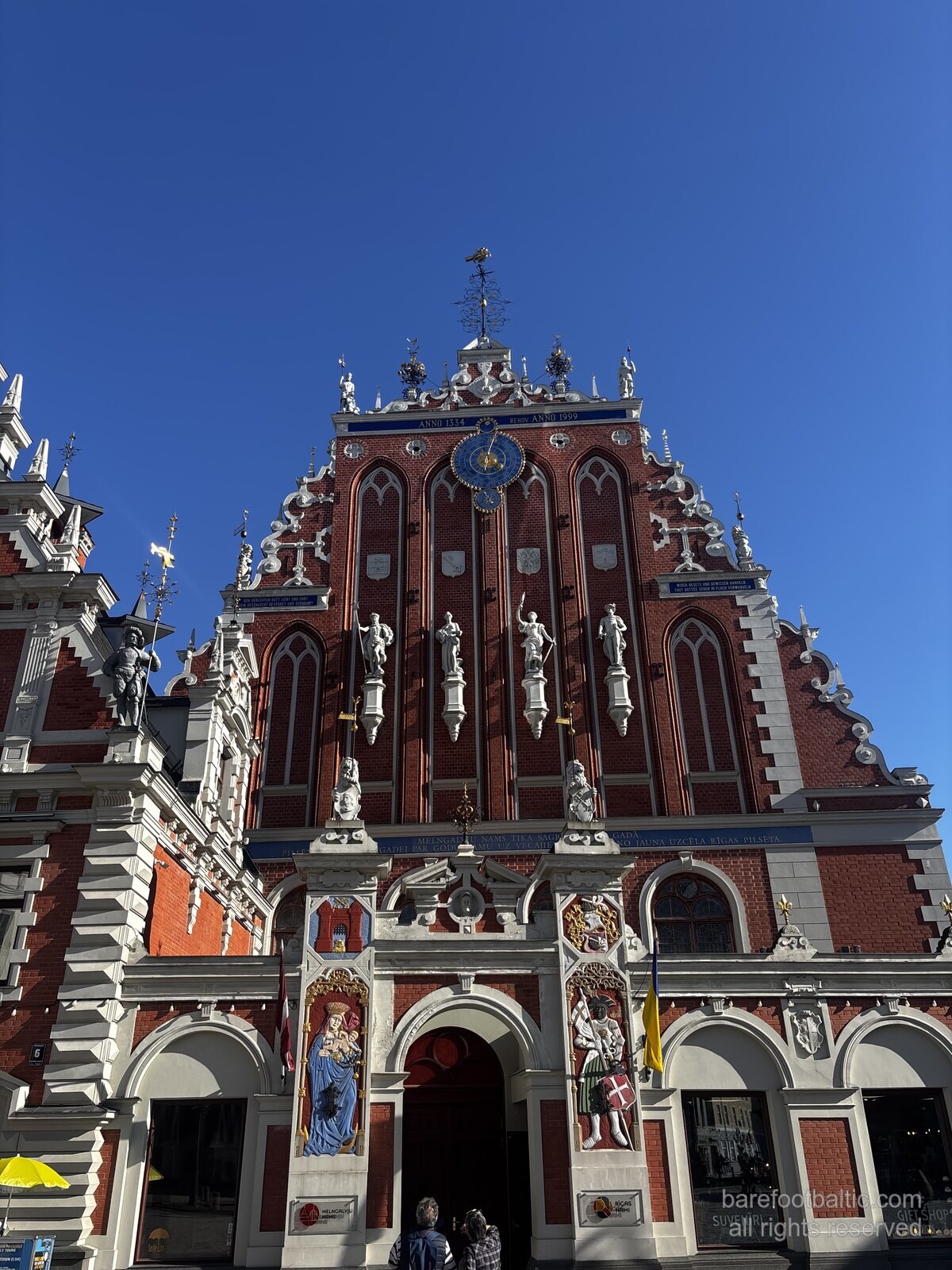
The front of the building is one of the densest decorative facades in northern Europe. From bottom to top, the things to look for.
The arcade at street level has arched openings, statues of biblical figures and mythological allegories, painted reliefs of saints, and the Brotherhood’s coat of arms in gold leaf. The smaller doorway in the centre is the original ceremonial entrance.
One floor up, large arched windows are flanked by allegorical statues. Neptune, Mercury, Peace, Justice, Unity. These are reconstructions of the originals.
The third storey has smaller windows, more statues, and the central decorative sundial. The sundial works. The gnomon is real bronze and the hour-marks are accurate Riga time. You can check it against your watch on a sunny day, allowing for daylight saving.
The gable on top is the elaborate stepped pediment with putti, banners, niches, and finials. A small bronze ship-weather-vane sits at the peak, the Brotherhood’s sign, recalling its merchant origins. ANNO 1334 is carved into the gable in gilded letters, the year of the building’s first construction.
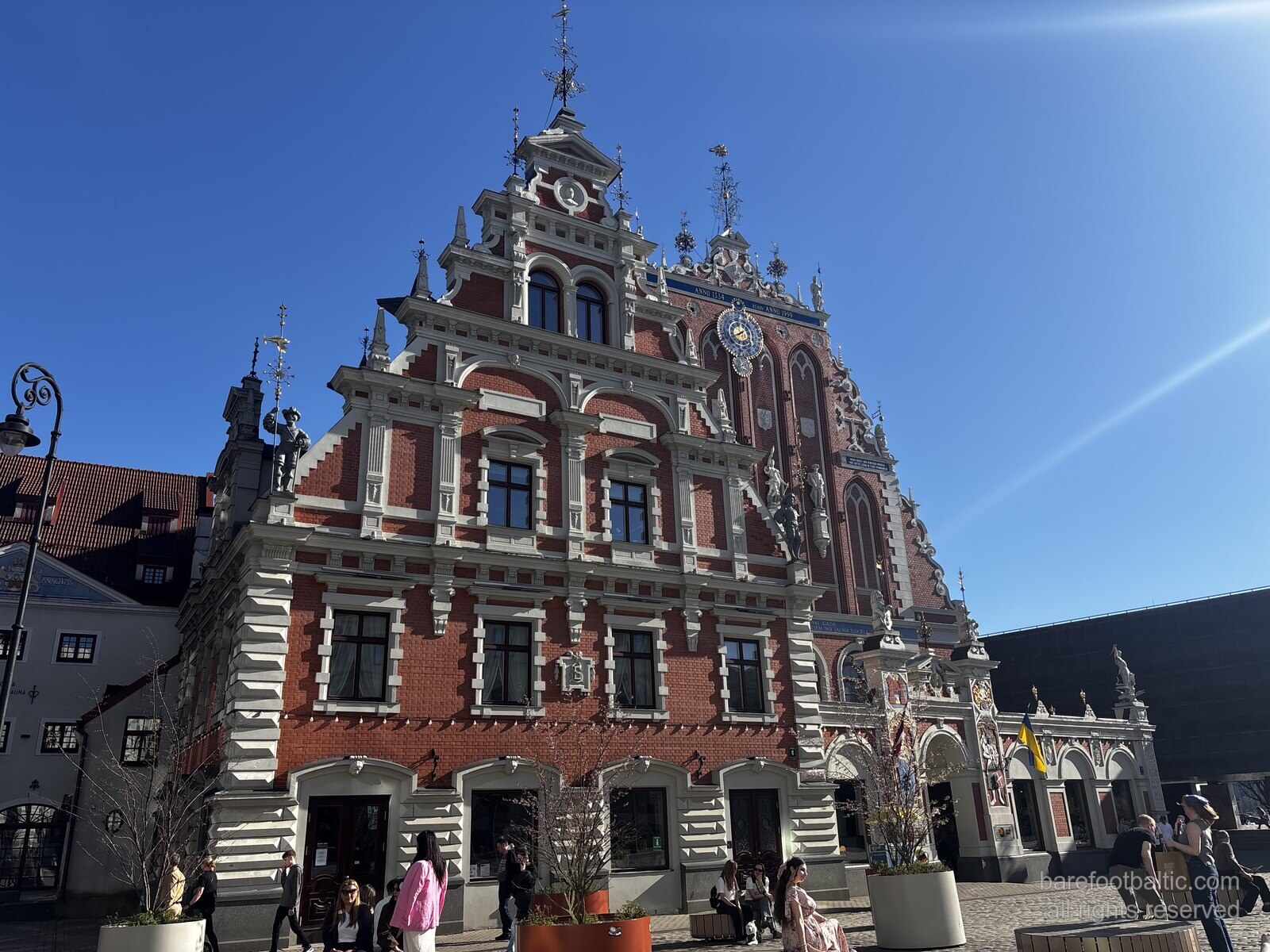
The neighbouring building to the left, the slightly less ornamented but still elaborate Schwabe House (Švāba nams), is a similar reconstruction of a separate 17th-century merchant house, now usually visited together with the Blackheads as one museum.
Vecās ēkas vairs nav. Mēs uzcēlām to no jauna, jo veidols mums bija svarīgs, pat ja oriģinālās sienas vairs nav.
A Latvian way of putting it. “The old building is gone. We rebuilt it from scratch because the shape mattered to us, even if the original walls aren’t there.”Inside the building
The visit inside has three parts.
The medieval cellar. Original 1334 stonework, low ceilings, brick walls. The cellar holds permanent exhibits about the Brotherhood’s history, with artefacts (silver, banners, medals) on display. This is the part of the building you cannot get anywhere else. Original medieval Riga, beneath your feet.
The period rooms on the upper floors. Reconstructed 17th-, 18th-, and 19th-century interiors with appropriate furniture, wallpaper, paintings, and ornament. These reflect the way the Brotherhood actually used the building over centuries. Small council chambers, dining rooms, robing rooms, withdrawing rooms.
The Great Hall. The largest room in the building, on the second floor, with a baroque painted ceiling, crystal chandeliers, and a parquet floor. This is the room used for the Brotherhood’s lavish banquets and balls in the 17th and 18th centuries. Today it’s used for Latvian state ceremonies, chamber music concerts, and the occasional presidential reception. If you can time your visit for a concert evening, do. The acoustics are good and the room takes the music well.
The silver collection is worth a slow look. Some pieces are 17th-century originals that survived the bombing because they had been moved to provincial museums before 1941. Others are 1990s reproductions. The labelling is honest about which is which.
Town Hall Square (Rātslaukums)
The square in front of the Blackheads is Rātslaukums, Town Hall Square. The also-reconstructed Riga Town Hall borders it on the south side, Kaļķu iela leading to the river on the west, and the modern Latvian Riflemen monument and the modern Museum of the Occupation on the east. In summer the square has cafés on every side. In late November to early January it is the main Riga Christmas market, voted third best in Europe in 2025 to 2026.
The bronze statue in front of the Blackheads is Roland, and it is a copy. Rolands were standard town-hall sculptures across the Hanseatic and free-imperial cities of northern Europe, symbolising civic justice and the autonomy of the merchant town from the local bishop or prince. The original Roland here (early 20th-century, replacing an 18th-century one) is now in the Blackheads’ museum. What stands on the square is a copy from the 1990s reconstruction. Riga’s Roland is the only one in the eastern Baltic.
Practical answers
Where it is and getting there
Rātslaukums 7, in the southern half of Riga’s Old Town. Two minutes’ walk south of St Peter’s Church, three minutes south of Riga Cathedral, three minutes from the Daugava embankment. The Old Town is pedestrianised, so you arrive on foot. Closest tram stop is Nācionālais teātris, eight minutes’ walk away.
Hours, costs, what to expect
The exterior of the building is on a public square and is free, accessible 24/7. The museum inside is open Tuesday to Sunday, roughly 11:00 to 18:00, closed Mondays, with longer hours in summer. Adult ticket around €7 to €8, with concessions for students, seniors, and children. The visit takes 60 to 90 minutes and includes both the Blackheads and the adjoining Schwabe House. Concert tickets for the Great Hall are sold separately and run from around €15.
Combining with the rest of the Old Town
The Blackheads is the southern bookend of the central Old Town walk, and pairs with St Peter’s tower two minutes north. The full Old Town circuit runs Freedom Monument, Powder Tower, Three Brothers, Castle, Cathedral, Cat House, Blackheads, and St Peter’s, all of it in the pillar guide. End the day on the platform of St Peter’s tower for the panorama at golden hour.
Christmas market
The main Riga Christmas market runs on Town Hall Square from late November to early January, with a smaller secondary market on Doma laukums by the cathedral. The Blackheads’ gilded façade lit at night above the market stalls is the photograph you see on every Riga winter advert. Hot mulled wine, smoked meats, hand-knitted mittens.
My take
The House of the Blackheads is the building on every Riga postcard, and it deserves the front-page treatment. The faithful reconstruction is impressive on its own terms. The building’s actual biography is more interesting than the postcard suggests. Medieval origin, 19th-century photographs, 1941 destruction, 1948 demolition by Soviet authorities, then reconstruction by independent Latvia from 1995 to 1999. Allow an hour for the museum, ten minutes for the facade and the square.
Frequently asked questions about the House of the Blackheads
Daiga Taurīte is a licensed Latvian tour guide and co-founder of Barefoot Baltic, which runs small-group day excursions from Riga. She grew up in Riga, spent two decades working in London, and came home in 2024. Barefoot Baltic is licensed by Latvia’s Consumer Rights Protection Centre (PTAC), holds ATD passenger transport licence PS-01995, and is insured by BTA Baltic for civil liability.
The Blackheads is the centrepiece of every Old Town walk we run. If you’d like a half-day with a licensed Latvian guide that includes the museum, the cathedral, the Cat House, and St Peter’s, get in touch.