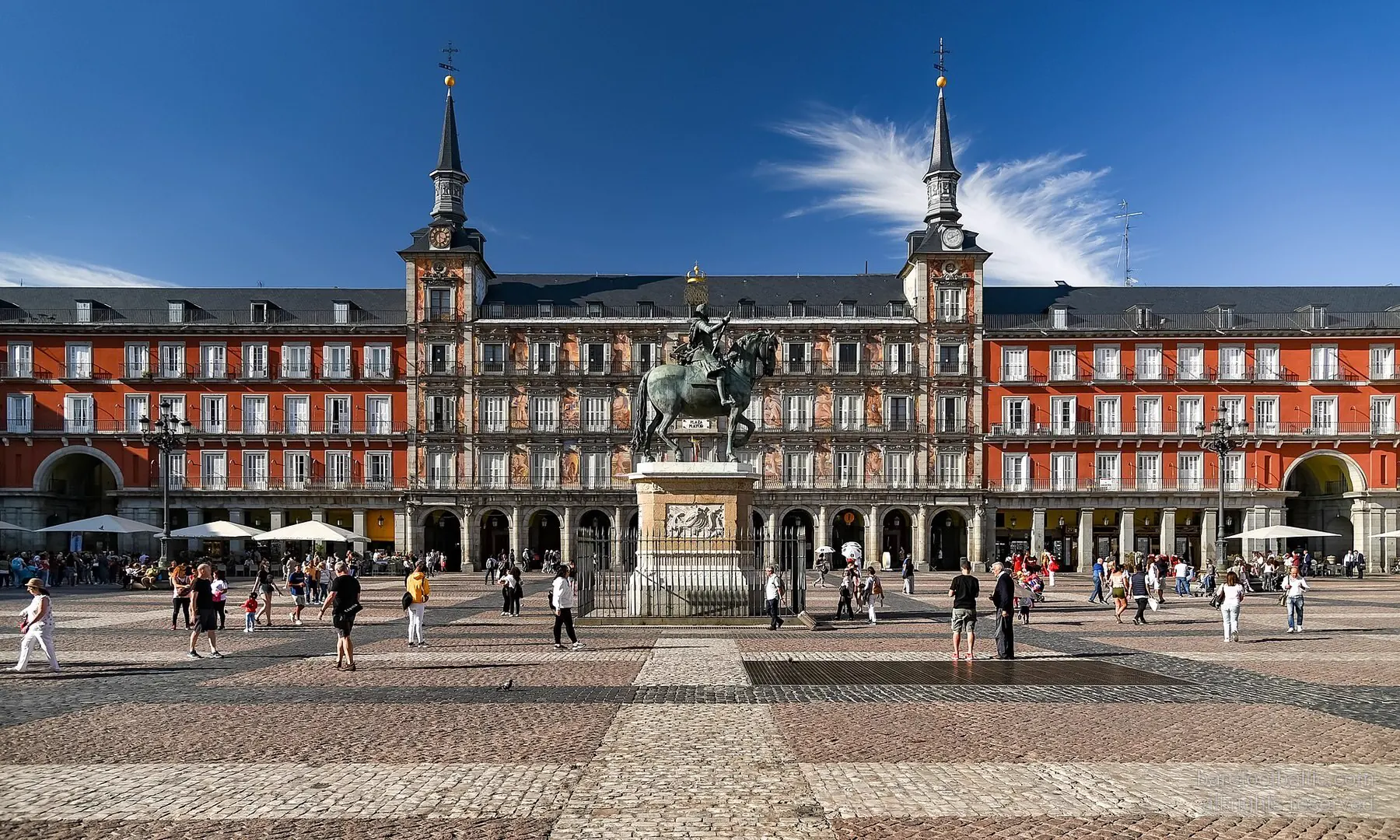
Highlights
Why nine days, three Iberian capitals, two self-guided days, every paid interior optional
Barcelona, Madrid (with a Toledo day-trip), Lisbon, with Sintra and Belém on the closing leg. Five guided days set the rhythm; two self-guided days (Day 4 Barcelona, Day 5 Madrid) sit between them so every guest can pace their own holiday and decide which paid interiors are worth it.
Every paid attraction along the route sits as an optional upgrade. The Sagrada Família, Park Güell, Casa Batlló, the Prado, the Royal Palace of Madrid, the Alcázar of Toledo, the Mosteiro dos Jerónimos, the Tower of Belém, Pena Palace at Sintra: none of them are in the €730 published price. Daiga pre-buys timed-entry tickets on request and you pay direct (no commission on top); where the official city pass offers a better deal (Barcelona Card, Madrid City Card, Lisboa Card) we pass the saving through. If you don’t want any of it, you don’t pay for any of it.
Day 6 is the long Madrid→Lisbon push by van (~7 hours via Cáceres) with an Extremadura lunch break. The published price covers the road work, the guiding work, and our European-licensed driver. Daiga walks the city days with you. Her team is at the wheel for the long inter-city stretches. One van, two crew, the whole route.
Food options
Each city carries its own food story. Barcelona and the Mercat de la Boqueria off La Rambla, Catalan tapas in Born, pintxos bars in Gòtic, seafood paella at Barceloneta. Madrid and the La Latina tapas crawls along Cava Baja, cocido madrileño at Lhardy or La Bola, cochinillo asado in Toledo on Day 4 if you want. Lisbon and the bacalhau dozens of ways, pastéis de Belém at the original 1837 bakery on Day 8, the fish-grill tascas in Alfama on Day 9 with fado in the room.
For desi cravings we have a working shortlist in each city. The Raval district in Barcelona (Carrer de Sant Pau and Rambla del Raval) has South Indian veg and Pakistani tandoor restaurants. Lavapiés in Madrid is the Indian-Bangladeshi curry quarter; Restaurante Bangalore and Maharajah Express are the reliable picks. Lisbon Martim Moniz is the lived-in South Asian and Indo-Goan quarter, with a deep Goan-Portuguese restaurant tradition (vindaloo and bacalhau on the same menu). The longer breakdown including supermarket aisles and where to find provisions lives in the Indian-food and provisions FAQ below.
Restaurant booking help is free. The van will drop the group at the restaurant and bring everyone back. Tell us what you fancy and we’ll make it happen.
A film or two to set the mood before you go
Nine days, three Iberian capitals. Daiga’s picks if you want to soak up the rooftops before the flight.
Barcelona. Vicky Cristina Barcelona (Woody Allen, 2008) is the obvious headline pick — Penélope Cruz won the Oscar for it, and the film covers the Gaudí trail from Park Güell to the Sagrada Família. L’Auberge Espagnole (Cédric Klapisch, 2002) is the older Erasmus-flat-share take on Barcelona for the bohemian streets in the Gòtic and El Born.
Madrid. Volver (Pedro Almodóvar, 2006) for working-class Madrid and Penélope Cruz again. Mujeres al borde de un ataque de nervios (Pedro Almodóvar, 1988) for 80s Madrid colour.
Lisbon. Night Train to Lisbon (Bille August, 2013) follows a Swiss professor on tram 28 through Alfama. Lisbon Story (Wim Wenders, 1994) is the older slow film for the city’s quieter corners.
India side. If you want the Indo-Portuguese connection, Trikal: Past, Present, Future (Shyam Benegal, 1985) is set in 1961 Goa during the Portuguese departure.
Detailed travel schedule — day-by-day
The first two days show in full by default; tap the button at the end of the visible days to read all of them.
Day 1: Daiga meets you at Barcelona El Prat. Welcome, drop, orientation chat.
Day at a glance · ~2,000 steps · ~18 km in the van (BCN→central Barcelona) · airport meet + welcome orientation in your hotel neighbourhood
Best one-stop routes to BCN from India: Lufthansa via Frankfurt, Emirates via Dubai, Qatar via Doha, Turkish via Istanbul (around 11–14 hours including the change). Daiga meets your flight at El Prat with a Barefoot Baltic sign.
About 25 minutes into central Barcelona. Drop at your hotel near Plaça Catalunya, the Born or the Eixample. Daiga goes over your Barcelona plan with you — the Day 2 walking route, the bundled Park Güell timed-entry slot, the Sagrada Família interior pre-booking if you opted for it, an Indian veg suggestion in El Raval — and takes any last-minute inputs or amendments. Evening yours.
This day is included in the Land + Guiding only fee, not separately charged.
Day 2: walking tour of Barcelona with Daiga — the free outdoor circuit + Park Güell
Day at a glance · ~12,000 steps · ~10 km in the van (cross-city transfers Plaça Catalunya↔Park Güell↔Barceloneta) · 8 free TripAdvisor sites covered (La Rambla, Plaça Reial, Barri Gòtic, Plaça Sant Felip Neri, Cathedral exterior, Passeig de Gràcia with Casa Batlló + Casa Milà exteriors, Sagrada Família exterior, Barceloneta beach) + optional Park Güell ticketed-zone entry (~€13 at the gate) + tapas + vermouth tasting in the evening
The first proper day. Daiga is with you from breakfast until late evening — this is the day the group becomes a group. The van handles the longer hops between neighbourhoods where parking allows; in the centre we walk. Almost everything we do today is free.
Morning: walk from your hotel into the Barri Gòtic: down La Rambla past the Liceu opera and into Plaça Reial with the Gaudí lampposts, the Cathedral of Barcelona exterior, the Plaça Sant Felip Neri with the Civil War bullet-scarred wall, the Plaça del Rei. Coffee in the Gothic Quarter. The Picasso Museum is on the route and the queue is usually short before 11am — optional upgrade (~€14) if anyone wants the Las Meninas variations room.
Lunch: tapas + vermouth at one of the Born vermouterias (Quimet i Quimet up in Poble-sec is the famous one, La Vermutería del Tano closer to Born). Sit-down lunch is on you (food and drink isn’t in our fee).
Afternoon: van up to Park Güell (Carmel Hill); optional timed entry to the Monumental Zone (~€13 at the gate, Daiga pre-books the slot on request). Ninety minutes: the dragon staircase, the Hypostyle Hall, the Trencadís serpentine bench overlooking the city. Down the back path to the Sagrada Família for the exterior view from Plaça de Gaudí (the best photograph; the lake reflects the Nativity facade). Sagrada Família interior is an optional upgrade (~€26 basic; ~€36 with the Passion Tower lift) — tell Daiga the night before so she pre-books the timed slot for whoever wants it. Otherwise the exterior is the moment, and it’s free.
Evening: walk down the Passeig de Gràcia past Casa Batlló and Casa Milà exteriors (free; interiors are optional upgrades at ~€35 / ~€25). Van across to Barceloneta for a sunset walk along the Mediterranean. If the weather is on we’ll bring the life vests and the picnic mat for a quick swim or a paddle. Tapas dinner in the Born; the late 22:00 reservation is the Spanish tradition.
Day 3: Van Barcelona → Madrid via Zaragoza lunch; afternoon Madrid orientation walk
Day at a glance · ~7,000 steps · ~620 km in the van (Barcelona→Zaragoza lunch stop→Madrid via the A-2) · 5 sites in Madrid (Plaza Mayor, Puerta del Sol, Plaza de Oriente, Royal Palace exterior + Almudena Cathedral exterior, Templo de Debod sunset view) plus a Zaragoza Basilica del Pilar stretch en route
Morning checkout. Bags into the van; We drive Barcelona→Madrid, around 6 hours on the A-2 with a proper lunch stop in Zaragoza (Aragonese capital, halfway, the Basilica de Nuestra Señora del Pilar on the Ebro is a 15-minute stretch through the old town if the schedule allows). Arrive Madrid by mid-afternoon.
Drop bags at your central Madrid hotel near Sol, Malasaña or the Gran Vía. Late-afternoon walk with Daiga: Plaza Mayor (the 17th-century Habsburg square), Puerta del Sol (Kilometre Zero of the Spanish road network), Plaza de Oriente facing the Royal Palace exterior (the largest royal palace in Europe by floor area, 135,000m² with 870 rooms; ceremonial only), the Almudena Cathedral exterior next door. Across to the Templo de Debod for sunset — an Egyptian temple from the 2nd century BCE that Egypt gifted to Spain in 1968 (Spanish help with the Abu Simbel relocation) and reassembled on the Montña del Príncipe Pío; the view across to the Royal Palace at golden hour is the postcard.
Late dinner around La Latina or Cava Baja (a Madrileño tradition; many family-run tabernas don’t take reservations).
Optional AVE high-speed upgrade. If you’d rather take the Renfe AVE (2 hours 30 minutes Barcelona Sants→Madrid Atocha), leave your suitcase in the van; the rest of the group rides with us. Buy the ticket yourself (around €60-100 second class depending on booking window). We meet you at Atocha with a written plan for the afternoon. Ask Daiga at booking.
Day 4: Toledo UNESCO day-trip from Madrid (Cathedral interior optional, ~€12 at the gate)
Day at a glance · ~10,000 steps · ~140 km in the van (Madrid↔Toledo round trip) · 5 sites in Toledo (Toledo Cathedral interior optional, ~€12 at the gate, Sinagoga del Tránsito + Sephardic Museum, Plaza de Zocodover, Mirador del Valle, Tagus river overlook from Castillo de San Servando) + partridge or marzipan tasting in the old town
Morning checkout from the Madrid hotel for the day. Van Madrid→Toledo, around an hour on the A-42. The whole walled city is UNESCO World Heritage. We park outside the walls and walk in. Daiga leads the morning circuit through the medieval Christian-Jewish-Muslim convivencia city: the Toledo Cathedral interior (second-largest in Spain after Seville, with El Greco’s Disrobing of Christ in the sacristy — entry optional ~€12 at the gate), the Sinagoga del Tránsito with the Sephardic Museum, the Plaza de Zocodover, the Alcázar exterior.
Lunch: in Toledo old town; the local partridge stew (perdiz a la toledana) and the famous marzipan from the Convento de Santo Domingo are the specialities. Veg/Jain partner kitchens on request.
Afternoon: walk across the Tagus to the Castillo de San Servando for the free climb and the panoramic view over the whole city (the view El Greco painted; the painting hangs at the El Greco Museum five minutes away). The Mirador del Valle across the river is the other postcard view if there’s time. Back to Madrid in the late afternoon. Evening optional — or save the energy for tomorrow.
Day 5: Self-guided Madrid — the headline paid interiors at your own pace, or rest
Day at a glance · self-guided rest day · Daiga and the van off · not charged · first of a Madrid SG pair (Day 5 + Day 6)
This day is not charged. Day 5 sits after Day 4 (Toledo UNESCO day) and pairs with Day 6 (also self-guided in Madrid) so the group has a proper weekend break in the middle of the trip — the LP-style two-day pause. Daiga is in town and reachable on WhatsApp; the van rests.
Free Madrid options. Walk from Plaza Mayor through the Mercado de San Miguel (the 1916 wrought-iron market hall converted to a gourmet food hall; jamón ibérico + Manchego cheese + Galician octopus on toast, you pay each stall direct). Plaza de la Villa, Almudena Cathedral exterior, up Calle Mayor to Plaza de Cibeles (the goddess fountain), along the Paseo del Prado past the Prado / Thyssen / Reina Sofía exteriors. Retiro Park — 125 hectares of Habsburg royal grounds, the Estanque rowing-boat lake (~€8 per boat), the Palacio de Cristal, the Rosaleda rose garden. All free.
Paid interiors, at your own pace. The bigger ticketed venues sit as optional upgrades — Prado (~€15), Reina Sofía (~€12, Picasso’s Guernica), Thyssen-Bornemisza (~€14), Royal Palace (~€14), Sorolla Museum (~€3). The Madrid Paseo del Arte Card covers Prado + Reina Sofía + Thyssen at ~€33 gate, ~€26 through us at the corporate rate.
Lunch + South Indian options: Lavapiés for the South Asian quarter (Shapla, Alibaba, Annapurna near Tirso de Molina — the standards). Or La Latina for proper Madrid tapas on Cava Baja.
Daiga and the van are off on Day 5. She is reachable on WhatsApp for emergencies.
Day 6: A free day in Madrid. Rest, shop, optional spend.
Day at a glance · your pace, your spend · 0 km from us; van rests; Daiga on WhatsApp · optional add-ons (Prado deep-dive, Reina Sofía, Sorolla Museum, El Rastro on Sundays, Gran Vía shopping, evening flamenco tablao)
The middle of the trip is the right place for a free day — by Day 6 you’ve been in the van and on your feet for five days straight; legs and laundry both need a pause. Daiga is in town and on WhatsApp; she’ll set you up with whatever you want and otherwise stays out of your way.
A few ideas for the day, all at your own cost:
- Rest. Sleep in. A late breakfast at the hotel. A walk through Retiro. We’ve had guests do nothing and report back that it was the best day of the trip.
- Museum deep-dive. Prado (~€15) or Reina Sofía (~€12 — Picasso’s Guernica is here) for the full three-hour version that we skip on Day 5. The Sorolla Museum (~€3, the painter’s own home) is the quieter gem most coach tours skip.
- Shopping. Gran Vía is the Madrid high street, easier than the Sunday-only El Rastro. The Salamanca district (Calle Serrano, Goya) is the upmarket strip; ABC Serrano has a quiet rooftop. Madrid’s El Rastro flea market runs every Sunday morning along Ribera de Curtidores — the city’s oldest open-air market.
- Optional flamenco tablao. Corral de la Moría (the oldest in Madrid, 1956, near the Royal Palace) and Cardamomo (Calle Echegaray, in the Letras quarter) are the two we book most often. Show with dinner, ~€55-90 pp. Daiga pre-books in the morning if you decide on the day.
- Lavapiés deep-dive. Madrid’s South Asian quarter — lunch at Shapla or Annapurna, a coffee at the Filmoteca Española café, the Calle de la Cabeza streetscape.
- Day-trip option. If you want one more guided day, ask Daiga to add a Segovia half-day (Roman aqueduct + Alcázar + cochinillo lunch, ~2 hours each way; her team at the wheel) — this adds a guided-day charge at €130 pp.
This day is not charged. No transportation in our fee, no guiding in our fee. Whatever you spend is your own — that’s the saving baked into a Day 6 that lets you breathe.
Day 7: Madrid → Lisbon via Cáceres UNESCO lunch; evening Lisbon orientation walk
Day at a glance · ~7,500 steps · ~625 km in the van (Madrid→Cáceres lunch & old-town walk→Caia frontier→Lisbon) · 6 sites (Cáceres UNESCO old town walk, Plaza Mayor Cáceres, Lisbon Praça do Comércio, Rua Augusta arch, Rossio, Chiado, optional Miradouro de São Pedro de Alcântara sunset) · the watch moves back one hour at the Caia frontier
The long van day, broken nicely. Morning checkout. We drive Madrid→Cáceres — around 3 hours 30 minutes on the A-5 across the Extremaduran meseta. We stop in Cáceres for the lunch and the old-town stretch. The walled medieval centre is UNESCO World Heritage — a near-intact ensemble of Roman, Moorish, Gothic and Renaissance architecture that almost no Indian-market Iberia tour stops in. Two hours: the Plaza Mayor, the Arco de la Estrella, the Plaza de San Jorge, the storks nesting on every bell tower. Lunch on the Plaza Mayor — Extremaduran jamón + Torta del Casar (the runny sheep-milk cheese) is the local plate.
Mid-afternoon back in the van. We drive Cáceres→Lisbon, around 2 hours 30 minutes via the A-66 and the Caia frontier at Badajoz/Elvas. Cross into Portugal; move your watch back one hour — Portugal is on WET, one hour behind Spain. Arrive Lisbon by early evening.
Drop bags at your central Lisbon hotel in Chiado, Bairro Alto or the Baixa. Late-evening walk with Daiga: Praça do Comércio on the Tagus (the great riverside square, the equestrian statue of José I), the Rua Augusta arch and the long pedestrian street, up through the Rossio with the wavy black-and-white calçada portuguesa cobbles, into Chiado (Café A Brasileira, the Pessoa statue), and up to the Miradouro de São Pedro de Alcântara in Bairro Alto for the sunset over the Alfama rooftops with the Castelo de São Jorge silhouetted opposite. Late dinner at a Bairro Alto petisco place. Quieter than Madrid; Portuguese dinner is 20:00, not 22:00.
Optional Iberia/TAP/Vueling flight upgrade. If you’d rather skip the van drive across Extremadura, fly Madrid Barajas→Lisbon Humberto Delgado (1 hour 20 minutes, ~€60-120 depending on booking window). Leave your suitcase in the van; we meet you at LIS with a written plan for the orientation walk. Note this means missing the Cáceres UNESCO stop. Ask Daiga at booking.
Day 8: Belém morning — Alfama afternoon — Castelo climb — Miradouro sunset
Day at a glance · ~14,000 steps · ~25 km in the van (central Lisbon↔Belém round trip) · 10 sites (Jerónimos cloister optional ~€12, Belém Tower interior optional ~€8, Padrão dos Descobrimentos riverbank, Pastéis de Belém original 1837 kiosk, Tram 28 ride, Sé Cathedral of Lisbon exterior, Castelo de São Jorge viewpoint climb, Alfama on foot, Miradouro da Senhora do Monte sunset, A Ginjinha do Rossio shot stop) + a pastel-de-nata tasting + an optional fado dinner
The long, satisfying Lisbon day. Morning: van west along the river to Belém, 7 km from central Lisbon. Jerónimos Monastery cloister (optional, UNESCO) — the Manueline cloister with the carved-stone ropes, anchors, sea-creatures and astrolabes that mark the 16th-century maritime Portuguese style. The church itself is free; the cloister is the ticket. Vasco da Gama’s tomb is in the lower church (free side, immediately on the left as you enter the main door). Belém Tower (optional, UNESCO) — the 1515 watchtower that guarded the spice-trade ships, climb the spiral inside for the river view. The Padrão dos Descobrimentos monument on the riverbank is free at the exterior. Across the road, Pastéis de Belém — the original 1837 pastel-de-nata kiosk (Monastery recipe; the only place legally allowed to use the “Pastéis de Belém” name). Sit-down counter, two natas and a bica each.
Lunch: back to central Lisbon. Petiscos at Time Out Market in Cais do Sodré (a former municipal market converted into a food hall in 2014 with 24 chef-led stalls; the Henrique Sá Pessoa stall is the headline). Or veg at Mom in Martim Moniz.
Afternoon: Tram 28 ride from Praça Luís de Camões up through Estrela, Sé Cathedral and into Alfama (we time it for the post-lunch lull to avoid the worst crowds). Off at Portas do Sol for the panoramic view over the Tagus and the Alfama rooftops. Walking tour of Alfama — the medieval Moorish quarter that survived the 1755 earthquake, the maze of stepped lanes, the Casa dos Bicos (Saramago Foundation), the Igreja de Santo António. Then the climb to Castelo de São Jorge — the steep stepped lanes are the workout; viewpoint at the top is free at the Largo Chão do Loureiro miradouro (the Castelo interior is the optional upgrade at ~€15 if anyone wants the ramparts).
Evening: climb (or van up if knees protest) to the Miradouro da Senhora do Monte for the highest viewpoint in Lisbon — the whole city laid out below, the Tagus, the 25 de Abril bridge, the Christ statue in Almada opposite. Sunset hour. Down via Mouraria for a ginjinha shot at A Ginjinha do Rossio (Lisbon’s sour-cherry liquor, ~€1.50; the original kiosk has been pouring since 1840).
Optional fado dinner in Alfama (Clube de Fado, Mesa de Frades, Casa de Linhares; ~€55-90 pp with dinner). Daiga pre-books if you opt in on the booking form. Otherwise late dinner at a petisco place in Bairro Alto.
Optional Indo-Portuguese deep-dive at Belém on the morning — tell Daiga the night before. The longer walk goes through the Padrão dos Descobrimentos sculptural sequence (Henry the Navigator at the prow, then Vasco da Gama, Bartolomeu Dias, Pedro Álvares Cabral, Luís de Camões), the 451-year Portuguese Goa thread, Catherine of Braganza’s 1661 Bombay dowry treaty, and the Maritime Museum (~€8 optional upgrade) which holds the India-trade-era astrolabes and the model of Vasco da Gama’s flagship. See the “Reading Lisbon through Indian eyes” deep-dive disclosure above.
Day 9: Sintra UNESCO morning, Mandir option, LIS drop
Day at a glance · ~10,000 steps · ~60 km in the van (Lisbon↔Sintra round trip) · 5 sites (Pena Palace gardens optional ~€10, Quinta da Regaleira optional ~€15 with the Initiation Well, Sintra old town walk, Vila Sassetti forest path, optional Comunidade Hindu de Portugal Mandir stop) + Sintra train + bus day-pass optional (~€16) + optional Pena Palace state-rooms interior upgrade
Last morning in Europe. Sintra is the UNESCO Cultural Landscape that the Portuguese kings used as their summer hideaway; the Pena Palace, the Quinta da Regaleira, the Castelo dos Mouros, the Palace of Sintra and the Monserrate Palace are all up in the same wooded hills 30 km west of Lisbon. We don’t try to do all of them. Daiga picks the two that matter most.
Early van Lisbon→Sintra (40 minutes via the A-37; we leave at 8:30am to beat the day-tripper buses that arrive from 10:30am). Park outside the old town; the local bus 434/435 day-pass is an optional add-on (~€16 at the ticket machine) Daiga pre-books on request so we ride up the hill rather than queuing for the limited parking at Pena. Two hours at Pena Palace gardens (optional, ~€10 at the gate; Parques de Sintra) — the gardens are the masterpiece, with the 200 hectares of cedars, oaks and rhododendrons that King Ferdinand II planted around the 19th-century romantic castle on the hill. The yellow-and-red palace exterior is the postcard; the state rooms inside are an optional upgrade (~€14 extra on top of the gardens ticket) for those who want the period interiors. Walk the gardens, climb to the Cross of the High (the highest point in the hills, panoramic view to the Atlantic and back to Lisbon on a clear day).
Mid-morning: bus down to Quinta da Regaleira (optional) — the early-20th-century estate of Carvalho Monteiro the millionaire, with the famous Initiation Well (a 27-metre spiral staircase down into the hillside; the Sintra photograph families come home with), the underground tunnels, the gardens with the chapel and the mythological grottoes. Ninety minutes.
Lunch: in Sintra old town — Tascantiga or the queixadas (sweet cheese pastries) at Piriquita. The Vila Sassetti forest path is the optional walk back down to the train station if your legs are still on (a 25-minute downhill through the laurel forest).
Afternoon: van back to Lisbon. On the way, if you opted for it on the booking form, we stop at the Comunidade Hindu de Portugal Mandir on Alameda Mahatma Gandhi — the Shri Radha Krishna temple of the established Goan / Daman / Diu / Gujarati / Punjabi community (around 9,000; total Hindu Portugal ~20,000). Brief community tour and, if pre-arranged, a vegetarian community lunch. Free entry; donation optional.
Late afternoon Daiga drops you at Lisbon Humberto Delgado (LIS) for your evening or night flight back to India. Best one-stop options: Lufthansa via Frankfurt, TAP via Lisbon (direct LIS-BLR a daily route in 2026), Emirates via Dubai, Turkish via Istanbul. LIS drop included in the Land + Guiding only fee, not separately charged.
If your return is the next morning rather than the same evening, we hold the Lisbon hotel for the Day 9 night and add a half-day at the Museu Nacional do Azulejo (Lisbon’s azulejo-tile museum) and Praça Martím Moniz on the morning of Day 10 before the LIS afternoon drop. Tell us at booking.
Day 1: Daiga meets you at Lisbon Humberto Delgado. Welcome, drop, orientation chat.
From India: TAP direct Bangalore–Lisbon daily, or one-stop via Frankfurt, Doha, Istanbul or Dubai; around 12–14 hours total. Daiga meets your flight at LIS with a Barefoot Baltic sign.
Twenty-five minutes through the city to your central Lisbon hotel in Chiado or Bairro Alto. Daiga goes over your Lisbon plan for Days 2–3 with you — the optional Pena Palace gardens timed slot, the Quinta da Regaleira slot, the Jerónimos cloister + Belém Tower entries (all pre-bookable, paid direct), an Indian veg dinner in Martim Moniz — and takes any last-minute inputs or amendments. Evening yours. Bundled into the package fee, not separately charged.
Day 2: Sintra UNESCO morning, optional Mandir afternoon
Early van Lisbon→Sintra (40 minutes; we leave at 8:30am to beat the coaches). Bus 434/435 day-pass optional (~€16). Two hours at Pena Palace gardens (optional, ~€10), then Quinta da Regaleira (optional, ~€15) with the 27-metre Initiation Well. Lunch in Sintra old town. Mid-afternoon van back to Lisbon. Optional Comunidade Hindu de Portugal Mandir stop on Alameda Mahatma Gandhi if you opted for it. Evening at the Miradouro da Senhora do Monte for sunset over Alfama; quiet petisco dinner in Bairro Alto. Pena Palace state-room interior is the optional upgrade (~€14 extra on top of bundled gardens).
Day 3: Belém morning, Alfama afternoon, Castelo de São Jorge climb, fado optional
Morning van Lisbon→Belém. Jerónimos Monastery cloister (optional, UNESCO) + Belém Tower interior (optional, UNESCO) + Padrão dos Descobrimentos riverbank + a pastel de nata at the original 1837 Pastéis de Belém. Vasco da Gama is buried at the Jerónimos lower church; ask Daiga for the Indo-Portuguese deep-dive if you want it. Lunch back in central Lisbon. Afternoon Tram 28 to Alfama; walking tour of the medieval Moorish quarter; the steep climb to the Castelo de São Jorge viewpoint (the Castelo interior is the optional upgrade at ~€15). Sunset at the Miradouro de Santa Luzia. Optional fado dinner in Alfama (~€55-90).
Day 4: Lisbon → Madrid via Cáceres UNESCO lunch, evening orientation walk
Morning checkout. We drive Lisbon→Cáceres via the A-6 and the Caia frontier, around 3 hours 30 minutes. Move your watch forward one hour at the border — Spain is on CET, one hour ahead of Portugal. Two hours in Cáceres UNESCO old town — Plaza Mayor, Arco de la Estrella, Plaza de San Jorge, the storks on the bell towers. Extremaduran jamón + Torta del Casar for lunch. Afternoon van Cáceres→Madrid, 3 hours on the A-5. Arrive Madrid by early evening; drop bags at your central hotel; orientation walk with Daiga — Plaza Mayor, Puerta del Sol, Plaza de Oriente facing the Royal Palace, Templo de Debod sunset. Late dinner around La Latina.
Optional Iberia/TAP flight upgrade. Fly Lisbon→Madrid (1 hour 20 minutes, ~€60-120). Leave the suitcase in the van; we meet you at Madrid Barajas. Means missing the Cáceres UNESCO stop.
Day 5: Madrid full day — Mercado de San Miguel tasting + Retiro + the museum mile
Mirror of the default-direction Day 5. Morning Mercado de San Miguel jamón + Manchego tasting; walk through Plaza de la Villa, Almudena Cathedral, Plaza de Cibeles, along the Paseo del Prado. Lunch at a Lavapiés thali if you want it. Afternoon Retiro Park; Estanque rowing if the weather is on; Royal Palace interior optional upgrade (~€14). Evening tapas in La Latina.
Day 6: A free day in Madrid. Rest, shop, optional spend.
The middle of the trip is the right place for a free day. Sleep in, sit in Retiro, do the Prado or Reina Sofía deep-dive, walk Gran Vía, lunch in Lavapiés, evening flamenco tablao at Corral de la Moría or Cardamomo (~€55-90 pp). Daiga on WhatsApp. Not charged.
Day 7: Toledo UNESCO day-trip from Madrid (Cathedral interior optional, ~€12 at the gate)
Mirror of the default-direction Day 4. Van Madrid↔Toledo (an hour each way). Toledo Cathedral interior optional, ~€12 at the gate, Sinagoga del Tránsito + Sephardic Museum, Plaza de Zocodover, the Tagus river overlook from the Castillo de San Servando. Partridge or marzipan lunch in the old town. Back to Madrid late afternoon.
Day 8: Van Madrid → Barcelona via Zaragoza lunch
Morning checkout. We drive Madrid→Zaragoza (the Aragonese capital, halfway on the A-2). Two hours in Zaragoza for lunch and the Basilica de Nuestra Señora del Pilar on the Ebro plus an old-town stretch. Afternoon van Zaragoza→Barcelona, 3 hours 30 minutes. Arrive Barcelona by early evening. Drop bags at your central Barcelona hotel near Plaça Catalunya, the Born or the Eixample. Late dinner at a Born tapas place.
Optional Renfe AVE upgrade. 2 hours 30 minutes Madrid Atocha→Barcelona Sants, ~€60-100. Suitcase in the van; we meet you at Sants.
Day 9: Barcelona morning circuit with Daiga + BCN drop
Last morning in Europe. Daiga walks the group through the Barri Gòtic: La Rambla, Plaça Reial, Cathedral of Barcelona exterior, Plaça Sant Felip Neri. Across to Park Güell (optional timed entry, ~€13 at the gate) for the Gaudí mosaics and the Trencadís bench, then a quick stop at the Sagrada Família exterior at Plaça de Gaudí. Sagrada Família basilica interior is the optional upgrade (~€26) if booked far enough ahead.
Late breakfast or an early lunch at Mercat de la Boqueria on La Rambla. Late afternoon we drive you to Barcelona El Prat (BCN) for your evening or night flight back to India. BCN drop included in the Land + Guiding only fee, not separately charged.
Days 1-5: Identical to the 9-day default (BCN meet, Barcelona, van to Madrid, Toledo, Madrid full day)
The 12-day extended keeps Days 1 through 5 of the 9-day default itinerary unchanged: Day 1 Daiga meets you at BCN, Day 2 Barcelona guided + Park Güell, Day 3 van Barcelona→Madrid via Zaragoza, Day 4 Toledo UNESCO day-trip, Day 5 Madrid full day with the Mercado de San Miguel tasting. See the 9 days · default tab above for the day-by-day detail. The extension begins on Day 6 with one of two route options.
Day 6 (Andalusia): Van Madrid → Cordoba (Mezquita) → Seville evening
Morning van Madrid→Cordoba, around 4 hours on the A-4 across the La Mancha plains (Don Quixote country; we stop at a Manchego cheese-and-olive-oil farm en route if the schedule allows). Two hours at the Mezquita-Cathedral of Cordoba (UNESCO; the 8th-century mosque with its 856 horseshoe-arched columns of jasper, onyx, marble and granite, with a Renaissance cathedral built inside it after the Reconquista in 1236). Mezquita interior is an optional ticket on the 12-day, ~€13 at the gate. Lunch in the Judería (the medieval Jewish quarter), then a walk through the Patios de Cordoba. Afternoon van Cordoba→Seville, 1 hour 45 minutes. Drop bags at your central Seville hotel near the Cathedral or Santa Cruz. Late dinner of tapas at one of the Santa Cruz tabernas.
Day 7 (Andalusia): Seville in full — Real Alcázar + Cathedral + Triana, optional flamenco
The Seville day. Real Alcázar of Seville (optional, UNESCO; the Moorish royal palace still in use by the Spanish royal family; the Game of Thrones Dorne palace; ~€14 at the gate), Seville Cathedral exterior (UNESCO; the largest Gothic cathedral in the world; Christopher Columbus is buried inside — interior optional upgrade at ~€13), La Giralda bell tower exterior. Walk through Santa Cruz (the old Jewish quarter), lunch at the Mercado de Triana across the Guadalquivir, an afternoon stretch on the Triana side. Evening optional flamenco performance at Casa de la Memoria (~€25 pp, the most authentic small-room tablao in Seville). Tapas dinner.
Day 8 (Andalusia): Free day in Seville. Rest, shop, optional spend.
The middle of the 12-day is the right place for a free day. Climb the Metropol Parasol for the panoramic view, wander Barrio Santa Cruz at your own pace, lunch by the Guadalquivir, sit in the Plaza de España, do the Cathedral interior on your own time if you opted in. Daiga on WhatsApp. Not charged.
Day 9 (Andalusia): Van Seville → Lisbon via the Algarve coast
Long drive Seville→Lisbon via the Algarve coast, about 4 hours 30 minutes with a coffee stop at Tavira or Faro on the Portuguese side. Cross into Portugal at the Guadiana river bridge near Ayamonte; move your watch back one hour. Check in to your Lisbon hotel. Late-evening orientation walk: Praça do Comércio, Rua Augusta, Rossio, the Miradouro de São Pedro de Alcântara sunset. Late dinner.
Days 10-12 (Andalusia): Belém + Alfama + Sintra + LIS drop — same as 9-day Days 8-9 but spread across three days
Day 10: full Belém morning (Jerónimos cloister + Belém Tower optional, paid direct) + Alfama afternoon + Castelo de São Jorge climb + Miradouro sunset (mirror of 9-day Day 8). Day 11: full Sintra UNESCO day (Pena gardens + Quinta da Regaleira optional, paid direct). Day 12: morning at the Museu Nacional do Azulejo or the Maritime Museum + the optional Comunidade Hindu de Portugal Mandir stop on the way to LIS drop. Trip ends at LIS for the night flight back to India.
Option B: Porto cap — replace Days 6-12 above
Day 6: free day in Madrid (mirror of 9-day Day 6 default). Day 7: van Madrid→Lisbon via Cáceres UNESCO lunch (mirror of 9-day Day 7). Day 8: Belém + Alfama + Castelo (mirror of 9-day Day 8). Day 9: Sintra day (mirror of 9-day Day 9 without the LIS drop — you stay over). Day 10: van Lisbon→Porto, 3 hours 30 minutes on the A1, or optional CP Pendular Alfa fast train (3 hours). Check in to your Porto hotel near Ribeira or Aliados. Afternoon walk through Ribeira waterfront (UNESCO) and São Bento station with the 20,000 azulejo tiles. Dinner at a Ribeira riverside restaurant. Day 11: Douro Valley wine-country day-trip — 2 hours up the N222 (one of Europe’s great driving roads), stops at two port-wine quintas with tastings, lunch on a terrace overlooking the Douro vineyards, back to Porto by evening. Or, alternative: port-wine cellars of Vila Nova de Gaia across the river (Sandeman, Taylor’s, Gra&ham; W&J). Day 12: Porto morning (Liberty Square, Aliados, Lello bookshop, the Sé Cathedral viewpoint) + LIS afternoon drop via 3-hour van back, OR OPO drop for the night flight back if your airline routes through there. Same indicative pricing as Option A.
Overall budget options
Land + Guiding only is the same across all three tiers. Accommodation flexes. Tap to compare hostel, poshtel and 3-star totals end to end.
Show the three-tier breakdown
| What you pay for | Hostel / dorm tier | Poshtel / private en-suite | 3☆ hotel tier |
|---|---|---|---|
| Land + Guiding only (per person) Same across all tiers. Pay in person on Day 1. | €730 | €730 | €730 |
| 8 nights central Barcelona + Madrid + Lisbon — per person, by occupancy | |||
| Solo (1 person per bed or room) | €160–360 | €560–1,040 | €960–2,240 |
| 2 sharing a private room (per person) | €160–360* | €280–520 | €480–1,120 |
| Family of 4 in a family room (per person) | — | €195–365 | €325–740 |
| Your India ↔ Europe return flight Book direct with the airline so miles + refund line stay yours. | €900 | €900 | €900 |
| Typical total trip cost per person | |||
| Solo | €1,790–1,990 | €2,190–2,670 | €2,590–3,870 |
| 2 sharing | €1,790–1,990* | €1,910–2,150 | €2,110–2,750 |
| Family of 4 in a family room | — | €1,825–1,995 | €1,955–2,370 |
* Hostel-dorm beds are sold per bed; per-head cost does not change with the number sharing the dorm. Hostel: shared dorm bed — €20–45 per night. Poshtel: upscale hostel with private en-suite rooms; family rooms often available. 3☆ hotel: standard mid-range hotel with breakfast; family rooms commonly bookable. Food and optional paid interiors (Sagrada Família, Prado, Jerónimos cloisters, etc.) are on top. Ask us for well-reviewed properties — central Barcelona, Madrid, or Lisbon. No commission to us either way.
What’s in the price, what’s not
What “Land + Guiding only” means: all internal road transport across Spain and Portugal + a licensed European guide + a dedicated minibus. No paid attraction entries are bundled — every paid venue on the route is an optional upgrade; Daiga pre-books on request and you pay direct, no commission on top.
Excludes: flight tickets / hotel stay / food / tips / all paid attraction entries.
| Land + Guiding only ledger | Per person |
|---|---|
| 5 guided days × €130 Daiga & her team on the ground | €650 |
| Cross-country fuel + Day 6 long push Iberia road work across two countries, headlined by the Day 6 Madrid→Lisbon ~625 km drive | +€80 |
| Total per person, Land + Guiding only | €730 |
Included with the price (no extra charge): Day 1 BCN meet, Day 9 LIS drop, free day in Madrid. Every paid attraction is an optional upgrade — Park Güell, Toledo Cathedral, Jerónimos cloister, Belém Tower, Pena Palace gardens, Quinta da Regaleira, Sintra train/bus day-pass, Sagrada Família basilica, Casa Batlló, Prado, Reina Sofía, Madrid Royal Palace, Pena Palace state rooms. Daiga pre-books on request and you pay direct, no commission on top. Extra: flights, hotels, food, tips, every paid venue entry along the route.
Women-led, with safety and privacy built in
Barefoot Baltic is a women-led tour company. Daiga runs the company and leads every guided day on this route. She is a police academy graduate with a law degree, and that training shows up in how the tour is run. When you book with us, the person you message is the person you’ll meet at Barcelona airport on Day 1.
Privacy is a written rule on this tour: guest names, room numbers, routes and photographs don’t leave the group without explicit consent. The group WhatsApp is opt-in. For solo women, the hotel room sits on the same floor as Daiga’s, never above, and the front seat in the van is yours if you want it. A women-only departure is available on request for private groups of 5 or more.
Included in €730
- Airport meet at BCN on Day 1 by Daiga in person, van drive to your central Barcelona hotel, welcome orientation walk in your hotel neighbourhood
- Airport drop at LIS on Day 9 (mirror for the reverse: LIS meet Day 1, BCN drop Day 9)
- Our own van across Spain and Portugal — our driver at the wheel end to end, including the intra-city moves where parking allows (so no Barcelona TMB or Madrid Metro card needed)
- Daiga walking the guided city days with you in person: Barcelona outdoor circuit on Day 2 (Barri Gòtic, La Rambla, Plaça Reial, Sagrada Família exterior, Park Güell, Passeig de Gràcia exteriors, Barceloneta), Madrid orientation on Day 3 evening, Toledo UNESCO on Day 4, Madrid full day with Mercado de San Miguel tasting on Day 5, Lisbon orientation on Day 7 evening, Belém + Alfama + Castelo climb on Day 8, Sintra UNESCO on Day 9
- Mercado de San Miguel table booking on Day 5 (the food itself is on you)
- Picnic gear and life vests for any seasonal Barceloneta or Sintra-area beach swim or paddle
- Full tour insurance under our operator policy
- Schengen visa application support — we walk you through the paperwork at no charge (the ~€90 consulate fee is yours to pay)
Not included — optional upgrades on request
If you want any of these, Daiga pre-books on request and you pay direct (no commission added on our side). Tell us at booking, or decide on the day — we hold contingency slots where we can. All paid venue entries on the route are optional; we don’t bundle them into the headline price.
- Park Güell ticketed-zone timed entry on Day 2 ~€13 adult at the gate
- Toledo Cathedral interior on Day 4 ~€12 adult at the gate
- Jerónimos Monastery cloister in Lisbon Belém on Day 8 (UNESCO) ~€12 at the gate
- Belém Tower interior on Day 8 (UNESCO) ~€8 at the gate
- Pena Palace gardens in Sintra on Day 9 (Parques de Sintra) ~€10 at the gate; state-rooms interior is a separate ticket (see below)
- Quinta da Regaleira with the Initiation Well on Day 9 ~€15 at the gate
- Sintra train + bus 434/435 day-pass on Day 9 ~€16 at the ticket machine; lets you ride up the hill rather than queue for the limited Pena parking
- Sagrada Família basilica interior (~€26 basic; ~€36 with the Passion Tower lift) — needs 2-3 month lead in peak summer; the Plaça de Gaudí exterior view we do on Day 2 is free
Show 17 more optional upgradesHide extra optional upgrades
- Casa Batlló interior (~€35) and Casa Milà/La Pedrera interior (~€25) on Passeig de Gràcia; exteriors are free and we walk both
- Picasso Museum Barcelona (~€14; 5,500 works; the Las Meninas variations room is the moment)
- Prado Museum Madrid (~€15; Velázquez Las Meninas, Goya, El Greco)
- Reina Sofía Madrid (~€12; Picasso’s Guernica)
- Madrid Royal Palace interior (~€14)
- Sorolla Museum Madrid (~€3; the painter’s own house, the quieter gem)
- Pena Palace state rooms interior (Sintra, ~€14 extra on top of the gardens ticket)
- Castelo de São Jorge interior (Lisbon, ~€15; the free Largo Chão do Loureiro miradouro near it gives a similar view)
- Maritime Museum Lisbon (~€8; India-trade astrolabes and the Vasco da Gama flagship model — the optional Indo-Portuguese deep-dive)
- Museu Nacional do Azulejo Lisbon (~€8; the Portuguese tile collection 15th century onwards)
- Fado dinner in Alfama (Clube de Fado, Mesa de Frades, Casa de Linhares; €55-90 pp with dinner)
- Flamenco tablao in Madrid (Corral de la Moría or Cardamomo; €55-90 pp with dinner) — or in Seville on the 12-day Andalusia (Casa de la Memoria, ~€25)
- Camp Nou stadium tour (~€30; FC Barcelona families) on Day 2 morning instead of an early Park Güell
- Renfe AVE Barcelona-Madrid or Iberia/TAP/Vueling flight Madrid-Lisbon on any leg you’d prefer to skip the long van drive — ticket on your own dime, suitcase travels in the van, we meet you at the destination
- International flights to BCN (or LIS for reverse). Use the airline you have miles on. We’ll book on your behalf at the actual rate the airline charges, no commission added
- Hotels for the eight nights — choose your own from a poshtel up to a five-star, or we’ll book at the rate the hotel charges us, no commission added
- Food, drinks, tips for the driver, the consulate’s Schengen visa fee (~€90), and your personal travel insurance
Available on request
- Schengen short-stay visa: form filling and supporting documents Free assistance. Single visa covers both Spain and Portugal.
- Hotel booking Free assistance, hotel charges apply
- Flight booking Free assistance, airline charges apply
- Pure Indian vegetarian meals (El Raval Barcelona; Lavapiés and Tirso de Molina Madrid; Martim Moniz and Mom Lisbon; partner kitchens in Toledo and Sintra) At-cost arrangement
- Jain meals Advance notice needed. We check the kitchens before confirming the route.
- Comunidade Hindu de Portugal Mandir stop on Day 9 (Alameda Mahatma Gandhi, Lisbon) Free; donation optional; community lunch on request
- Indo-Portuguese deep-dive at Belém on Day 8 morning — the longer Vasco da Gama / Padrão sequence walk Free, swapped in at request
- Sagrada Família interior pre-booking Requires 2-3 month booking window in peak summer; ~€26 basic ticket paid direct, no commission on top
- Last-minute Sintra Pena state-rooms add-on if seats free up Daiga checks the morning of
- Segovia as a Madrid day-trip swap (Roman aqueduct + Alcázar + cochinillo lunch, 1 hour by van; via Chamartín) Free swap from Toledo if you tell us at booking
- Indian helper accompanying the tour Nominal additional fee
- Infant car seat, toddler car seat or child booster in the van Free with two weeks’ notice; tell us the child’s age at booking
- Child discount on venue savings (Park Güell, Toledo Cathedral, Jerónimos cloister, Belém Tower, Pena gardens, Quinta da Regaleira) Pass-through of the venue’s own child reduction; no markup. Indicative: infant ~€730, child 4–11 ~€990, teen 12–17 ~€1,030, adult €730
- Child-minders at the hotel or at kid-friendly attractions Nominal hourly fee; request for any tour date and we’ll arrange if logistics allow. Free days are easiest; we’ll try on guided days too.
- 12-day Andalusia extension (Cordoba Mezquita + Seville Cathedral + Real Alcázar between Madrid and Lisbon) From €1,300 pp, groups of 7+, indicative; final on quote
- 12-day Porto cap (Porto Ribeira + São Bento azulejos + Douro Valley wine-country day-trip at the end) From €1,300 pp, groups of 7+, indicative; final on quote
- Group customisation: days, pace, destinations €130 per guided day per person, on a private quote
A film or two to set the mood before you go
Three cities, three distinct cinema traditions.
Barcelona. Vicky Cristina Barcelona (Woody Allen, 2008) traces Gaudí, Park Güell, the Eixample blocks and the Catalan countryside at Oviedo. All About My Mother (Pedro Almodóvar, 1999) starts in Madrid and ends in Barcelona’s old hospital district.
Madrid. Almodóvar, basically all of him — Volver (2006), Talk to Her (2002), Pain and Glory (2019) are the easy entry points. The Prado, the Reina Sofía, the Lavapiés street markets all show up.
Lisbon. Night Train to Lisbon (Bille August, 2013) walks the Alfama hills, tram 28, the Belém riverside. Lisbon Story (Wim Wenders, 1994) is the more meandering version of the same city.
Citypass through us — our corporate rate is roughly 20% below the gate
We don’t bundle paid attractions into the published price. Instead, if a guest wants the bigger ticketed interiors, we pre-buy the official city pass at our operator-corporate rate and pass the saving on. Tell Daiga at booking which guests want a pass; we order ahead, you collect from her on Day 1. The default published price doesn’t pay for any of this — you only spend what you want.
Indicative 2026 prices. Children typically price at roughly half the adult rate on each official pass; the same ~20% corporate discount applies on the child rate.
| Pass (official operator) | What it covers | Gate adult | Our rate | You save |
|---|---|---|---|---|
| Barcelona Card 72h | Museums + transport (Sagrada Família and Park Güell are separate) | €59 | ~€47 | ~€12 |
| Sagrada Família + Park Güell | Single venues (separate from the Barcelona Card; we pre-book at the gate) | €26 + €13 | €26 + €13 | no discount; book early |
| Madrid Paseo del Arte Card | Prado, Reina Sofía, Thyssen | €33 | ~€26 | ~€7 |
| Lisboa Card 72h | Jerónimos Monastery, Belém Tower, Tram 28, Sintra train, 50+ others | €62 | ~€50 | ~€12 |
We don’t take a margin on the citypass either way — the saving is yours. If your dates slip or your group cancels the pass before activation, we cancel and refund at the same rate.
The route, on the map
Barcelona → Madrid (with the Day 4 Toledo UNESCO day-trip) → Lisbon (via the Day 7 Cáceres UNESCO lunch stop; Day 9 Sintra UNESCO). The van does every inter-city leg by default; AVE Barcelona-Madrid and Iberia/TAP Madrid-Lisbon are optional upgrades. The exact order shifts a little when weather dictates; the spine of the week stays the same.
~1,400 km end-to-end · Spain, Portugal · 23+ TripAdvisor & UNESCO sites along the way · one Schengen visa · one Euro
What to expect
The day-to-day rhythm, and how this differs from a packaged coach tour.
Nine days, Barcelona to Lisbon. We meet you at BCN on Day 1, drive you to your hotel, take you through the plan, and stay on WhatsApp. From Day 2 the walks and the van take over: Barcelona's free outdoor circuit plus the optional Park Güell ticketed zone, the long van drive to Madrid via Zaragoza lunch on Day 3, Toledo's UNESCO old town on Day 4, a full Madrid day with a jamón tasting at Mercado de San Miguel on Day 5, a free Madrid day mid-trip on Day 6, the long van push to Lisbon via Cáceres UNESCO lunch on Day 7, Belém + Alfama + the Castelo climb on Day 8, Sintra on Day 9. The van earns its keep on the long meseta crossings and on the Day 7 Cáceres stop the train doesn’t do cleanly. AVE Barcelona-Madrid and the Iberia/TAP flight Madrid-Lisbon are available as optional upgrades for anyone who’d rather skip the long drives.
How we're a bit different from the standard Europe package out of India. Three things, said plainly.
One, we don't charge you for days you don't need us. Day 6 in Madrid is yours: rest, shop, do a Prado deep-dive or a Reina Sofía half-day, sit at a tapas bar at 14:00 like a Madrileño, walk Retiro Park at golden hour. Daiga gives you a written plan the night before with pre-booked Reina Sofía slots if you want them, a flamenco tablao at Corral de la Moría or Cardamomo for the evening, the metro lines that work and the ones that don't, and a WhatsApp number that's live. Six guided days where the van and a real guide add something, one rest day where they wouldn’t. €730 Land + Guiding only, total.
Two, you book your own flights and your own hotels. Use the airline you have miles on. Pick a hostel for €30 a night, or pick a five-star for €400; either works because the tour fee doesn’t depend on it. The Indian-market all-inclusive packages bundle the cheapest hotel they can find at the highest markup they can defend — we don't carry that line. If you want our help booking, we'll do it at the actual rate the hotel charges us, no commission added.
Three, you pay nothing until you land. No deposit. No credit-card hold. You confirm the seats with us by email and pay the €730 in person to Daiga at the airport when you arrive. If something falls apart at your end (visa rejection, family emergency, an airline pulls a route) you owe us nothing. We hold the seats on your word.
Who’s with you for the whole week. The team is two people — Daiga & her team. That’s it. No third-party guides flown in for one day, no franchise partners we’ve never met, no coach company subcontracted on the day. Daiga is a European citizen who has run this route herself enough times to know which Aragonese roadside venta does the proper migas for the Day 3 lunch, which Toledo viewpoint is empty at 4pm when the tour-bus crowd has cleared, which Lisbon miradouro catches the late golden hour properly. Our second crew member drives the longer days (Barcelona-Madrid on Day 3 and Madrid-Lisbon on Day 7 are the long ones) and handles the second pair of hands when the group is at maximum (fourteen seats). On the city walks, she’s the one at the front of the room telling you what you’re looking at. The case for this set-up is small and specific: you spend nine days with the same two people, you get to know them by Day 3, and nobody is reading from a manual.
EURO road-trip, by design. Think of this as a continental road trip with a fourteen-seat van, your bags in the back, a planned route that swerves the queueing capitals where the metro does the work, and a single bill at the end for the days the van actually moves. Barcelona to Madrid is around 6 hours in the van with a proper lunch break in Zaragoza. Madrid to Lisbon is around 6 hours via Cáceres, the UNESCO old town we use for lunch. The Toledo day-trip from Madrid is 70 km each way (an hour). Sintra is 40 minutes from central Lisbon. No ten-hour coach days; no airport queues between cities unless you want them.
Train and flight as optional upgrades, never bundled. The Renfe AVE Barcelona-Madrid (2 hours 30 minutes Sants to Atocha) and the Iberia/TAP/Vueling Madrid-Lisbon flight (1 hour 20 minutes) are both options if you’d rather skip the long van drives, but we don’t fold their cost into the €730 Land + Guiding only price. The Madrid-Lisbon direct high-speed train doesn’t exist in 2026 yet — the Évora-Caia section opens late-2026 and the full line targets 5 hours by 2030 (European Commission DG MOVE). For now, the flight is the obvious alternative to the van. Leave your suitcase with us, buy your own ticket, and we’ll meet you at the destination station or LIS with a written plan for the rest of the day. Ask Daiga at booking; she’ll send the timetable.
If you have a fortnight, the 12-day Andalusia extension adds Cordoba and Seville between Madrid and Lisbon — private quote from €1,300 per person on private groups of 5 or more. A 12-day Porto cap adds two Porto nights and a Douro Valley wine-country day at the end on the same private-quote basis.
Travelling on a budget? Consider hostels and “poshtels”
Hostels are a great option for budget holiday seekers, and Barcelona, Madrid and Lisbon all have excellent ones. Clean, central, run by friendly young owners, and a fraction of the cost of a hotel.
“Poshtels” are a newer breed of posh hostels. They cut all the frills (no minibar, no concierge, no buffet breakfast) and give you a dirt-cheap stay in the middle of a city. Lisbon is the cult destination for poshtels — Lost Inn and the Independente Suites are the design-magazine examples; Barcelona’s Casa Gracia is similar.
Land + Guiding only is the same across all three tiers. Accommodation is what flexes. Pick whichever fits your budget and travel style; we can book any of them on request, or you book direct.
| What you pay for | Hostel / dorm tier | Poshtel / private en-suite | 3☆ hotel tier |
|---|---|---|---|
| Land + Guiding only Daiga & her team, our van, all internal road transport including the Day 6 long push Madrid→Lisbon. No paid attraction entries bundled. Pay in person on Day 1. | €730 | €730 | €730 |
| Your 8 nights of accommodation Lisbon and Madrid are the cheapest tier on the route; Barcelona summer is the dearest; Toledo Parador-style stays push higher if you want the historical building. | €160–360 | €560–1,040 | €960–2,240 |
| Your India ↔ Europe return flight Book direct with the airline so miles and refund line stay yours. Open jaw BCN-in / LIS-out is usually the same fare as a BCN return. | €900 | €900 | €900 |
| Optional citypass through us Barcelona Card 5-day at ~€43 + Madrid City Card 72h at ~€42 + Lisboa Card 72h at ~€44. Indicative if you want most paid interiors covered; Sagrada Família, Prado and Mosteiro dos Jerónimos are all separate timed tickets Daiga pre-books on request, you pay direct. | €200 | €200 | €200 |
| Typical total trip cost per person Citypass row is optional — if you skip it the totals drop by €200. Food on top. | €1,990–2,190 | €2,390–2,870 | €2,790–4,070 |
Ask us for well-reviewed ones. We’ve walked into most of the hostels and poshtels along this route personally, and we know which ones are quiet enough for couples and families, which have lockable private rooms, and which are best for solo women. No commission to us either way — we’ll point you to the right one for your trip.
Self cooking / Heat & serve options
The main itinerary stays open for guests who want to venture out into Catalan, Castilian and Portuguese food; all three reward curiosity. For the desi side, here’s what we can do and where the reliable places are. This is the long version; the short version is “tell us what you want, we’ll make it happen”.
What we can carry from our base, on advance request
We drive from our base before the tour starts, which means we can put a small selection of Indian provisions in the van on the way over — tell us at booking and it’s already on board when we meet you at BCN on Day 1:
- Frozen paratha (plain, methi, aloo)
- Frozen samosa (potato + pea, lamb keema on request)
- Ready-meal sachets (palak paneer, chana masala, dal makhani, butter chicken — MTR / Haldiram’s / Patak’s brands)
- Masala packets (chai masala, garam masala, pav bhaji)
- Instant filter coffee + Brooke Bond / Wagh Bakri tea bags
- Pickles + papad on request
Spanish and Portuguese apartments often have a kettle but no microwave; if your accommodation has a kitchenette this opens up cook-in options. We can drop the group at a supermarket on arrival for fresh bread, fruit and milk.
Where to buy Indian provisions on the ground
Barcelona: the Raval district — Carrer de Sant Pau, Carrer de l’Hospital, Rambla del Raval. South Asian groceries with masala by weight, basmati, frozen options. Sariya and Bombay Bazar are the well-stocked picks. One short walk from La Rambla.
Madrid: Lavapiés is the Indian-Bangladeshi quarter, three Metro stops from Sol. Spices on Calle del Mesón de Paredes, halwai sweets at Saima Sweets, the larger Indian Bazar on Calle de Argumosa.
Lisbon: Martim Moniz is the South Asian heart. Indian Bazar Lisboa on Rua do Benformoso, plus the working Goan-Portuguese grocers on Rua das Olarias. The Comunidade Hindu de Portugal Mandir at Lumiar (north Lisbon) has a small attached community shop with proper havan supplies.
South Indian veg + Indo-Portuguese, the headline
Barcelona South Indian veg: Govinda’s on Plaça de la Vila de Madrid (Hare Krishna pure-veg, since 1981), Surya on Carrer de l’Aurora, Tandoor on Carrer de Vallhonrat. Govinda’s does the closest thing to a proper thali in the city.
Madrid South Indian veg: Restaurante Bangalore on Calle del Olivar (Lavapiés), Maharajah Express on Calle de Carlos Arniches, Govinda’s Madrid on Calle de Valverde. All three do dosa and thali reliably.
Lisbon — the Indo-Portuguese tradition: the 451-year Portuguese presence in Goa (1510-1961) left a distinct kitchen tradition in Lisbon. Calcuta Indiana on Rua do Norte (Bairro Alto) and Real Indiana on Avenida Almirante Reis do the proper Goan vindaloo, sorpotel and xacuti. For the historical context, the Comunidade Hindu de Portugal Mandir at Lumiar serves a free community lunch on Sundays; the community traces back to Portuguese Goa and Mozambique.
For a free langar lunch, the Sikh gurdwara at Hospitalet de Llobregat (~30 min from central Barcelona) serves vegetarian langar daily to anyone who walks in (covered head, washed hands, no shoes). Free, all day.
How the van side works
If the group wants to go out for dinner to any restaurant in Barcelona, Madrid or Lisbon, tell us and we send the van to pick the group up from the hotel and drop you at the restaurant, and come back to collect afterwards. Particularly useful for a multi-generational family with grandparents in tow, or after a long day of walking. Free; it’s already part of the van availability you’re paying for. Worth knowing the van cannot enter the Barri Gòtic, the older Alfama lanes in Lisbon, or the central Madrid pedestrian zones (limited-traffic zones); we send a written drop-and-collect plan the morning of.
Jain meals
Jain meals are available with two weeks’ advance notice. The kitchen prep at the restaurants we work with takes that long for proper no-root-vegetable, no-onion, no-garlic cooking.
🛍 Shopping in Barcelona, Madrid and Lisbon — the full picture
The main itinerary doesn’t organise shopping for you, but a lot of guests want a clear read on what’s where. This block covers the central-city streets you can walk on the guided days or your own time, the outlet centres around Barcelona and Madrid worth knowing about, and the practical bits (VAT refund for non-EU passport holders, baggage allowance, what the van can carry). The van does the bag-shuttling between stops on the guided days.
Barcelona — the headline shopping streets
- Passeig de Gràcia (Eixample) — the 1.3 km luxury boulevard from Plaça de Catalunya to Av Diagonal. Casa Batlló and Casa Milà sit on the same street. Louis Vuitton, Chanel, Loewe (the Spanish leather house, founded 1846), Cartier, Burberry. Free to walk; the modernista architecture is the highlight.
- Portal de l’Àngel (Gòtic to Plaça de Catalunya) — the busiest pedestrian shopping street in Spain by foot traffic. Zara flagship, Mango, Bershka, Stradivarius. Spanish high-street density.
- El Born + Born Cultural Centre — the design-boutique neighbourhood. Independent shops, vintage Spanish ceramics, small fashion houses. Worth a Day 4 self-guided afternoon.
- El Corte Inglés Plaça de Catalunya — the largest department store in Spain. Useful for a one-stop perfume, leather, kitchenware, kids’ clothes run.
- La Roca Village outlet — ~40 minutes north of Barcelona by van. 140+ luxury houses at 30-60% off (Loewe, Tous, Camper, Carolina Herrera). Day 4 van swap option for groups of 7+.
Madrid — the headline shopping streets
- Calle Serrano (Salamanca) — the Madrid luxury spine. Loewe flagship, Carolina Herrera, Tous, Adolfo Domínguez. The Salamanca district is the city’s most polished quarter, walkable from the Prado.
- Gran Vía — the 1.5 km early-20th-century boulevard from Plaça de España to Calle de Alcalá. Zara, H&M, Mango, Lefties, plus the Schweppes neon sign at Edificio Carrión (the photograph everyone takes).
- Calle Fuencarral — the indie + streetwear spine north of Gran Vía. Spanish skate shops, vintage stores, Mercado de Fuencarral the small indie mall.
- Las Rozas Village outlet — ~30 minutes north-west of Madrid by van. 100+ luxury houses (Loewe, Carolina Herrera, Hugo Boss, Polo Ralph Lauren). Day 5 van swap option for groups of 7+.
Lisbon — the headline shopping streets
- Avenida da Liberdade — the 1.1 km luxury boulevard north from Restauradores. Louis Vuitton, Prada, Gucci, Tod’s, Burberry. Tree-lined; the closest Lisbon gets to the Champs-Élysées.
- Chiado + Rua Garrett — the central pedestrian shopping district. Bertrand Bookstore (the oldest still-operating bookshop in the world, founded 1732), Café A Brasileira, plus mid-tier Portuguese brands and the El Corte Inglés Lisbon flagship.
- Príncipe Real — the design-boutique quarter. Embaixada (a 19th-century palace converted into a concept store), independent Portuguese designers, ceramics studios.
- Feira da Ladra (Campo de Santa Clara, Alfama) — the Tuesday and Saturday flea market behind the National Pantheon. Vintage Portuguese ceramics, azulejos tiles, retro furniture. Daiga can route a Day 9 morning past it if those days line up.
- Freeport Designer Outlet (Alcochete) — ~25 minutes south of Lisbon over the Vasco da Gama bridge. 130+ luxury houses. Day 9 van swap option for groups of 7+ on private quote.
The van side — how we handle the bags
On all the guided days the van is parked nearby with locking storage. Drop your morning shopping bags in the boot at the next stop and they ride along until you check into the hotel that evening.
VAT refund for Indian passport holders
EU refunds sales tax to non-EU visitors who export the goods within 90 days. Spain and Portugal both participate.
Spain: IVA ~13% effective refund on any purchase amount (Spain has no minimum threshold). Process at BCN or MAD before check-in via the DIVA kiosks.
Portugal: IVA ~13-15% effective refund on purchases over €50 in a single store. Process at LIS before check-in via the e-Taxfree kiosks.
Bring your passport when you shop. The shop fills out a tax-free voucher; you stamp it at the airport on departure; the refund hits your card 4-8 weeks later.
Baggage allowance on the way home
Most India-bound flights from BCN, MAD or LIS allow 23 kg checked + 8 kg cabin in economy. Premium economy and business get more. An extra-bag fee at the airport is ~€90-150 per leg on most carriers. We weigh suitcases at the hotel the night before the airport drop on request.
Private group of 5 or more? We’ll build the trip around you.
For private groups of 5 or more, most things flex. Length, destinations, pace, focus.
- Add the Andalusia extension (Cordoba Mezquita + Seville Cathedral + Real Alcázar between Madrid and Lisbon).
- Add the Porto cap (Porto + the Douro Valley wine country at the end).
- Swap Toledo for Segovia as the Madrid day-trip (Roman aqueduct + cochinillo lunch).
- Add a Camp Nou stadium tour for FC Barcelona families on Day 2 morning.
- Build a confirmed Comunidade Hindu de Portugal Mandir community lunch in Lisbon on Day 9.
- Add a confirmed fado dinner in Alfama and a flamenco tablao in Madrid as paired cultural evenings.
- Slower pace for grandparents? We rework the day timings (Spanish dinner culture is 21:30+; we can adjust to earlier hotel restaurants) and cap walking distances at 3km per day.
- Build the full Indo-Portuguese Belém deep-dive in on Day 8 morning rather than as an optional.
Same Latvia-registered operator, same crew, same insurance. We send you a transparent per-person quote on the same €130-per-guided-day logic as the public tour.
We’ve hosted Indian families before
Past Indian guests on our Baltic Trio, London-to-Paris and 9-day Paris-to-Venice have come from India, the US and the UK — multi-generational families, couples on anniversary trips, solo women, friend groups. Most shapes you can think of, with most appetites you can think of.
References available on request. We share contact details of past Indian guests who agreed to be referees, so you can ask them what we were like to travel with. Just ask.
Request references on WhatsAppFrequently asked: questions Indian travellers send us
One Schengen short-stay (Type C) visa application covers Spain and Portugal for the full week. We apply through the Spanish consulate (you spend most nights in Spain on the default 9-day; on the reverse Lisbon-to-Barcelona we apply through Portugal). We help with the application paperwork at no extra cost — the form, the supporting documents (invitation letter, day-by-day itinerary, hotel confirmations if booked through us, travel-insurance guidance). You pay the consulate fee directly (currently around €90). Apply at least 15–30 days before travel; 45 days for May to September departures.
Yes. The team is two people — Daiga as your guide, our European-licensed driver at the wheel. That’s the whole team, and that’s deliberate. Daiga meets you at Barcelona BCN on Day 1 and stays through the drop at Lisbon LIS on Day 9. Her team is at the wheel of the van for the long inter-city stretches (Barcelona→Madrid on Day 3, Madrid→Lisbon on Day 7). Daiga runs the city walks herself: Barcelona outdoor circuit + Park Güell on Day 2, Madrid orientation evening on Day 3, Toledo on Day 4, Madrid full day with the Mercado de San Miguel tasting on Day 5, Lisbon orientation evening on Day 7, Belém + Alfama + Castelo climb on Day 8, Sintra UNESCO on Day 9 — she’s the one at the front of the room throughout. No third-party guides, no franchise partners, no day-rate freelancers in each city. Day 6 in Madrid is a free day in the middle of the trip — rest, shop, optional flamenco / Prado deep-dive / Reina Sofía at your own cost. Daiga is on WhatsApp through it. See the “How we work across the route” section above for the full operational picture.
No. We don’t fold either into the €730 Land + Guiding only price. The default Barcelona-to-Madrid leg is by our van on Day 3 (around 6 hours via the A-2 with a proper lunch stop in Zaragoza). Same logic on Madrid-Lisbon on Day 7 (around 6 hours via Cáceres for a UNESCO old-town lunch break). If you’d rather take the Renfe AVE Barcelona-Madrid (2 hours 30 minutes Sants to Atocha) or the Iberia/TAP/Vueling Madrid-Lisbon flight (1 hour 20 minutes), you’re welcome to. Leave your suitcase in the van, buy your own ticket (AVE typically €60-100 second class; Madrid-Lisbon flight typically €60-120 depending on booking window), and we’ll meet you at the destination station or LIS with a written plan for the rest of the day. Note the Madrid-Lisbon direct high-speed train doesn’t exist in 2026 — the Évora-Caia section opens late-2026 and the full line targets 5 hours by 2030 (European Commission DG MOVE).
No, it’s an optional thread, not the spine. The week is the Iberian week: Barcelona, Madrid, Toledo, the long van drives, Lisbon, Sintra. The 451-year Indo-Portuguese arc (Vasco da Gama set sail from Belém in July 1497, Portuguese Goa from 1510 to 1961, Bombay as Catherine of Braganza’s 1661 dowry) is available as an optional Belém deep-dive on Day 8 if you want it: Daiga gives the longer history walk at the Padrão dos Descobrimentos exterior, the Jerónimos cloister (Vasco da Gama is buried inside), and Belém Tower. The Comunidade Hindu de Portugal Mandir at Alameda Mahatma Gandhi (Goan, Daman, Diu, Gujarati and Punjabi-origin community, around 9,000) is a separate stop on Day 9 on request. None of this is on the headline itinerary; ask if you want any of it added on the day. See the “Reading Lisbon through Indian eyes” deep-dive disclosure above for the longer version.
Madrid empties out in August. Many small family-run tabernas and family restaurants close for the month while the staff leave for the coast (Asturias, Cantabria, Galicia, Alicante). The big tourist spots stay open but quality dips. Madrid heat is the other thing — 35-40 °C is normal, the Royal Palace queue moves slowly. We avoid August departures on this route and run May–early July or mid-September–October as the sweet spots. If August is the only window that works for your family, ask and we’ll route through Bilbao or San Sebastián for the cooler Atlantic days instead.
Yes, almost. Both Spain and Portugal use the Euro and the standard EU Type C / Type F round two-pin plug (a Type C charger fits a Type F socket; a basic EU adapter is enough). Voltage is 230V everywhere, the same as India. The one thing to watch is the time zone — Portugal is on Western European Time (WET), one hour behind Spain. Move your watch back one hour when you cross the Spanish-Portuguese border on Day 7.
Spain is on CET: IST − 4:30 in winter, IST − 3:30 in summer. Portugal is on WET: IST − 5:30 in winter, IST − 4:30 in summer. Portugal is always one hour behind Spain. On Day 7 of the tour, when the van crosses the Caia frontier at Badajoz / Elvas, you move your watch back one hour. Clocks change automatically across both countries on the last Sunday of March (forward) and the last Sunday of October (back). Jet-lag is mild in this direction: you fly out from India in the evening, land in Barcelona in the morning, lose roughly three and a half hours, and most guests are sleeping normally by night two.
Yes. Barcelona has El Raval / Rambla del Raval as the South Asian cluster — Surya, Veggie Garden, Govinda Vegetarian, plus the long-standing Pakistani-Punjabi cafés. Madrid is the deepest scene: Lavapiés / Tirso de Molina, the South Asian quarter since the late 1980s, with Shapla, Alibaba, Annapurna and dozens of thali joints. Toledo is small and thin; we pre-book partner-kitchen veg meals or route lunch through a vegetarian-friendly restaurant in the old town. Lisbon’s Martim Moniz square is the South Asian food hub; Goan-Portuguese fusion is unique to the city (try Mom). Sintra has a few vegetarian-leaning places near the train station. Jain meals are available with advance notice. Tell Daiga before the route is confirmed so she can check the kitchens on your dates.
Available with advance planning. On a private trip we coordinate a respectful group visit to one of the temples on the route: Lisbon’s Shri Radha Krishna Mandir on Alameda Mahatma Gandhi (run by the Comunidade Hindu de Portugal, founded 1982, serving the established Portuguese Hindu community of Goan, Daman, Diu, Gujarati and Punjabi origin — around 9,000; total Hindu Portugal roughly 20,000), Madrid’s smaller Tamil community temple in the Lavapiés area, or Barcelona’s small Vaishnava centre in El Raval. The Lisbon temple welcomes group visits by prior arrangement and serves a vegetarian community meal on request. None are walk-up tourist temples; the visit needs prior coordination with the temple, which is why Daiga checks the schedule before confirming it. On a free day, the Day 6 Madrid free day is yours to visit the Lavapiés temple on your own. Source: comunidadehindu.org.
Yes if we book ahead. Tickets release on sagradafamilia.org in fixed quarterly windows and sell out 2–3 months ahead in peak summer. Realistic lead time: 2 to 3 months for May-September departures, 4-6 weeks otherwise. If your booking with us is at least three months out, we apply for the timed-entry slot in your name and confirm in writing. The basilica interior is the optional upgrade (~€26 basic; ~€36 with the Passion Tower elevator). The Sagrada Família exterior at Plaça de Gaudí — the better photograph in most lights — is free and we walk that on Day 2. If the interior is sold out for your dates we route a longer Park Güell morning instead.
Tap water is safe everywhere on the route (EU drinking-water standards). Our van carries chilled bottled water. Mobile data: a standard EU eSIM (Airalo, Holafly) works in both countries; cheaper than Indian roaming for a week. Free Wi-Fi is in all hotels and most cafés. Credit cards: Visa and Mastercard work almost everywhere; contactless tap-to-pay is standard. RuPay International on the Discover network usually works at card terminals. Carry around €150–200 in small notes for tips, the rare cash-only tapas bar and the ginjinha kiosk.
Yes, children are welcome and families travel with us often. Three things to flag at booking:
Child seats — free, with two weeks’ notice. We provide an infant car seat (0–18 months), a toddler car seat (1–4 years), or a child booster (4–12 years) in the van at no extra charge. Tick the add-on on the booking form below or tell Daiga over WhatsApp at least two weeks before travel so the right gear is in the van on Day 1.
The tour base price is the same for every guest, regardless of age. The van drive and the city walks cost the same whether the seat carries an adult or a child — we charge for the work, not the guest. Where the family saving sits: every paid venue along the route is optional (Park Güell, Toledo Cathedral, Jerónimos cloister, Belém Tower, Pena Palace gardens, Quinta da Regaleira and the rest), and most of them charge less or nothing for kids — typically free under age 4 or 6, around half-price from 4 to 11, small reductions in the teen years. You pay the venue direct at whatever the gate charges your child. Rough indicative venue cost for Barcelona-Madrid-Lisbon if you take up every optional paid stop:
- Infant (0–3 years): ~€730 (most venues free)
- Child (4–11): ~€990 (venues at half-price)
- Teen (12–17): ~€1,030 (small venue reductions)
- Adult (18+): €730
Daiga confirms the exact number for your children at booking once she has their ages.
Child-minders on any tour date. We arrange a professional child-minder at a nominal hourly fee by advance request, not only the Day 6 Madrid free day or evenings — ask and we’ll try to set it up if the city we’re in that day allows. CosmoCaixa Barcelona (science museum), Madrid Zoo Aquarium, the Lisbon Oceanário (one of the largest in Europe), and the Sintra Toy Museum are examples of well-tried free-day destinations; hotel and evening minders are arrangeable in most cities. The Madrid late-dinner culture (21:30+) is the one thing kids might struggle with; tell us at booking and we’ll route early dinners through hotel restaurants.
We keep moving. Iberia gets less rain than northern Europe; summer showers are short. The Prado, the Reina Sofía, the MNAC in Barcelona, and the Museu Nacional do Azulejo in Lisbon all cover wet days. Sintra is famously misty even when it’s sunny in Lisbon — we treat the mist as part of the atmosphere rather than the problem. The one seasonal call we make seriously is the Sintra Pena Palace gardens on Day 9: if the forecast is heavy rain we swap to a longer Quinta da Regaleira morning (more interesting in the mist) plus the National Palace of Sintra interior in the town centre. The Belém riverbank on Day 8 is exposed; bring a light rain jacket.
Insurance: Schengen rules require Indian passport holders to hold travel insurance covering medical and repatriation expenses up to €30,000 across the Schengen area. We share trusted Indian provider names during the visa-help step. Our tour is separately insured under our operator policy. Pay on arrival: you book your own flights and your own hotels, confirm your seats with us by email, and pay the €730 in person to Daiga when she meets you at BCN on Day 1 (or at LIS on Day 1 for the reverse). We hold the seats once you submit an enquiry, share basic ID details, and confirm your itinerary direction and start date. If you ask us to book hotels or flights for you, those carry their own deposits set by the hotel or airline, but the Barefoot Baltic fee itself stays pay-on-arrival.
These routes are private enquiries, not scheduled seats. Daiga confirms the date only after checking the vehicle and guide calendar for your group. The working group size is 5 to 14 guests in one van.
No — no paid venue tickets are bundled into the €730. The headline price is deliberately the floor, not the ceiling: it covers our crew and our minibus end to end, and every paid attraction on the route is an optional upgrade you pay direct. Full breakdown is in the “What’s in the price, what’s not” block; the short version:
The €730 covers: five guided days with Daiga & her team (driving, guiding, end-to-end care); our van across Spain and Portugal including most intra-city moves (so no separate Barcelona TMB or Madrid Metro pass needed); the BCN meet on Day 1 and the LIS drop on Day 9; Park Güell ticketed-zone timed entry; Toledo Cathedral interior; Jerónimos Monastery cloister; Belém Tower interior; Pena Palace gardens (Sintra); Quinta da Regaleira; the Sintra train + bus 434/435 day-pass; the Mercado de San Miguel sit-down jamón + Manchego tasting table on Day 5 (food on you); picnic gear and life vests for any seasonal lake or beach swim; tour-operator insurance; Schengen visa application support.
Every paid attraction along the route is an optional upgrade Daiga pre-books on request, you pay direct (no commission on top): Park Güell (~€13), Toledo Cathedral (~€12), Jerónimos cloister (~€12), Belém Tower (~€8), Pena Palace gardens (~€10), Quinta da Regaleira (~€15), Sintra train + bus pass (~€16), Sagrada Família basilica interior (~€26), Casa Batlló (~€35), Casa Milà (~€25), Picasso Museum Barcelona (~€14), Prado Museum (~€15), Reina Sofía (~€12), Madrid Royal Palace interior (~€14), Pena Palace state rooms (~€14 extra), Castelo de São Jorge interior (~€15), Maritime Museum Lisbon (~€8), Museu Nacional do Azulejo (~€8), fado dinner in Alfama (€55-90), flamenco tablao Madrid (€55-90), Camp Nou stadium tour (~€30), AVE Barcelona-Madrid or Iberia/TAP Madrid-Lisbon as a swap for the long van drives.
Not in the €730 and not offered as upgrades: international flights, hotels, food and drink, tips for the driver, the consulate’s Schengen visa fee (~€90), and your personal travel insurance.
Within a meaningful distance of the rest of the group’s hotels — meaning a short walk or a five-minute drive at most. The van has to pick everyone up in the morning and drop everyone off in the evening; if one hotel is forty-five minutes across town from the others, that’s an hour and a half each day eaten by traffic, and it’s the rest of the group’s holiday time we’re spending.
If you let us know your hotel choice at booking, Daiga’s happy to look at the location and tell you whether it works. We can usually find a way. If you book somewhere genuinely far from the rest of the group, we reserve the right to ask you to make your own way to a central pickup point each morning (typically the closest metro stop to the other hotels, or the main station). We’ll try our best to find a solution that works for everyone — this rarely turns into a real problem, but it’s worth saying out loud.
If you’d rather we just book the hotel for you, we’ll pick something central and walkable to where the group is staying, at the actual rate the hotel charges us. No commission added.
Yes. These multi-day routes are now private tours for groups of 5 or more. Pricing is €130 per guided day per person plus a single cross-country adjustment (~€80) for the Day 6 Madrid→Lisbon long push and two-country routing. The default 9-day has five guided days plus a free day in Madrid, at €730 per person, Land + Guiding only, either direction. No paid attractions are bundled; every venue ticket is optional and paid direct. Day 1 airport meet, Day 9 airport drop and the Day 6 free middle day are included in the fee (the transport-and-guiding fee doesn’t apply on the free day because we don’t provide either; the spend is yours). Pre-priced 12-day extensions: Andalusia (Cordoba Mezquita + Seville Cathedral + Real Alcázar between Madrid and Lisbon) from €1,300 pp on private quote; Porto cap (Porto Ribeira + São Bento azulejos + Douro Valley wine-country day-trip at the end) from €1,300 pp on private quote. Private-group customisations stay inside our existing Iberian operating radius: swap Toledo for Segovia, add a Camp Nou stadium tour as a confirmed Day 2 morning, add a Bilbao + Guggenheim cap on the Spain side, build a confirmed Comunidade Hindu de Portugal Mandir lunch in Lisbon. Flights and hotels stay yours to book in all cases. Same crew, same Latvia-registered operator, same insurance. Ask us for a private quote and references from past Indian guests.
Deeper context worth a read
Longer pieces guests have asked us about over a hotel-bar evening. None of it is on the headline itinerary; tap whichever interests you.
Why this route, the way we run it Three options for the same week, said plainly
Barcelona, Madrid and Lisbon are cities Indian travellers know by name but rarely visit together on a single trip. There are three ways to put a week here together. Here they are honestly so you can pick.
Self-planned
The advantage is total control. The cost is the admin: three hotel bookings, a Renfe AVE ticket Barcelona-Madrid, an Iberia or TAP flight Madrid-Lisbon, the Park Güell timed-entry release window (park-guell.org, 90 days out), the Sagrada Família timed entry if you want the interior (sagradafamilia.org, 2-3 months ahead in peak summer), the Toledo AVE ticket, the Sintra Pena Palace timed entry (parquesdesintra.pt, 1-2 weeks ahead minimum), the Belém combined cloister + tower ticket, the long van drives across Barcelona-Zaragoza-Madrid and Madrid-Cáceres-Lisbon that no train does cleanly, and the station-to-hotel logistics in three cities where you’ve never been. Doable if you enjoy planning. A Rick Steves Spain and a Portugal guidebook will cover most of what you need.
Packaged coach tour
The advantage is everything is organised and the Land + Guiding only price is low. The trade-off is the size of the group and the schedule. The packaged Iberia coach tours tend to land in Sintra around 11am (peak crowd), do a 60-minute Pena Palace queue and a 45-minute Quinta da Regaleira walk, and leave by 2pm. Toledo gets compressed into a 4-hour bus stop. Cáceres gets skipped entirely because the coach can’t pull into the old town. The Belém walk gets a 45-minute Jerónimos pass-through. You see most of the headline cities; you don’t actually spend time in any of them.
Our version
Five to fourteen people in a van the operators own. Daiga & her team run the whole nine days end-to-end from BCN arrival to LIS departure. Daiga walks every guided day herself: Barcelona outdoor circuit on Day 2 (Gaudí exteriors, Barri Gòtic, tapas + vermouth in the evening, optional Park Güell ticketed zone), Madrid orientation on Day 3, Toledo UNESCO on Day 4, Madrid full day with the Mercado de San Miguel jamón tasting on Day 5, Lisbon orientation on Day 7, Belém + Alfama on Day 8 with the Castelo climb, Sintra UNESCO on Day 9. Our driver is at the wheel for the long inter-city stretches. The €730 covers the crew, the minibus and the airport runs — no paid attraction tickets are bundled. Every paid venue along the route (Park Güell, Toledo Cathedral, Jéronimos cloister, Belém Tower, Pena Palace gardens, Quinta da Regaleira, Sintra train + bus pass, Sagrada Família basilica, Casa Batlló, Casa Milà, Prado, Reina Sofía, Madrid Royal Palace, Pena Palace state rooms, fado dinner, flamenco tablao) is an optional upgrade — Daiga pre-books on request, you pay direct, no commission on top. Five guided days + one free day in Madrid on Day 6. Hotels are yours to book at any level from poshtel to five-star, or we’ll book at the rate the hotel charges us.
Who it’s not for. Anyone who wants a 40-person coach. Anyone who needs hotels and flights bundled in the Land + Guiding only price. Anyone who wants the “just the beach” Algarve trip (we don’t do that; we’re a culture road trip with the Mediterranean and the Atlantic touched at the edges).
Spain and Portugal, by the numbers Two countries, one Schengen visa, one Euro — with one quirk worth knowing per country
Two countries on the Iberian Peninsula, one Schengen short-stay visa (Type C) for Indian passport holders. Same currency (Euro), same plug (EU Type C / F), same voltage (230V). The differences are smaller than you’d think — with one notable exception: Portugal is one hour behind Spain. Move your watch back at the Caia frontier on Day 7.
Spain
Where the tour starts
- Population ~48 million
- Languages Castilian Spanish (national); Catalan (co-official in Catalonia — Barcelona signage says “Carrer” not “Calle”); Basque and Galician in their regions. English is universal in tourist Madrid and Barcelona, thinner in Toledo and Cáceres.
- Currency Euro (EUR, €)
- Plug Type C / F (round two-pin)
- Time zone CET: IST − 3:30 in summer, − 4:30 in winter
- One quirk: Spanish dinner culture is late — 21:30 to 23:00 is normal in Madrid. Family-run tabernas often close 16:00-20:00 between lunch and dinner. Tell us at booking if you want earlier dinners and we’ll route through hotel restaurants or the few earlier-opening Iberian places.
- Spain has the third-most UNESCO World Heritage Sites in the world (50 as of 2026). Three are on our default route: the Works of Antoni Gaudí (Park Güell + Sagrada Família + Casa Batlló + Casa Milà), the Historic City of Toledo, and the Old Town of Cáceres (the Day 7 lunch stop, Extremadura).
Portugal
Where the tour ends
- Population ~10.4 million
- Language Portuguese (closer to Spanish in writing than in speech; the two languages are NOT mutually intelligible in conversation despite what Indian travel agents sometimes claim). English is universal in tourist Lisbon and Sintra.
- Currency Euro
- Plug Type C / F (same as Spain; a Type C charger fits everywhere)
- Time zone WET (Western European Time, same as London): IST − 4:30 in summer, − 5:30 in winter. Portugal is always one hour behind Spain. Move your watch back one hour at the Caia frontier on Day 7.
- One quirk: azulejos, the blue-and-white tin-glazed ceramic tiles that cover the outside of churches, train stations and ordinary apartment buildings. The Museu Nacional do Azulejo in Lisbon holds the full collection from the 15th century onwards (the tradition came to Portugal via Moorish Spain, and the Portuguese took it to Goa). Two UNESCO listings on our route: Belém Tower + Jerónimos Monastery, and the Sintra Cultural Landscape.
Reading Lisbon through Indian eyes Vasco da Gama 1497, Padrão dos Descobrimentos, Portuguese Goa, the Lisbon Mandir — if you want it on Day 8
The week itself is about the Iberian route Barcelona-to-Lisbon. The Indian thread underneath sits mostly at Belém, and Indian guests have asked us about each of these over a hotel-bar evening. None of it is on the headline itinerary. Ask on the day if you want any of it added to the Belém walk or built into the Day 9 LIS drop.
Vasco da Gama and the Belém launch point (1497-1498)
Vasco da Gama set sail from the Restelo Beach (now the Belém district of Lisbon) on 8 July 1497 with four ships and around 170 men. He rounded the Cape of Good Hope and reached Calicut on 20 May 1498, opening the European sea route to India and ending the Venetian monopoly on the spice trade. The Padrão dos Descobrimentos monument on the Tagus riverbank (built 1960 for the 500th anniversary of Henry the Navigator’s death) depicts Henry the Navigator at the prow followed by Vasco da Gama, Bartolomeu Dias, Pedro Álvares Cabral and the other explorers. Vasco da Gama is buried at the Jerónimos Monastery 200 metres away (his tomb is to the left of the main door as you enter). The monastery itself was paid for by the spice-trade taxes the India route generated for the next century. Belém Tower, 500 metres further along the river, is the 1515 watchtower that guarded the returning India ships.
Portuguese Goa (1510-1961)
Goa was captured by Afonso de Albuquerque on 25 November 1510 and remained Portuguese for 451 years until India’s annexation on 19 December 1961 (“Operation Vijay”). Longer than British India by most counts. The Portuguese also held Daman and Diu (returned in the same 1961 operation), Dadra and Nagar Haveli (transferred 1954), and Bombay from 1534 to 1661. The cultural carryover is visible: Goan Catholic architecture, feni cashew liquor, Indo-Portuguese furniture, and the Konkani language with its substantial Portuguese-loanword content. None of this is on the standard tourist itinerary in Lisbon, but Daiga can add a thread of it through the Belém walk on request.
Catherine of Braganza and the 1661 dowry: Bombay to England
When the Portuguese princess Catherine of Braganza married Charles II of England in May 1662, her dowry included Tangier and the seven islands of Bombay (which Portugal had held since 1534). The English East India Company took possession in 1668. Catherine is also credited with popularising tea in England (she brought a chest of tea as part of her dowry). There’s a statue of her at the Praça da Figueira in Lisbon, and the Igreja dos Mártires in Chiado holds her birth-certificate records.
The Lisbon Hindu community: around 9,000 Goan / Daman / Diu / Gujarati / Punjabi
Portugal’s Hindu community is approximately 20,000 today (Wikipedia “Hinduism in Portugal”); the established Goan, Daman, Diu, Gujarati and Punjabi core is around 9,000 strong, the rest more-recent Nepali and other Hindu immigrants. The Comunidade Hindu de Portugal was founded in 1982 and operates the main temple, the Shri Radha Krishna Mandir on Alameda Mahatma Gandhi in Lisbon. The community runs Diwali celebrations open to the public, weekend cultural classes, and a community kitchen that serves vegetarian meals to visitors by prior arrangement. We coordinate a respectful visit on the Day 9 LIS-drop leg if you ask. Source: comunidadehindu.org.
The lived-in Indian footprint elsewhere on the route
Barcelona’s El Raval has a smaller South Asian cluster — mostly Pakistani-Bangladeshi-Indian families post-2000, with decent restaurants along Rambla del Raval but nothing close to the Lavapiés depth in Madrid. Madrid’s “Little India” is Lavapiés (south of Sol), the South Asian quarter since the late 1980s: Shapla, Alibaba, Annapurna, halal butchers and a Tamil community temple. Toledo’s only Indian thread is medieval: the city was the centre of the Sephardic spice trade with India before the 1492 expulsion; the Sephardic Museum at the Sinagoga del Tránsito has an exhibit on the spice-trade routes via Alexandria.
Sources: Wikipedia “Vasco da Gama” (departure 8 July 1497, Calicut arrival 20 May 1498); Padrão dos Descobrimentos official Lisbon site (1960 construction, sculptor Leopoldo de Almeida); Wikipedia “Annexation of Goa” (Operation Vijay, 19 December 1961); Wikipedia “Catherine of Braganza” (1661 dowry treaty); Comunidade Hindu de Portugal (comunidadehindu.org); Wikipedia “Hinduism in Portugal” (community size, demographics); UNESCO World Heritage List (Works of Antoni Gaudí; Historic City of Toledo; Old Town of Cáceres; Belém Tower and Jerónimos Monastery; Cultural Landscape of Sintra); Sephardic Museum Toledo (Museo Sefardí).
How we work across the route Daiga & her team end-to-end; no third-party guides
Here’s how the operation actually runs, for guests who want the details. The team is two people — Daiga & her team. The company is registered in Latvia (Ronda Sprints Solutions SIA), insured under that registration, and operates one van across the route.
Daiga’s role
She is with you all nine days, from the Day 1 airport meet through the Day 9 airport drop. She handles the schedule, the dietary preferences, the hotel coordination, the airport transfers, the Park Güell timed-entry booking, the Sagrada Família interior slot if you want it, the Toledo Cathedral entry, the Sintra Pena Palace timed entry, the Belém combined ticket window, the late-night WhatsApp question. She runs the city walks herself in Barcelona, Madrid, Toledo, Lisbon and Sintra; her team is at the wheel for the long inter-city stretches (Barcelona→Madrid on Day 3, Madrid→Lisbon on Day 7). She also carries the thread of the week: how Catalan Barcelona is different from Castilian Madrid, why Toledo’s convivencia matters, why Cáceres is on the route at all, how the Belém district can be read as the Indo-Portuguese story in stone for anyone who wants that thread.
Our second crew member’s role
Second pair of hands when the group is at fourteen, and the driver across the long inter-city days (Barcelona→Madrid in particular, and Madrid→Lisbon). European-licensed, has been on these routes with Daiga for years, with the basics in each of the languages we touch.
What we don’t do
We don’t partner with local franchise guides, freelance walking guides hired-by-the-day, or any third-party tour-company operating in each city. Everything that happens on the route is one of the two of us. The Day 6 free day in Madrid is the one day a guest is on their own and that’s by design — rest, shopping, optional spend at their pace. The reason for two-people-only is plain: nine days with the same two faces is the product. Different voice in every city is what coach tours do, and we’re not that.
The legal entity
The operator is Ronda Sprints Solutions SIA, a Latvia-registered tour operator. Insurance, consumer protection and the contract sit with us in Latvia. Across the route we use our own van; nothing on the ground is subcontracted to third-party tour operators. Paid venue admission (Park Güell, Toledo Cathedral, Pena Palace gardens, Quinta da Regaleira, Jerónimos cloister, Belém Tower and the rest) is via each venue’s published ticketing; you pay direct at the gate or Daiga pre-books for you on request.
🛍️ Shopping on the route, the honest version
Two Iberian countries, two EU members, one shared currency (EUR), three different things actually worth carrying home: Spanish leather, Portuguese ceramic tiles, and food. Daiga doesn’t do pushy retail stops. We tell you where the worthwhile places are, route the van past them on guided days, and carry the bags between cities for you. Short briefing per city, then the refund mechanics.
Barcelona — Passeig de Gràcia, Born boutiques, La Boqueria
Passeig de Gràcia is the luxury row — the Gaudí buildings (Casa Batlló, La Pedrera / Casa Milà) interspersed with Loewe, Hermes, Chanel, Cartier and the Spanish flagships of Adolfo Domínguez and Lupo. Las Ramblas sits west of the Gothic Quarter for the everyday-tourist shopping spine (and the better-than-its-reputation flower stalls). La Boqueria market (the Sant Josep Boqueria covered market on Las Ramblas, open since 1840) is the food anchor — jamón ibérico, manchego, saffron, smoked paprika, vacuum-packed for the flight home. El Corte Inglés at Plaça de Catalunya is the Spanish flagship department store for one-stop convenience. The Born and Gòtic quarters east of Las Ramblas have the small-designer boutique cluster on Carrer dels Banys Vells and Carrer Princesa. Mercat de Sant Antoni on Sundays has the weekend book + collectibles market that locals go to.
Madrid — Salamanca district, Gran Vía, Rastro Sunday market
The Salamanca district — bounded roughly by Calle de Serrano, Calle de Velázquez and Goya — is Madrid’s answer to the Barcelona Passeig de Gràcia. Loewe’s historic flagship on Serrano 26, plus Carolina Herrera, Manolo Blahnik, the Spanish luxury houses. Gran Vía is the high-street workhorse with H&M, Zara, Mango (the Spanish brands are cheaper here than abroad), and the historic Madrid cinemas. El Corte Inglés Callao is the Madrid flagship department store with the rooftop terrace. Mercado de San Miguel next to Plaza Mayor (already on the Day 5 itinerary) is the food market for jamón, vermouth and tapas; for full-immersion food shopping, Mercado de la Cebada in La Latina is the local-shopper alternative. The El Rastro Sunday flea market on La Latina’s Calle de la Ribera de Curtidores has antiques, leather, vinyl, vintage Spanish ceramics — opens 8am, busiest 11am-2pm. Real Madrid fans: the official store at the Santiago Bernabéu stadium is the certified merchandise stop (not the knockoff stalls outside).
Toledo — Damascene metalwork, marzipan, ceramics
Toledo’s craft trifecta: Damascene metalwork (the gold-and-silver inlay on blackened steel, a craft brought by the Visigoths and refined by the Moors) at family workshops on Cuesta del Can and Calle de Comercio; marzipan at Mazapán de Toledo Santo Tomé (Calle Santo Tomé 3, the historic 1856 maker); Talavera ceramic tiles and dishware (the blue-and-yellow-on-white pottery the Royal Family used) at the small Plaza del Conde shops. Spanish daggers and Toledo swords at the workshops on Cuesta del Can — mostly decorative now, but a few sword-makers still hand-forge.
Lisbon — Chiado, Avenida da Liberdade, LX Factory
Avenida da Liberdade running north from Rossio Square is Lisbon’s luxury row — Louis Vuitton, Prada, Gucci, Hermes, plus the Portuguese flagship of Loja das Conservas (the canned-fish heritage shop, the Portuguese national obsession in tin form). Chiado just west of Bairro Alto has the Portuguese-design boutique cluster — A Vida Portuguesa (the curated-Portuguese-heritage shop with the original soaps, ceramic mugs, sardine tins, Castelbel candles) on Rua Anchíeta; the Portuguese book chain Bertrand on Rua Garrett (founded 1732, the oldest still-operating bookstore in the world per Guinness). Bairro Alto at street-level has the smaller designer boutiques and vinyl shops. LX Factory in Alcântara (the former 1846 textile factory complex turned creative quarter) has Portuguese indie-design shops, the Ler Devagar bookstore in an old printing-press warehouse, and the Sunday LX Market. Feira da Ladra flea market in Campo de Santa Clara (Tuesday and Saturday mornings) is the Lisbon equivalent of El Rastro — Portuguese ceramics, old fado records, religious objects, Azulejo tiles. Manteigaria on Rua do Loreto 2 in Chiado for fresh pastel de nata to go (some say better than Belém; we’ll let you judge).
Sintra — Casa Piriquita travesseiros + queijadas
Sintra’s edible souvenirs are tightly defined. Casa Piriquita (Rua das Padarias 1, founded 1862) is the original maker of travesseiros (the elongated almond-and-egg pastry made only here) and queijadas de Sintra (small cheesecake-tarts, a 12th-century recipe). Travesseiros keep about 24 hours; queijadas keep 3-4 days. Buy on Day 9 morning if you can.
Belém — the originals at Pasteis de Belém
Pastéis de Belém (Rua de Belém 84-92, founded 1837) is the original maker of the pastel de nata, the recipe still held by the Mosteiro dos Jerónimos descendants. The pastries are made from scratch every day; they travel up to 24 hours refrigerated or 2-3 days frozen. Buy a 12-pack box for the flight; the airport stores stock them too but the queue at the original on Rua de Belém is part of the experience. Indo-Portuguese food souvenirs around the Mosteiro: Portuguese piri-piri sauce, Madeiran honey-cake (bolo de mel), Port wine from the Sandeman or Taylor’s tasting rooms back in the city.
VAT-refund mechanics — both Iberian countries in the EU, both use EUR
Simpler than the Western European multi-currency tours: no non-EU border-stamp complications, single currency, one Global Blue / Premier Tax Free procedure at your final Schengen airport.
- Spain: 21% VAT; refund kicks in on purchases > €0 in one store (Spain has no minimum threshold — any amount qualifies) since the 2018 change. Around 13-15% returned after the agency fee.
- Portugal: 23% VAT; refund > €61.50 per receipt. Around 14-16% returned.
Ask for the Global Blue, Premier Tax Free or Tax Free Worldwide form at the cashier and present your passport. At your final Schengen airport (LIS on the default Barcelona-to-Lisbon panel, BCN on the reverse) drop the stamped form in the airport refund-counter postbox or take it to the desk for cash. Goods must leave the EU within 90 days and the receipt must be in your name. Daiga walks you through the paperwork before the airport drop on the last day.
How the van handles shopping bags
On guided days where the route passes a craft cluster (Passeig de Gràcia on Day 2 Barcelona, El Corte Inglés Callao on Day 5 Madrid evening, Toledo workshops on Day 4, Avenida da Liberdade on Day 7 Lisbon arrival, Chiado on Day 8 morning), the van parks nearby with the engine off. Bags ride in the back between stops so nobody walks the next leg carrying a Mazapán de Toledo box or a Pastéis de Belém cake-tin. On the Day 6 Madrid free day (or Day 8 Andalusia extension free day), the van rests; carry-on shopping waits in your hotel and Daiga writes a metro routing in advance for guests who want to keep shopping.
The honest baggage advice
Standard Indian airline international allowance is 23kg checked. Iberian shopping is heavier than the Baltic (Damascene metalwork, Talavera ceramic tiles, a Loewe leather bag) but lighter than Italy (no silk-and-leather Florence combo). Leave 5-7kg of room when you fly out from India if you’re planning a real shopping leg. The van has space for one extra small carry-on per person picked up en route. Tell us at booking and we’ll set the loading plan accordingly. The limit is what fits between the seats of the van, not what you can carry on your back.