Highlights
Why five countries in fourteen days
Five countries, fourteen days. Two-night stays in every capital. In a ten-countries-in-ten-days package the headline sites get about thirty minutes each, and the rest is driving. We didn’t want to write that one. The Baltic capitals are small enough to walk and quiet enough to sit in. Half a day in the Tallinn Old Town and another half in a Riga café reads differently from a bus-window photograph and onwards by 11am. Same in Warsaw at dusk: Stare Miasto after the day groups have left is a different square from the same square at noon. With hotels and your flight added on top, the total trip cost is around the same as a multi-country coach package out of India. The shape of the days is what differs.
Food options
Regional food across the route, picked because the cook makes it well. In Helsinki, rye bread and berry tarts at the market hall, plus the long-running vegetarian places in Punavuori for the evening. The Estonian and Latvian capitals share black rye with cottage cheese, dill, and a lunchtime soup. Vilnius does cottage-cheese cepelinai and the cold pink šaltibarščiai soup in summer. Kraków is pierogi country — potato-and-cheese or sauerkraut-and-mushroom, depending on the kitchen. Jain travellers, bring snacks for the longer drive days. We’ll stop where you ask. A daily Indian meal is not part of this trip. If that’s a non-negotiable, the route shape we’ve built isn’t the right one for you, and we’d rather you know that up front than find out on Day 4.
Detailed travel schedule — day-by-day
The first two days show in full by default; tap the button at the end of the visible days to read all of them.
Day 1: Daiga meets your flight at Helsinki-Vantaa (HEL). Welcome drive into Helsinki, orientation chat.
Day at a glance · ~1,500 steps · ~20 km in the van (HEL→central Helsinki) · airport meet + orientation chat
Daiga meets your flight at Helsinki-Vantaa. About 20 km from HEL to central Helsinki by van (or by Finnair shuttle train, 18 minutes either way). Hotel drop in Kamppi, Punavuori or Eira depending on what you've booked. Daiga sits with you to take any last-minute inputs or amendments to the plan. Bundled into the package fee, not separately charged. Evening yours.
Day 2: Helsinki guided morning, Suomenlinna UNESCO, Old Market Hall salmon-soup tasting, evening Tallink Silja ferry to Tallinn
Day at a glance · ~10,500 steps · ~15 km in the van + 80 km Tallink ferry (2h crossing) · 7 sites covered (Senate Square + Helsinki Cathedral exterior, Temppeliaukio Rock Church, Esplanadi, Sibelius Monument, Helsinki Old Market Hall + salmon soup, Suomenlinna UNESCO €8 optional upgrade at the gate, Tallink Silja ferry €30 optional upgrade at the gate)
Morning Helsinki walk with Daiga from 9 AM. We start at Senate Square with Carl Ludvig Engel's neoclassical Helsinki Cathedral (1852, the white-domed building on every Helsinki postcard, exterior only). Past Esplanadi park to Temppeliaukio Rock Church — 1969, carved into a granite outcrop, the acoustic for which Sibelius would have killed (free entry; check service hours). Past the parliament building to the Sibelius Monument — Eila Hiltunen's 1967 organ-pipe steel sculpture in Sibelius Park, with a bronze bust of the composer beside it.
Lunch at the Helsinki Old Market Hall on the South Harbour quay — the wooden market hall from 1888, now serving Finnish salmon soup (lohikeitto), cinnamon buns (korvapuusti), reindeer pâté for the curious, plus reliable veg options at the falafel-and-soup stalls. The salmon soup is the operator's signature first taste of the route.
Afternoon at Suomenlinna (€8 optional upgrade at the gate). The Suomenlinna ferry departs the South Harbour every 30 minutes; the day-pass is bundled into the price. Suomenlinna is the 18th-century Swedish sea fortress on a cluster of six islands, built 1748, UNESCO World Heritage since 1991. Walking the open-air fortress is free; we do the 2-hour loop — King's Gate, the dry dock from 1750 (still functional), the Great Courtyard. Optional Submarine Vesikko interior (~€8, not bundled) for guests who want the WWII naval-museum layer.
Evening Tallink Silja ferry Helsinki → Tallinn (€30 optional upgrade at the gate, 2-hour crossing, ~80 km). The ferry leaves around 7:30 PM from the West Harbour terminal. There is no overland alternative since the Russian transit route closed in 2022, so the ferry is the crossing — we bundle the standard fare into the price. Daiga rides with you. Coffee, dinner buffet (optional, not bundled), a Baltic sunset over the Gulf of Finland. We arrive Tallinn's Old City Harbour around 10 PM and walk you 10 minutes to your Tallinn hotel.
Day 3: Tallinn UNESCO Old Town with Daiga — Toompea, Town Hall Square, Olde Hansa lunch, Kadriorg
Day at a glance · ~9,500 steps · ~8 km in the van (Old Town↔Kadriorg) · 7 sites covered (Toompea Hill viewpoints, Alexander Nevsky Cathedral exterior, Town Hall Square / Raekoja plats, Raeapteek 1422, medieval city walls, Kadriorg Palace gardens, Olde Hansa lunch)
Daiga walks you through Tallinn's UNESCO Old Town from 9 AM. We start at the Toompea Hill viewpoints (the Patkuli platform and the Kohtuotsa viewing area — the Lower Town from above, the medieval roof line intact since the 14th century). Past Alexander Nevsky Cathedral on the exterior, then down to Raekoja plats — Town Hall Square, the only intact 14th-century Gothic town hall in Northern Europe. Quick stop at Raeapteek, the apothecary that's been running on the same corner since 1422.
Lunch at Olde Hansa on Vana turg — medieval-Hanseatic-style Estonian cuisine, candle-lit, served by waiters in 14th-century costume. It's the city's most photographed restaurant and one of the few places in Europe still serving honey-and-juniper-flavoured medieval food on a daily basis. Long lunch — about 90 minutes.
Afternoon at Kadriorg — the baroque palace gardens (Peter the Great built it for Catherine I in 1718), the swan pond, the KUMU art museum exterior. Optional KGB Museum at Viru Hotel (~€8, top floor, the original KGB listening post) for guests who want the Soviet-era layer. Walk back along the medieval city walls before dinner.
Day 4: Lahemaa National Park — Viru Bog boardwalk, Palmse Manor, Käsmu fishing village
Day at a glance · ~12,000 steps · ~140 km in the van (Tallinn→Lahemaa→Tallinn) · 4 sites (Viru Bog boardwalk, Palmse Manor, Sagadi Manor, Käsmu fishing village)
Day-trip with Daiga out of Tallinn, an hour east on the highway. Lahemaa National Park is the Estonian forest + bog + coastline park — the country's first national park, founded 1971 while the Soviet Union officially didn't acknowledge ecology as a problem. About 725 km², half of it old-growth pine forest.
Morning at the Viru Bog boardwalk — a 5 km wooden loop across raised peatland, dark pools, dwarf pines, the silence everyone tells you about. You don't need waterproof boots; the boardwalk's elevated. We bring picnic mats and a flask of coffee.
Afternoon at the two German-Baltic manor houses inside the park — Palmse (restored, museum + gardens) and Sagadi (forest museum, the pre-Soviet German-baron estate culture preserved in carriage halls). Then 20 minutes north to Käsmu, the fishing village on the Gulf of Finland with the maritime museum (a private collection of model ships in a sea-captain's wooden house from the 1880s).
Winter alternative (December-February): the bog boardwalk is closed and the manor gardens iced. We shift the day to the Tallinn Christmas Market on Raekoja plats — one of the prettiest in Northern Europe, mulled wine and Estonian gingerbread, with the medieval Old Town as backdrop.
Day 5: Long van day Tallinn → Riga via Pärnu lunch stop, Riga orientation walk in the evening
Day at a glance · ~6,500 steps · ~310 km in the van (Tallinn→Pärnu→Riga, Via Baltica E67, ~4 hrs driving) · 3 sites (Pärnu beach + old town walk, Riga Old Town orientation, Three Brothers exterior)
Pack-up morning, then south on the Via Baltica E67 motorway. Pärnu is the lunch stop — 2 hours from Tallinn, on the Gulf of Riga. Estonia's summer beach town, with a wide white-sand beach and a small wooden-villa old town. We eat at one of the seafront places (vegetarian options confirmed in advance).
Schengen border into Latvia is paperwork-free — no stop, no document check, the only change is a sign saying Latvija. Another 2 hours south brings us to Riga, where we check you in to the hotel by 6 PM.
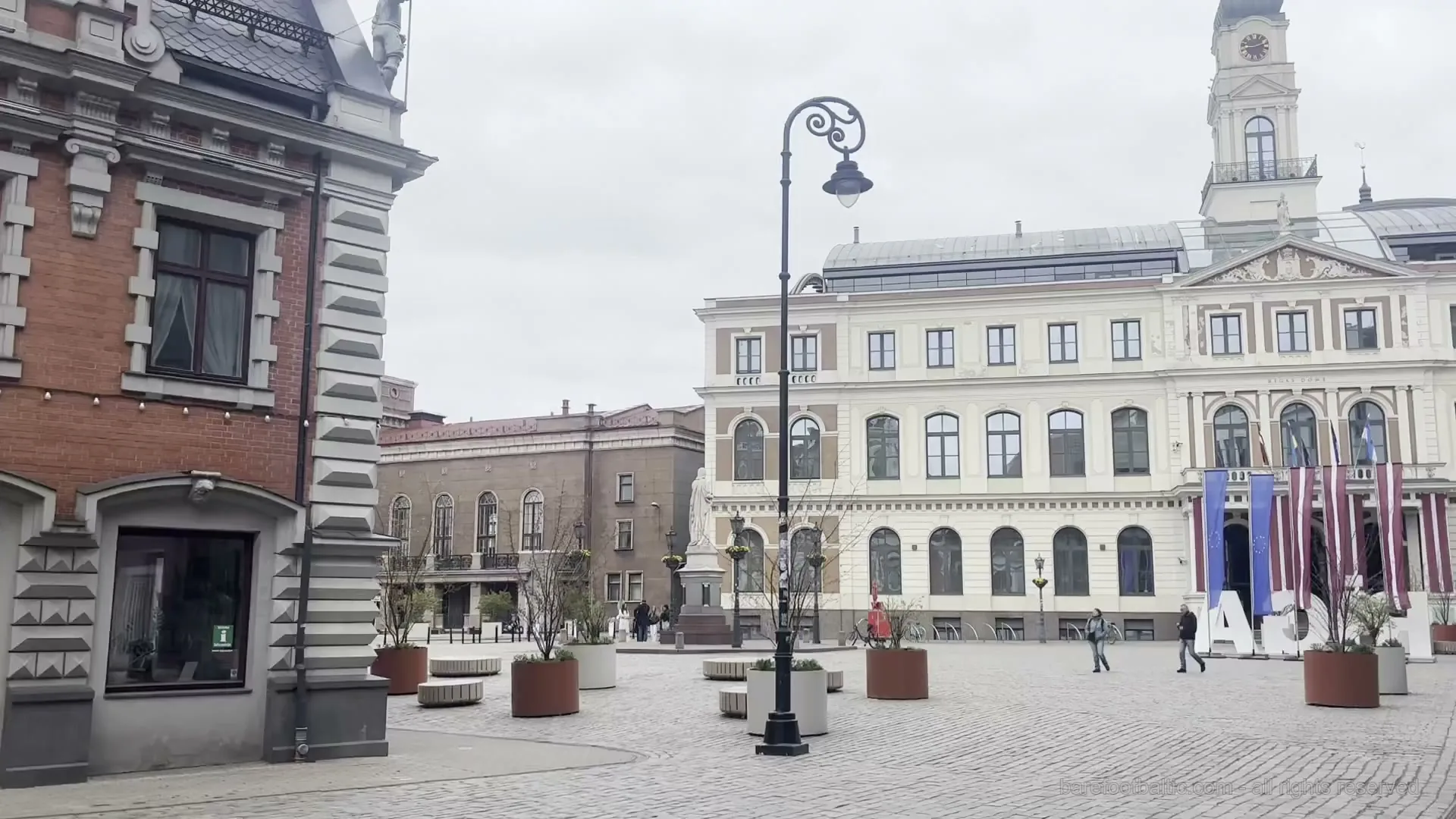
Evening Riga orientation walk with Daiga — a gentle 90 minutes from the hotel down to the Old Town: Three Brothers (the trio of medieval merchant houses on Mazā Pils iela), Riga Cathedral exterior, Town Hall Square with the House of the Blackheads exterior (the rebuilt 14th-century guild hall). Dinner is on you; Indian Raja in the Old Town or Sue's on the south side if you want Indian veg.
Day 6: Riga UNESCO Old Town + Art Nouveau Alberta iela + Central Market food walk + Riga Black Balsam
Day at a glance · ~11,000 steps · ~6 km in the van (hotel↔Central Market↔Alberta iela) · 8 sites (House of the Blackheads exterior, Three Brothers, Riga Cathedral exterior, St Peter's spire, Town Hall Square, Art Nouveau Alberta iela, Central Market food walk, optional Tagore plaque at University of Latvia)
Daiga's morning walk through Riga's UNESCO Old Town: House of the Blackheads exterior (the rebuilt 14th-century merchant guild), Three Brothers (the three oldest houses in Riga, 15th-17th century), Riga Cathedral exterior on Doma laukums, St Peter's Church spire (€9 optional climb for the rooftop view). Through Līvu laukums to the Town Hall Square.
Mid-morning Art Nouveau walk on Alberta iela — Riga has the largest concentration of Art Nouveau architecture in Europe, around a third of the buildings in the Old Town and the centre were built in the style between 1900 and 1914. Most of Alberta iela was designed by Mikhail Eisenstein (the father of the filmmaker Sergei Eisenstein who made Battleship Potemkin). The Riga Art Nouveau Museum is at Alberta iela 12 if you want the interior (~€9 optional). Optional 15-minute Tagore plaque stop at the University of Latvia main building on Raiņa bulvāris — Tagore lectured there in 1926. Pārdaugava community visit on request.
Lunch + Central Market food walk: Riga Central Market is one of the largest covered markets in Europe, in five repurposed German Zeppelin hangars from World War 1. Rye bread, smoked fish, Latvian cheeses, mushroom-and-dill pancakes. We graze our way through the four halls and the outdoor stalls.
Late afternoon Riga Black Balsam tasting at a small bar near the Central Market — the bitter herbal liqueur (24 botanicals, 45% ABV, produced in Riga since 1752) is Latvia's national drink. The operator's signature stop. Daiga has the long-version history. Evening: Folkklubs Ala basement folk-music venue on request, or Indian veg at Indian Raja.
Day 7: The Gauja Valley with Daiga — Sigulda + Cēsis, Turaida Castle and the Cable Car, Cēsis by candlelight
Day at a glance · ~10,500 steps · ~170 km in the van (Riga→Sigulda→Cēsis→Riga, ~3 hrs driving total) · 5 sites along the way (Sigulda Castle, Turaida Castle €8 optional upgrade at the gate, Sigulda Cable Car €10 optional upgrade at the gate, Krimulda Manor, Cēsis Castle €10 optional upgrade at the gate)
The Gauja Valley sits an hour northeast of Riga. By Day 7 you've spent six days in the van — Helsinki, the Tallink ferry across, Tallinn UNESCO, Lahemaa, Tallinn to Riga, the Riga Old Town and Art Nouveau — and the route slows down. Short driving day (~170 km), three sites that fit comfortably into one walking circuit, lunch in Cēsis between the two castles. The brochure version of Latvia is peaceful, forested, slightly underrated. Day 7 is when that lines up with what's actually in front of you.
Sigulda, morning. Sigulda is the small town the Gauja Valley wraps around — 50 km from Riga, 50 minutes' drive. We start at Sigulda Castle (the 13th-century Livonian Order ruin, free, walk-through), then take the Sigulda Cable Car across the valley (~€10 optional, at the gate, the only commercial cable car in the Baltics, hung between Sigulda and Krimulda, 1043 m long, opened 1969 and rebuilt in 1999 — we cross the river 42 m up with autumn colours below in September, full leaf in May-July). On the other side: Turaida Castle (~€8 optional, at the gate, the 13th-century red-brick castle built by Bishop Albert of Riga, with the Rose of Turaida legend — Maija the gardener's daughter, 1601, the story every Latvian schoolchild knows). Krimulda Manor exterior on the walk back to the van.
Lunch in Cēsis — the small medieval town 30 km further north, the old capital of the Livonian Order. Cafe Vinetta on the main square does the kind of mushroom-and-rye lunch you'll remember. Optional Sigulda bobsleigh-track summer-bob (~€16, the actual Olympic training track, paved over in summer, runs at 70 km/h).
Cēsis Castle by candlelight, afternoon (~€10 optional, at the gate). The medieval Livonian Order castle ruin you walk through holding an actual lit candle in a small lantern. There's no electric lighting inside — the route is rough stone stairs and arched cellar passages, and the candle is the entire light source. The kind of touristy experience that sounds gimmicky and then turns out to be genuinely good. Kids love it; adults remember it.
Back to Riga for dinner — the drive home, an hour. Ask along the way and you'll hear the lived-through version of the second Soviet occupation, the deportations of 1949, the Baltic Way of 1989 — recent enough to be living memory across the region.
Day 8: Free day in Riga — Jūrmala, Rundāle, or just rest
Day at a glance · self-guided · van rests · options: Jūrmala beach 40 min train, Rundāle Palace 90 min van, canal-boat cruise Old Town, Salaspils Memorial 18 km, or full rest in the hotel
Day 8 is a self-guided day. Daiga has arranged the tickets and the directions; you go on your own; we don't charge for transportation or guiding that day; that's the saving for you. The first free day sits in the middle of the trip by design — you've spent six guided days with us, and a breather here is more useful than a breather at the end.
Options Daiga will plan for you in advance:
- Jūrmala beach day (summer) — 40-minute commuter train from Riga Central Station to Majori. Latvia's seaside resort, wooden Art Nouveau cottages along Jomas iela, an 8-km Baltic Sea beach, optional swim (water hits 19-21°C in July-August). Train ticket ~€2 each way.
- Rundāle Palace (90 min from Riga by van) — the “Versailles of the Baltics”, designed by Rastrelli (the same architect who built the Winter Palace in St Petersburg for Empress Anna Ioannovna). 138 baroque rooms, the formal gardens with 2,300 roses in May-June. Entry €12. If you want this, we run the van out for an extra €40/group (not in the €1,170 base).
- Canal-boat cruise in the Old Town — 1-hour electric-boat loop on the city canal and a stretch of the Daugava, €25.
- Salaspils Memorial — the Soviet-era memorial at the site of the German Salaspils concentration camp, 18 km southeast of Riga, sombre, free, public transport route 18 from the central station. Recommended for older guests who want the Soviet-history layer.
- Just rest — the hotel café, the Old Town, the Central Market again, a long lunch at Indian Raja, a sauna at our recommended Latvian sauna place in Pārdaugava. Nothing wrong with doing nothing.
Day 9: Long van day Riga → Vilnius via the Hill of Crosses, Vilnius orientation walk in the evening
Day at a glance · ~7,500 steps · ~290 km in the van (Riga→Šiauliai→Vilnius, ~4 hrs driving total) · 3 sites (Hill of Crosses, Vilnius Cathedral Square exterior, Gates of Dawn)
Pack-up morning, then south on the E67. The Schengen border into Lithuania is paperwork-free. About 2 hours from Riga gets us to the Hill of Crosses near Šiauliai — a small hill in the middle of farmland with approximately 200,000 crosses planted on it, brought by Lithuanian Catholic pilgrims since the 1830s, then through the Soviet ban (the Soviets bulldozed it three times in the 1960s-70s; pilgrims rebuilt it three times). Pope John Paul II visited in 1993. It's a working pilgrimage site, not a tourist attraction — you can buy a wooden cross at the stall for €5 and add it. Some Indian guests find it more moving than they expected.
Lunch in Šiauliai or at a roadside cafe heading south. Another 2 hours brings us to Vilnius — we check you in to the hotel by 5-6 PM.
Evening Vilnius orientation walk with Daiga — Cathedral Square (Katedros aikštē), Gates of Dawn (Aušros Vartai) at dusk, Pilies gatvē the cobbled main street. Dinner: Bombay Bar in the Old Town if you want Indian veg, or local cepelinai (potato dumplings with mushrooms) at a Lithuanian place we use.
Day 10: Vilnius UNESCO Old Town + Gediminas Tower + Užupis + Trakai Castle + Karaim kibinai
Day at a glance · ~11,000 steps · ~60 km in the van (Old Town↔Užupis↔Trakai↔Vilnius) · 6 sites along the way (Cathedral Square + Bell Tower, Gediminas Tower €8 optional upgrade at the gate, St Anne's Church exterior, Gates of Dawn, Užupis bohemian quarter, Trakai Castle €11 optional upgrade at the gate) + Karaim kibinai lunch in Trakai
Daiga walks Vilnius's UNESCO Old Town in the morning — the largest medieval old town in Eastern Europe, on the UNESCO list since 1994. Cathedral Square with the Bell Tower; Gediminas Tower (~€8 optional, at the gate, the surviving wing of the Upper Castle, 14th century, panorama of the Old Town from the top — we take the funicular up); St Anne's Church exterior (the brick Gothic gem Napoleon allegedly wanted to take back to Paris on the palm of his hand); the Gates of Dawn / Aušros Vartai with the Black Madonna icon; and Užupis, the bohemian quarter that declared itself the “Republic of Užupis” in 1997, with a tongue-in-cheek constitution including “everyone has the right to be happy”.
Afternoon Trakai (~€11 optional, at the gate, 30 min from Vilnius): Trakai Castle — the 14th-century lake castle on Lake Galvē, seat of the Grand Duchy of Lithuania, the only insular castle in Eastern Europe. We cross the wooden bridges to the island. Optional rowing-boat across the lake (~€8/boat, summer only). Karaim kibinai lunch at a Trakai konoba — the Karaim are a Tatar-Karaim ethnic minority brought to Trakai by Grand Duke Vytautas in 1397, still living there as a small community of around 200 people, with their own cuisine (kibinai, the half-moon pastries stuffed with lamb, chicken or mushroom; the mushroom kibinai is naturally vegetarian). One of the last living Karaim communities in Europe.
Back to Vilnius for dinner. The Stradiņš-equivalent Lithuanian-Indian student community is smaller than Riga's but it exists; Bombay Bar in the Old Town is the reliable Indian-veg dinner spot.
Day 11: Long van day Vilnius → Warsaw via the Suwałki corridor, Warsaw orientation walk in the evening
Day at a glance · ~5,500 steps · ~440 km in the van (Vilnius→Suwałki→Białystok→Warsaw, ~6 hrs driving — the longest single van day of the tour) · 2 stops (Suwałki lunch, Warsaw Krakowskie Przedmieście evening walk)
This is the long day. Honest: about 6 hours behind the wheel including the lunch stop, ~440 km. We start at 8 AM from Vilnius, take the A16 south through the Lithuanian forest, cross the Schengen border into Poland near Suwałki (paperwork-free), then south on the S8 expressway through the Suwałki corridor — the strategically important 65 km strip of NATO/EU territory between Russia (Kaliningrad) and Belarus. Lunch in Suwałki or at a Białystok roadside cafe.
Her team is at the wheel for the full leg; Daiga handles the rest-stop briefings and the WhatsApp end of any guest questions. The van has good seats and AC. There's no scenic stop big enough to justify breaking the day further — the road runs through forest and farmland with a few small Polish towns. Bring a book or a podcast. We arrive Warsaw by 6 PM and check you in to your hotel in Śródmieście or the Old Town.
Evening orientation walk along the Royal Way / Krakowskie Przedmieście — the wide tree-lined boulevard that runs from the Old Town south to Łazienki Park. Pałac Prezydencki (the Presidential Palace), the Holy Cross Church where Chopin's heart is interred in a column, the University of Warsaw main gate. Dinner: pierogi at a Stary Dom in Śródmieście, or India Curry on Marszałkowska if you want Indian veg.
Day 12: Warsaw UNESCO Old Town + Royal Castle + Łazienki Park + Skwer Dobrego Maharadży (optional)
Day at a glance · ~12,000 steps · ~12 km in the van (Old Town↔Łazienki↔optional Wilanów) · 6 sites along the way (Warsaw UNESCO Old Town, Royal Castle €10 optional upgrade at the gate, Sigismund's Column, Royal Way, Łazienki Park + Chopin Monument, optional Skwer Dobrego Maharadży) + optional Wilanów Palace €10 or POLIN Museum €11
Daiga walks Warsaw's UNESCO Old Town in the morning. This is the deepest historical thread on the route, and it needs telling properly: the Old Town you're walking through was deliberately destroyed by the Nazis in 1944, then deliberately rebuilt brick-by-brick from rubble between 1945 and 1980. After the failed Warsaw Uprising in August-September 1944, Hitler ordered Warsaw razed to the ground — about 85% of the city was destroyed, including every building in the Old Town. After the war, Polish architects used Bernardo Bellotto's 18th-century cityscape paintings (Bellotto signed his Warsaw work as Canaletto, his uncle's name) as the reconstruction blueprint, alongside surviving photographs, drawings and salvaged building fragments. The work took 35 years. UNESCO inscribed the Old Town on the World Heritage list in 1980, specifically citing criteria ii and vi for the act of reconstruction itself — an unusual UNESCO citation, the only one of its kind for that scale of post-war restoration.
Warsaw Old Town walk: Castle Square with Sigismund's Column (1644, the first secular monument in Warsaw, rebuilt 1949), Royal Castle (€10 optional upgrade at the gate) — the interior we walk through is the 1971-1984 rebuild, with the original 17th-century Canaletto paintings hanging in the rooms they depicted, salvaged from Nazi looting at the end of the war. The Old Town Market Square, the Barbican (1540), St John's Archcathedral. Lunch at U Fukiera or a pierogi place on the Old Town Square.
Afternoon at Łazienki Park — the 18th-century royal park, free entry, the Palace on the Isle (Pałac na Wyspie) exterior, the Chopin Monument where the Sunday open-air piano recitals take place mid-May to end-September. If your trip falls on a Sunday in that window, we time the visit to noon or 4 PM for the recital (free, you sit on the grass). Peacocks wander the park.
Optional Skwer Dobrego Maharadży stop (30 minutes, on request): the Good Maharaja Square, central Warsaw, with the statue of Maharaja Jam Saheb Digvijaysinhji of Nawanagar — honouring the ~1,000 Polish refugee children he sheltered at the Balachadi camp in Gujarat between 1942 and 1946. A 10-minute walk from the Old Town. If you want the deeper Indo-Polish history, this is the headline stop on the whole route. (See the Indian-eyes disclosure higher up the page for full sourcing.)
Other optional afternoon stops: Wilanów Palace (~€10, the “Polish Versailles”, 1696, 20 minutes south of the Old Town), or the POLIN Museum of the History of Polish Jews (~€11, opened 2014 on the site of the former Warsaw Ghetto, covers a thousand years of Polish-Jewish history).
Day 13: Free day in Warsaw — POLIN, Wilanów, Vistula bike, or just rest
Day at a glance · self-guided · van rests · options: POLIN Museum, Wilanów Palace, Old Town second-look, Vistula riverside cycle, Polish cooking class, or full rest
Day 13 is a self-guided day. Daiga has arranged the tickets and the directions; you go on your own; we don't charge for transportation or guiding that day; that's the saving for you. A breather before the WAW airport day tomorrow.
Options Daiga will plan for you in advance:
- POLIN Museum deep-dive (~€11) — the four-hour walk through Polish-Jewish history, opened 2014, on the site of the former Warsaw Ghetto. The Bombay Sassoon connection panel is small but worth finding.
- Wilanów Palace + gardens (~€10, half-day) — the 1696 “Polish Versailles”, 20 min south of the centre, the formal gardens worth the trip on their own.
- Old Town second-look — the photo-friendly hour with no time pressure, plus the Barbican and the medieval city walls Daiga didn't have time for on Day 12.
- Vistula riverside cycle — rent a Veturilo bike (~€2/hour) and ride the Vistula east bank, the “wild” bank, the one the Old Town overlooks. About 10 km north-south of usable cycle path.
- Polish pierogi class at a Warsaw cooking school (~€60, half-day, you eat what you make). Daiga has the names.
- Just rest — the hotel café, a long lunch at one of the Indian restaurants on Marszałkowska, a sauna at our recommended Warsaw place. Nothing wrong with doing nothing on the day before you fly.
Auschwitz on Day 13? Not possible from Warsaw on a day-trip — 8+ hours of road time for a 3-hour visit. If you want Auschwitz, book the 17-day extended panel (next tab), or talk to us about ending the tour with a Kraków (KRK) departure instead of WAW.
Day 14: Warsaw morning + WAW airport drop in the afternoon
Day at a glance · ~3,000 steps · ~15 km in the van (hotel → WAW Chopin) · airport drop included
Final morning. Depending on your flight time, a slow breakfast, a last walk through the Old Town, a stop at the Chopin Heart pillar in Holy Cross Church if you didn't see it Day 11. Light lunch.
Afternoon WAW airport drop — Warsaw Chopin (WAW) is 10 km south of the centre, 20 minutes by van. The airport drop is included with the price, not separately charged. Daiga waves you off at departures. Total tour fee paid: €1,170 per person — 8 guided days + 4 self-guided rest days + Tallink Silja ferry essential. Free days, airport days, the Tallink ferry crossing all included.
Day 1: Daiga meets your flight at WAW. Welcome drive into Warsaw.
Day at a glance · ~1,500 steps · ~10 km in the van (WAW→central Warsaw) · airport meet + orientation chat
WAW airport meet, drive to your hotel in Śródmieście or the Old Town (about 10 km from WAW, 20 minutes). Daiga sits with you to take any last-minute inputs or amendments to the plan. Bundled into the package fee, not separately charged. Evening yours.
Day 2: Warsaw UNESCO Old Town + Royal Castle + Łazienki Park + Skwer Dobrego Maharadży (optional)
Same Warsaw day as default Day 12 — Old Town walk with the deliberate-destruction-then-rebuild story, Royal Castle (~€10 optional, at the gate), Łazienki Park with the Chopin Monument (free Sunday recitals mid-May to end-September), optional Skwer Dobrego Maharadży stop with the Jam Saheb statue.
Day 3: Free day in Warsaw — POLIN, Wilanów, or just rest
Day 3 is your self-guided day in Warsaw — not charged. Same options as default Day 13: POLIN Museum (~€11), Wilanów Palace (~€10), Vistula cycle, Polish pierogi class, or just rest. Auschwitz is not possible as a day-trip from Warsaw — book the 17-day extended panel if you want it.
Day 4: Long van day Warsaw → Vilnius via the Suwałki corridor
The long day, north-bound. ~440 km, ~6 hours of driving on the S8 expressway through Białystok, the Suwałki corridor, the Schengen border into Lithuania (paperwork-free), and down to Vilnius for evening check-in. Her team is at the wheel for the full leg; Daiga handles the rest-stop briefings and the WhatsApp end of any guest questions. Bring a book.
Day 5: Vilnius UNESCO Old Town + Gediminas Tower + Užupis + Trakai Castle + Karaim kibinai
Same Vilnius + Trakai day as default Day 10. Gediminas Tower ~€8 optional, at the gate, Trakai Castle ~€11 optional, at the gate. Karaim kibinai lunch in Trakai (the Tatar-Karaim community Vytautas brought in 1397).
Day 6: Long van day Vilnius → Riga via the Hill of Crosses
North on the E67. Hill of Crosses near Šiauliai — ~200,000 crosses, planted through the Soviet ban, Pope John Paul II 1993. Schengen border into Latvia paperwork-free. Riga check-in by 6 PM. Evening orientation walk — Three Brothers, Riga Cathedral exterior, Town Hall Square.
Day 7: Riga UNESCO Old Town + Art Nouveau Alberta iela + Central Market + Black Balsam
Same as default Day 6 — House of the Blackheads exterior, Alberta iela Art Nouveau (Mikhail Eisenstein), Central Market food walk in the Zeppelin hangars, Riga Black Balsam tasting. Optional 15-minute Tagore plaque stop at the University of Latvia on Raiņa bulvāris.
Day 8: The Gauja Valley with Daiga — Sigulda + Cēsis, Turaida Castle, Cable Car, Cēsis by candlelight
Same Gauja Valley day as default Day 7. Turaida Castle (~€8 optional, at the gate), Sigulda Cable Car (~€10 optional, at the gate), lunch in Cēsis, candlelight tour of Cēsis Castle (~€10 optional, at the gate). Back to Riga for dinner.
Day 9: Free day in Riga — Jūrmala, Rundāle, or just rest
Day 9 is your self-guided free day — not charged. Same options as default Day 8: Jūrmala beach (summer), Rundāle Palace (€12 + €40/group van surcharge), canal-boat, Salaspils Memorial, or rest.
Day 10: Long van day Riga → Tallinn via Pärnu lunch stop, Tallinn orientation walk in the evening
North on the Via Baltica E67. Pärnu lunch stop — the Estonian summer beach town on the Gulf of Riga. Schengen border into Estonia paperwork-free. Arrive Tallinn 5-6 PM. Evening orientation walk — the medieval Old Town, Town Hall Square, the city walls glimpse.
Day 11: Tallinn UNESCO Old Town with Daiga — Toompea, Olde Hansa lunch, Kadriorg
Same Tallinn day as default Day 3 — Toompea viewpoints, Town Hall Square, Olde Hansa medieval Hanseatic lunch, Kadriorg afternoon, optional KGB Museum (~€8).
Day 12: Lahemaa National Park — Viru Bog boardwalk, Palmse, Käsmu
Same Lahemaa day as default Day 4 — Viru Bog 5 km boardwalk loop, Palmse and Sagadi manor houses, Käsmu fishing village. Winter alternative: Tallinn Christmas Market.
Day 13: Tallink Silja ferry Tallinn → Helsinki + Helsinki guided afternoon
Day at a glance · ~80 km Tallink ferry (2h crossing, €30 optional upgrade at the gate) + ~9,000 steps walking · 5 sites (Senate Square, Helsinki Cathedral exterior, Esplanadi, Helsinki Old Market Hall salmon-soup tasting, Suomenlinna €8 optional upgrade at the gate)
Mid-morning Tallink Silja ferry from Tallinn Old City Harbour to Helsinki West (€30 bundled, 2 hours, Gulf of Finland crossing). Arrive Helsinki by early afternoon. Daiga walks you through Senate Square + Helsinki Cathedral exterior + Esplanadi + the Old Market Hall salmon-soup tasting, then Suomenlinna ferry across to the UNESCO sea fortress (~€8 optional, at the gate, 30-min ferry, open-air walk). Evening Helsinki hotel check-in in Kamppi or Punavuori.
Day 14: Helsinki morning + HEL airport drop in the afternoon
Final morning. Optional Temppeliaukio Rock Church + Sibelius Monument if you didn't fit them on Day 13, or a slow café morning. Light lunch. Afternoon HEL Helsinki-Vantaa airport drop — 20 km from the centre, 20 minutes by van. Drop bundled, not separately charged.
Days 1-13: Same as the default 14-day — HEL Day 1 through Warsaw Day 13 free
Identical to the default Helsinki-to-Warsaw 14-day route up through Day 13. HEL meet, Helsinki guided + Tallink ferry, Tallinn, Lahemaa, Tallinn→Riga, Riga + Art Nouveau + Central Market, the Gauja Valley with Daiga on Day 7, free day Riga Day 8, Hill of Crosses + Vilnius, Vilnius + Trakai, long van Vilnius→Warsaw, Warsaw + Royal Castle + Łazienki + Jam Saheb optional, free day Warsaw Day 13.
Day 14: Van Warsaw → Kraków (~4 hrs south), Kraków UNESCO Old Town evening walk
Day at a glance · ~5,000 steps · ~290 km in the van (Warsaw→Kraków, ~4 hrs driving) · 2 sites (Kraków UNESCO Main Market Square, Cloth Hall exterior)
Morning van south on the A1 motorway. Lunch on the road. Kraków hotel check-in by 4 PM in the UNESCO Old Town (Kazimierz or near Rynek Główny). Evening orientation walk with Daiga — Rynek Główny, the largest medieval town square in Europe (40,000 m², 1257), the Cloth Hall (Sukiennice, Renaissance, 16th century), St Mary's Basilica exterior with the hourly bugle call (the hejnał trumpeted from the tower on the hour and abruptly cut off, commemorating the 1241 Mongol-invasion trumpeter shot in the throat). Dinner: traditional Polish at a Kraków cellar restaurant.
Day 15: Auschwitz-Birkenau morning (~3 hours on-site), Wieliczka Salt Mine UNESCO afternoon
Day at a glance · ~9,000 steps · ~140 km in the van (Kraków↔Oświęcim↔Wieliczka↔Kraków) · 2 UNESCO sites (Auschwitz-Birkenau, Wieliczka Salt Mine)
The day this panel exists for. Early start from Kraków. Auschwitz-Birkenau (Państwowe Muzeum Auschwitz-Birkenau) is in Oświęcim, ~70 km west of Kraków, ~1 hour by van. The site has a hard advance-booking cap; we book your slot at the time of confirming the panel. The guided tour is ~3 hours on-site, walking both Auschwitz I (the main camp, the brick barracks, the “Arbeit Macht Frei” gate, the death wall, the gas chamber and crematorium I) and Birkenau (Auschwitz II, the larger killing centre, the train tracks and unloading ramp, the ruins of the gas chambers and crematoria II-V). The guide is the Auschwitz Museum's own; we step back. Daiga has the cultural and historical context on the van ride out and back; she doesn't intrude on the visit itself.
Afternoon at the Wieliczka Salt Mine (UNESCO since 1978, ~€32 entry, ~3 hours underground) — the 13th-century salt mine on the southern edge of Kraków with chapels and statues carved from rock salt by the miners themselves. The Chapel of St Kinga, 101 m underground, is the headline: a full church, including chandeliers cut from salt crystal, carved by three generations of miners between 1895 and 1963. The Polish-Indian rock-salt trade history is small but present — the Wieliczka curators have a panel.
Back to Kraków for a quiet dinner. Most guests want a quiet evening after Auschwitz; we don't force a programme.
Day 16: Wawel Castle + Kraków UNESCO Old Town + Schindler's Factory
Day at a glance · ~11,000 steps · ~5 km in the van · 4 sites bundled (Wawel Castle €10 optional upgrade at the gate, Wawel Cathedral exterior, Kraków UNESCO Old Town walk, Schindler's Factory €8 optional upgrade at the gate) + optional Kazimierz Jewish quarter walk
Morning at Wawel Castle (€10 optional upgrade at the gate) — the royal residence on the limestone hill above the Vistula, seat of the Polish kings from the 11th century to 1596, the State Rooms with the Sigismund tapestry collection (the 16th-century Flemish tapestries that survived the Nazi occupation by being shipped to Canada). Wawel Cathedral on the exterior (the coronation church, the Sigismund Bell). The dragon's den at the base of the hill (the legend of Smok Wawelski).
Afternoon at Schindler's Factory (€8 optional upgrade at the gate), now the Museum of Kraków under Nazi occupation 1939-1945. Oskar Schindler's enamelware factory at Lipowa 4 in the Zabłocie district; the museum tells the broader story of occupied Kraków, with Schindler's office preserved. Walk through the Kazimierz Jewish quarter on the way back if you have energy — Szeroka Street, the surviving synagogues, the Plac Nowy market.
Final Kraków dinner. Pierogi at one of the cellar restaurants, or veg Indian at India Curry on the way back to the hotel (there are two Indian veg places in Kraków).
Day 17: Kraków morning + KRK airport drop OR back to WAW
Final morning. KRK Kraków John Paul II Airport is 15 km west of the city centre, 20 minutes by van — LOT, Lufthansa, Turkish, KLM all fly out of KRK with one-stop connections to Indian metros. KRK airport drop included. Alternative: if your return flight is from Warsaw (LOT direct to Delhi), we drive you back to WAW (~4 hours) for an evening departure — WAW drop also bundled. Tell us at booking which airport you fly out of.
17-day pricing math: 11 guided days × €130 = €1,430, plus a ~€370 cross-country adjustment for the Tallink Silja ferry, intra-Baltic fuel, the Polish corridor, and the Warsaw↔Kraków leg. From €1,800 per person on private quote, Land + Guiding only. No paid attraction entries bundled; every paid venue along the route (the 14-day venues + Wawel Castle ~€10 + Schindler's Factory ~€8 + Auschwitz Museum coach & entry ~€35 + Wieliczka Salt Mine ~€32) is an optional upgrade paid direct. Groups of 7+ only; Kraków hotel nights add ~€90-160 per double per night (paid by guest direct to hotel).
Overall budget options
Land + Guiding only is the same across all three tiers. Accommodation flexes. Tap to compare hostel, poshtel and 3-star totals end to end.
Show the three-tier breakdown
| What you pay for | Hostel / dorm tier | Poshtel / private en-suite | 3☆ hotel tier |
|---|---|---|---|
| Land + Guiding only (per person) Same across all tiers. Pay in person on Day 1. | €1,170 | €1,170 | €1,170 |
| 13 nights Helsinki + Tallinn + Riga + Vilnius + Warsaw — per person, by occupancy | |||
| Solo (1 person per bed or room) | €235–520 | €910–1,690 | €1,560–2,600 |
| 2 sharing a private room (per person) | €235–520* | €455–845 | €780–1,300 |
| Family of 4 in a family room (per person) | — | €305–565 | €520–865 |
| Your India ↔ Europe return flight Book direct with the airline so miles + refund line stay yours. | €880 | €880 | €880 |
| Typical total trip cost per person | |||
| Solo | €2,285–2,570 | €2,960–3,740 | €3,610–4,650 |
| 2 sharing | €2,285–2,570* | €2,505–2,895 | €2,830–3,350 |
| Family of 4 in a family room | — | €2,355–2,615 | €2,570–2,915 |
* Hostel-dorm beds are sold per bed; per-head cost does not change with the number sharing the dorm. Hostel: shared dorm bed — €18–40 per night. Poshtel: upscale hostel with private en-suite rooms; family rooms often available. 3☆ hotel: standard mid-range hotel with breakfast; family rooms commonly bookable. Food and optional paid interiors are on top. Ask us for well-reviewed properties across central Helsinki, Tallinn, Riga, Vilnius and Warsaw. No commission to us either way.
What’s in the €1,170, what’s not
What “Land + Guiding only” means: all internal road transport in the EU + a licensed European guide + entry fees to the venues we bundle + a dedicated minibus.
Excludes: flight tickets / hotel stay / food / tips.
| Land + Guiding only ledger | Per person |
|---|---|
| 8 guided days × €130 Daiga & her team on the ground | €1,040 |
| Cross-country ferry + fuel essential Helsinki ↔ Tallinn ferry + intra-Baltic + Polish corridor | €130 |
| Total per person, Land + Guiding only | €1,170 |
No paid attraction entries are bundled. Tallink Silja Helsinki↔Tallinn ferry (~€30), Suomenlinna ferry day-pass (~€8), Turaida Castle (~€8), Sigulda Cable Car (~€10), Cēsis Castle (~€10), Gediminas Tower Vilnius (~€8), Trakai Castle (~€11), Warsaw Royal Castle (~€10) are all optional — pay at the gate or take the citypass through us at our corporate rate. Extra: flights, hotels, restaurant meals, tips, optional paid attractions.
Women-led, with safety and privacy built in
Barefoot Baltic is a women-led tour company. Daiga runs the company and leads every guided day on this route. She is a police academy graduate with a law degree, and that training shows up in how the tour is run. When you book with us, the person you message is the person you’ll meet at Helsinki airport on Day 1.
Privacy is a written rule on this tour: guest names, room numbers, routes and photographs don’t leave the group without explicit consent. The group WhatsApp is opt-in. For solo women, the hotel room sits on the same floor as Daiga’s, never above, and the front seat in the van is yours if you want it. A women-only departure is available on request for private groups of 5 or more.
Included in €1,170 (Land + Guiding only)
- HEL airport meet on Day 1 + WAW airport drop on Day 14 (mirror for the reverse panel)
- AC van transport across the 5 countries (~1,040 km on the Via Baltica E67 + S8 expressway)
- Tallink Silja ferry Helsinki↔Tallinn standard fare €30 optional upgrade at the gate — the only viable crossing of the Gulf of Finland
- Daiga as your guide, with our second crew member as driver on the long legs
- Optional venue upgrades through us at our corporate rate — Suomenlinna ferry day-pass €8, Turaida Castle €8, Sigulda Cable Car €10, Cēsis Castle €10 (incl. candlelight tour), Gediminas Tower Vilnius €8, Trakai Castle €11, Warsaw Royal Castle €10
- Helsinki Old Market Hall salmon-soup tasting on Day 2
- Olde Hansa lunch reservation on Day 3 Tallinn (you order from the menu and pay; we hold the table)
- Riga Central Market food walk + Riga Black Balsam tasting on Day 6 (the operator's signature stop)
- Karaim kibinai lunch reservation in Trakai on Day 10
- Schengen visa application support — invitation letter, itinerary, supporting docs (consulate fee ~€90 paid separately by you; one Type C visa covers all 5 countries)
- Indian veg meal arrangements through the Indian communities in Helsinki, Tallinn, Riga, Vilnius and Warsaw on request
- Child seats (infant, toddler, booster) free with 2 weeks' notice
- Full tour insurance under our operator policy
Not included
- International flights (we can help book if you'd like)
- Hotels for the 13 nights on the ground (we can help book or recommend hostels/poshtels)
- Restaurant meals (you order at the table and pay there)
- Optional venue interiors: Suomenlinna Submarine Vesikko (~€8), KGB Museum Tallinn (~€8), Kadriorg Palace interior (~€7), Riga Art Nouveau Museum (~€9), Rundāle Palace (~€12), House of the Blackheads interior (~€8), Vilnius Cathedral Crypts (~€10), Lennusadam seaplane harbour (~€15), Wilanów Palace (~€10), POLIN Museum (~€11)
- Auschwitz-Birkenau day-trip — not possible on the 14-day default; on the 17-day extended Kraków panel only
- Wieliczka Salt Mine — 17-day extended panel only
- Tips for Daiga & her team (entirely your discretion)
- Schengen visa fee (~€90 to consulate)
- Personal travel insurance, which Schengen requires (~€20-30 from Indian providers we suggest)
- The 17-day Kraków extended panel itself, which is from €1,800 pp on private quote
Available on request (no extra fee)
- Schengen visa application package One Type C visa covers all 5 countries. Invitation letter, itinerary, hotel confirmations, travel-insurance pointer.
- Hostel/poshtel recommendation We’ve walked into most of them in Helsinki, Tallinn, Riga, Vilnius and Warsaw. No commission to us either way.
- Hotel booking help Hotel charges apply.
- Flight booking help Airline charges apply.
- Indian veg routing — Chutney Lounge Helsinki, Chakra Tallinn, Indian Raja Riga, Bombay Bar Vilnius, India Curry Warsaw Restaurant bills paid at the table.
- Skwer Dobrego Maharadży stop (Day 12 Warsaw) The Jam Saheb of Nawanagar statue, 30-minute walk from the Old Town. Free, on request.
- Tagore plaque stop at the University of Latvia (Day 6 Riga) 15-minute walk on Raiņa bulvāris, free.
- POLIN Museum of the History of Polish Jews (Day 12 or 13 Warsaw) €11 entry paid at the door.
- Hindu temple visit in Helsinki ISKCON, Riga or ISKCON Latvia Sri Ramanuja Tamil mandir on Mūkusalas iela in Pārdaugava.
- Child seats (infant, toddler, booster) Free with 2 weeks' notice; ages on booking form.
- Łazienki Park Chopin Sunday recital (Day 12 or 13, free, mid-May to end-September Sundays at noon & 4 PM)
- Baltic Song and Dance Celebration tickets (Estonia 2027, Latvia 2028, Lithuania 2028) If your dates overlap a celebration week.
- Customisation: days, pace, destinations For groups of 7 or more, on a private quote.
A film or two to set the mood before you go
The Nordic and Baltic cinema canon is deeper than most people expect.
Copenhagen. Babette’s Feast (Gabriel Axel, 1987) is the obvious Danish film — quiet, slow, deeply Danish in its emotional register. The HBO/SVT series The Killing (Forbrydelsen, 2007-2012) for the city in winter; Borgen (2010-2013) for the political backdrop.
Stockholm. The Girl with the Dragon Tattoo (Niels Arden Oplev, 2009) opens with the Södermalm skyline you walk on Day 6. The original Swedish trilogy is harder to find but worth it. Smiles of a Summer Night (Ingmar Bergman, 1955) for the older Sweden.
Helsinki. The Other Side of Hope (Aki Kaurismäki, 2017) and the wider Kaurismäki filmography — deadpan, quiet, blue light, a lot of empty bars. Once you see one Kaurismäki film the rest of Helsinki makes more sense.
Tallinn. Tenet (Christopher Nolan, 2020) uses the Old Town and the Linnahall sea-wall in the freeport heist sequence. Cold War (Pawel Pawlikowski, 2018) for the older Baltic feel.
Citypass through us — our corporate rate is roughly 20% below the gate
We don’t bundle paid attractions into the published price. Instead, if a guest wants the bigger ticketed interiors, we pre-buy the official city pass at our operator-corporate rate and pass the saving on. Tell Daiga at booking which guests want a pass; we order ahead, you collect from her on Day 1. The default published price doesn’t pay for any of this — you only spend what you want.
Indicative 2026 prices. Children typically price at roughly half the adult rate on each official pass; the same ~20% corporate discount applies on the child rate.
| Pass (official operator) | What it covers | Gate adult | Our rate | You save |
|---|---|---|---|---|
| Copenhagen Card 72h | Tivoli, Rosenborg, Christiansborg, 80+ others, plus public transport (incl. airport metro) | ~€140 | ~€112 | ~€28 |
| Stockholm Pass (Go City) 2-day | Vasa Museum, Royal Palace, Skansen, 45+ others | ~€125 | ~€100 | ~€25 |
| Helsinki Card 48h | Suomenlinna ferry, Ateneum, Kiasma, 30+ others, plus transport | €78 | ~€62 | ~€16 |
| Tallinn Card 48h | 50+ Old Town attractions, plus public transport | €65 | ~€52 | ~€13 |
We don’t take a margin on the citypass either way — the saving is yours. If your dates slip or your group cancels the pass before activation, we cancel and refund at the same rate.
What to expect
The day-to-day rhythm, and how this differs from a packaged coach tour.
Fourteen days, five countries, one van, two operators — and one ferry across the Gulf of Finland. That's the shape. Day 1 starts when Daiga meets your flight at Helsinki-Vantaa (HEL). Day 14 ends when we drop you at Warsaw Chopin (WAW) in the afternoon. Everything in between is van, except the Tallink Silja ferry from Helsinki to Tallinn on Day 2 evening — there is no overland alternative since the Russian transit route closed in 2022, so the ferry is the crossing, and we bundle the standard fare into the price.
From Tallinn south the road is easy: the Via Baltica E67 motorway runs Tallinn-Pärnu-Riga-Šiauliai-Vilnius, then the S8 expressway through the Suwałki corridor takes us into Poland and on to Warsaw. About 1,040 km of driving total, broken into 4-6 hour van days with lunch stops. Two days are longer — Day 5 Tallinn→Riga via Pärnu (~310 km), and Day 11 Vilnius→Warsaw (~440 km, the longest single van day). We're honest about that in the daily-stats strip on each itinerary day.
€1,170 per person, Land + Guiding only. Eight guided days × €130 = €1,040, plus a ~€130 cross-country adjustment for the Tallink Silja Helsinki↔Tallinn ferry, intra-Baltic fuel, and the Polish corridor. No paid attraction entries bundled; every paid venue along the route (Tallink Silja ferry ~€30, Suomenlinna ferry day-pass ~€8, Turaida Castle ~€8, Sigulda Cable Car ~€10, Cēsis Castle ~€10, Gediminas Tower ~€8, Trakai Castle ~€11, Warsaw Royal Castle ~€10) is an optional upgrade Daiga pre-books on request, you pay direct. Day 1 HEL airport meet, Day 8 free in Riga, Day 13 free in Warsaw and Day 14 WAW drop are concierge time or rest days included with the fee, not separately charged.
On Day 7 we walk Sigulda and Cēsis in the Gauja Valley. Daiga has been on these roads for years. The other days run through cities Daiga has worked across many seasons — Helsinki, Tallinn, Vilnius and Warsaw — with the same operator across all five.
The team is two of us: Daiga as your guide and our European-licensed driver at the wheel on the long van legs (Day 5 Tallinn→Riga, Day 9 Riga→Vilnius via the Hill of Crosses, Day 11 Vilnius→Warsaw). Daiga leads the city walks. We do the entire fortnight ourselves, end to end. Private groups of 5 or more only. There are no set departure dates. Daiga checks the vehicle and guide calendar around your group before confirming the trip.
How the fortnight breaks down: Day 1 HEL meet + drive into Helsinki + orientation chat (bundled); Day 2 guided Helsinki + Suomenlinna + evening Tallink ferry to Tallinn; Day 3 Tallinn UNESCO Old Town + Olde Hansa Hanseatic lunch + Kadriorg; Day 4 Lahemaa National Park day-trip; Day 5 long van Tallinn→Riga via Pärnu; Day 6 Riga Old Town + Art Nouveau Alberta iela + Central Market food walk + Riga Black Balsam tasting; Day 7 the Gauja Valley with Daiga (Sigulda + Cēsis); Day 8 free in Riga (not charged); Day 9 Riga→Vilnius via the Hill of Crosses; Day 10 Vilnius UNESCO Old Town + Trakai Castle + Karaim kibinai; Day 11 long van Vilnius→Warsaw via the Suwałki corridor; Day 12 Warsaw UNESCO Old Town + Royal Castle + Łazienki + optional Skwer Dobrego Maharadży stop; Day 13 free in Warsaw (not charged); Day 14 WAW airport drop in the afternoon (bundled). Free days sit at Day 8 and Day 13 by design — you've spent six guided days in the van before each one and earned the breather.
You book your own flights and hotels. Use the airline you have miles with. Pick a hostel or a five-star. The Land + Guiding only price is the same. Pay nothing until Daiga meets you on Day 1 — card, cash or Wise transfer, your call. One Schengen Type C visa covers all five countries; we help with the paperwork (you pay the consulate fee, around €90). We'll point you at well-reviewed hostels and poshtels in each city; we'll arrange Indian veg meals through the established Indian communities in Helsinki, Tallinn, Riga, Vilnius and Warsaw on request; we'll fit child seats if you tell us two weeks before departure. None of that costs extra — it's the concierge work, and it's bundled.
Travelling on a budget? Consider hostels and “poshtels”
Hostels are a great option for budget holiday seekers, and the five capitals on this route have some of the best in Northern Europe. Clean, central, run by friendly young owners, and a fraction of the cost of a hotel.
“Poshtels” are a newer breed of posh hostels. They cut all the frills (no minibar, no concierge, no buffet breakfast) and give you a dirt-cheap stay in the middle of a city, often at a fraction of the cost of a hotel bed. Many offer private en-suite rooms that look and feel like a boutique hotel room, but at hostel prices. Rooftop bars, design-magazine interiors, espresso machines in the lobby. You sacrifice almost nothing except the brand name.
Land + Guiding only is the same across all three tiers. Accommodation is what flexes. Pick whichever fits your budget and travel style; we can book any of them on request, or you book direct.
| What you pay for | Hostel / dorm tier | Poshtel / private en-suite | 3☆ hotel tier |
|---|---|---|---|
| Land + Guiding only Daiga & her team, our van, all internal road transport across Finland, Estonia, Latvia, Lithuania and Poland. No paid attraction entries bundled. Pay in person on Day 1. | €1,170 | €1,170 | €1,170 |
| Your 13 nights of accommodation Helsinki is the dearest tier; Tallinn and Riga middle; Warsaw and Vilnius the cheapest. The Baltic capitals run roughly half the Nordic prices. | €235–520 | €910–1,690 | €1,560–2,600 |
| Your India ↔ Europe return flight Book direct with the airline so miles and refund line stay yours. Open jaw HEL-in / WAW-out is usually the same fare as a HEL return; Finnair has the only direct India route into the region. | €880 | €880 | €880 |
| Optional headline-interior entries Tallinn Kadriorg Palace ~€8 + Riga Art Nouveau Museum ~€6 + Trakai Castle interior ~€10 + Warsaw Royal Castle ~€30 + Wilanów Palace ~€25 + Helsinki Suomenlinna ferry ~€5. Indicative if you want most paid interiors covered. | €110 | €110 | €110 |
| Typical total trip cost per person Entry-fee row is optional — if you skip it the totals drop by €110. Food on top. | €2,395–2,680 | €3,070–3,850 | €3,720–4,760 |
Ask us for well-reviewed ones. We’ve walked into most of the hostels and poshtels in the five capitals personally, and we know which ones are quiet enough for couples and families, which ones have lockable private rooms, and which ones are best for solo women. No commission to us either way — we’ll point you to the right one for your trip.
Self cooking / Heat & serve options
The main itinerary stays open for guests who want to venture out into Nordic, Baltic and Polish food — smoked fish, rye bread, pierogi, salmiakki, salty liquorice, the lot. For the desi side, the Northern European route is thinner than the Paris or London tours. Here’s what we can do and where the reliable places are. This is the long version; the short version is “tell us what you want, we’ll make it happen”.
What we can carry from our base, on advance request
Our base is in the Gauja Valley, two hours east of Riga. We drive from there to TLL or HEL on the morning of Day 1, which means we can put a small selection of Indian provisions in the van on the way over — tell us at booking and it’s already on board:
- Frozen paratha (plain, methi, aloo)
- Frozen samosa (potato + pea, lamb keema on request)
- Ready-meal sachets (palak paneer, chana masala, dal makhani, butter chicken — MTR / Haldiram’s / Patak’s brands)
- Masala packets (chai masala, garam masala, pav bhaji)
- Instant filter coffee + Brooke Bond / Wagh Bakri tea bags
- Pickles + papad on request
Nordic and Baltic hotels usually have a kettle, often a microwave, and many apartments have a kitchenette. Restock is easy. We can drop the group at a supermarket on arrival.
Where to buy Indian provisions on the ground
Helsinki: Asia Market on Hakaniemi square is the largest South Asian grocer in the city. Punjab Tukkukauppa near the central train station carries deep stock of basmati, dal, atta, halwai sweets.
Tallinn: Spice Bazaar on Pirita tee. Solaris Centre’s Rimi Hypermarket carries the Indian aisles.
Riga: Saima Asian Food on Brivibas iela; Bombay Food Store on Marijas iela behind the central market.
Vilnius: Asian Food Market on Pylimo gatve.
Warsaw: Indian Bazar on Marszałkowska, plus the cluster of Asian grocers on Koło Street (Wola district). The Vietnamese-Polish Asian quarter near Plac Bankowy also has Indian provision stalls.
Reliable Indian restaurants on the route
Helsinki: Maharaja on Hietalahdenkatu, Namaskaar on Mannerheimintie. Both do dosa.
Tallinn: Elevant on Vene tn (the established Old Town Indian since the 1990s), Spice India on Roosikrantsi.
Riga: India Raja on Aspazijas bulvaris (most central), Kashmir Hut on Brivibas iela (closest to home cooking).
Vilnius: Sue’s Indian Raja on Vokieciu (the headline; family-run since 1996).
Warsaw: India Curry on Krucza, Bombay Music on Marszałkowska, Bollywood Lounge in the Old Town. Maharaja Thali House on Wilcza does the closest thing to a proper south-Indian thali.
How the van side works
If the group wants to go out for dinner to any restaurant in Helsinki, Tallinn, Riga, Vilnius or Warsaw, tell us and we send the van to pick the group up from the hotel and drop you at the restaurant, and come back to collect afterwards. Free; it’s already part of the van availability you’re paying for. Nordic and Baltic Old Town pedestrian zones are short walks from the van parking.
Jain meals
Jain meals are available with two weeks’ advance notice. The kitchen prep at the restaurants we work with takes that long for proper no-root-vegetable, no-onion, no-garlic cooking.
🛍 Shopping in Helsinki, the Baltic capitals and Warsaw — the full picture
The main itinerary doesn’t organise shopping for you, but a lot of guests want a clear read on what’s where. Northern Europe trades in design (Finnish + Scandinavian-influenced), amber, linen, ceramics, vodka, glassware and natural cosmetics. The malls and chain stores exist but aren’t the point.
Helsinki — Finnish design + Marimekko
- Esplanadi — the central tree-lined park-boulevard, with Marimekko flagship at one end and Stockmann department store at the other. The Finnish design houses (Iittala, Arabia, Aarikka, Pentik) sit along it.
- Design District Helsinki — the 25-block creative quarter centred on Punavuori. ~200 independent designer studios, ceramicists, jewellers. Free design-district map at the Helsinki tourist office.
- Old Market Hall (Vanha Kauppahalli, 1889) on the harbour — smoked salmon, rye bread, salted reindeer, cloudberry jam. Useful for taking food gifts home (most are vacuum-sealed for travel).
- Hakaniemi Market Hall — the working everyday market, with Asia Market next door for South Asian provisions.
Tallinn — Estonian design + knitwear
- Viru tn + Sauna tn (Old Town) — the central pedestrian streets. Estonian knitwear (Aade Lõng pure-wool yarn), juniper-wood kitchenware, ceramics.
- Katariina Käik — the small medieval lane with working artisan studios (glassblower, hatter, leatherbinder).
- Telliskivi Creative City — the converted railway warehouses west of the Old Town. Indie-design quarter, Saturday flea market.
Riga — amber, linen, Art Nouveau ceramics
- Tērbatas iela + Brīvības iela — the central streets through the Art Nouveau heritage quarter.
- Riga Central Market — the five repurposed 1924-1930 Zeppelin hangars hold one of Europe’s largest covered markets. Smoked fish, rye bread, pickles, amber stalls round the perimeter.
- Amber — the Baltic Sea coastline is the world’s richest amber deposit (40 million years older than Mediterranean amber). A.A. Amber Studio on Kaļķu iela is the certified workshop direct sale; skip the cruise-ship souvenir shops on Šķūņu iela.
Vilnius — linen, ceramics, Užupis art
- Pilies gatvė (Old Town) — central old-town pedestrian street. Lithuanian amber stalls, linen shops, ceramics from Pakruojis Manor.
- Užupis art quarter — the self-declared “Republic of Užupis”, an artist neighbourhood with working ceramic studios and direct artist sales.
Warsaw — vodka, pierogi-related kitchenware, Polish poster art
- Nowy Świat & Krakowskie Przedmieście — the royal-route shopping spine running from the Old Town south. Polish design boutiques, vodka shops (Wyborowa, Belvedere flagships), book shops.
- Hala Mirowska — the 1899 covered market, restored after WW2. Polish charcuterie, pickles, oscypek mountain cheese.
- Polish poster art — the Warsaw cinema poster tradition is a recognised graphic-design movement (Henryk Tomaszewski et al.). Galeria Plakatu in the Old Town sells originals + reproductions.
- Old Town gift stalls — amber from the Baltic coast (Gdańsk is the Polish amber capital), wooden Christmas decorations, hand-painted ceramics.
The van side — how we handle the bags
On all the guided days the van is parked nearby with locking storage. Drop your morning shopping bags in the boot at the next stop and they ride along until you check into the hotel that evening.
VAT refund for Indian passport holders
EU refunds sales tax to non-EU visitors who export the goods within 90 days. Finland, Estonia, Latvia, Lithuania and Poland all participate; thresholds and percentages vary slightly.
Finland (Helsinki): ALV refund on purchases over €40 in a single store. Process at HEL airport.
Estonia, Latvia, Lithuania: KM/PVN/PVM refund on purchases over €25-55 in a single store. Process at TLL, RIX or VNO airport.
Poland: PTU refund on purchases over PLN 200 (~€47) in a single store. Process at WAW or KRK airport.
Bring your passport when you shop. The shop fills out a tax-free voucher; you stamp it at the airport on departure; the refund hits your card 4-8 weeks later.
Baggage allowance on the way home
Most India-bound flights from HEL, TLL, RIX, VNO or WAW route via Finnair (direct India), Turkish (via Istanbul), LOT (via Warsaw) or airBaltic (to European hubs). Most allow 23 kg checked + 8 kg cabin in economy. An extra-bag fee at the airport is ~€90-150 per leg. We weigh suitcases at the hotel the night before the airport drop on request.
Private group of 5 or more? We’ll build the trip around you.
For private groups of 5 or more, we adjust most things. Number of days, the destinations, the pace, the focus.
- 17-day extended with Kraków + Auschwitz + Wieliczka? Panel 3 above. From €1,800 pp on private quote.
- Swap a Lithuania day for a second Gauja Valley day? Easy — it's the region the crew works most weeks of the season.
- Add the Białowieża primeval forest (UNESCO, Poland-Belarus border)? On a private quote, ~2 extra days from Warsaw.
- Add 2 nights at Jūrmala beach on the Latvian coast? On request.
- Add a Sibelius Hall concert evening in Helsinki, or a Polish folk-music night in Kazimierz Kraków? If dates align.
- Cut to 10 days by dropping Lahemaa + the Vilnius→Warsaw leg? About €1,000 pp, Land + Guiding only.
Same crew (Daiga & her team), same van, same Latvia-registered operator, same insurance. Pricing stays €130 per guided day per person plus a cross-country adjustment for the ferry + multi-country fuel. No paid venue entries are bundled; every paid attraction along the route is an optional upgrade Daiga pre-books on request, you pay direct. Free days don't get charged. We send you a transparent quote on the same logic as the public tour.
We’ve hosted Indian families before
Private bookings have come from India, from the US, and from the UK. Multi-generational families (including grandparents who lived through the India-USSR years and wanted to see the Soviet legacy at the Salaspils Memorial or the KGB Museum Vilnius), couples, solo women, friend groups. Most shapes you can think of.
References available on request. We’re happy to share contact details of past Indian guests who agreed to be referees. Just ask — we'll WhatsApp you two or three.
Request references on WhatsAppFrequently asked: questions Indian travellers send us
One Schengen short-stay (Type C) visa covers all five countries. Finland joined Schengen in 1996; Estonia, Latvia, Lithuania and Poland in 2007. You apply once, in India, before you fly. We help with the application form, the supporting documents (invitation letter, itinerary, hotel confirmations, travel-insurance guidance) at no extra cost. The visa fee itself is paid by you to the consulate, currently around €90. Apply at least 30 days before travel; we recommend 45+ days for May–August departures.
Honest answer. Auschwitz-Birkenau is in Oświęcim, ~330 km / 4 hours south of Warsaw by road, with a hard advance-booking cap and a 3-hour minimum on-site visit. A 14-day default that ends in Warsaw can’t fit it without an 8-9 hour same-day road trip, which we won’t ask you to do — the visit deserves more than a quick window.
We have two honest answers for guests who want Auschwitz included:
- The 17-day extended Kraków panel (Panel 3 in the itinerary above) adds a 2-night Kraków base — Auschwitz-Birkenau morning, Wieliczka Salt Mine UNESCO afternoon, Wawel Castle, Schindler’s Factory, Kraków UNESCO Old Town. From €1,800 pp on private quote.
- End the tour at Kraków (KRK) instead of Warsaw (WAW). We route the last 3 days through Kraków including Auschwitz, and you fly out of KRK (LOT, Lufthansa, Turkish all serve KRK).
Tell us at booking and we’ll quote either. We don’t bundle Auschwitz on the 14-day default because we won’t pretend logistics that don’t work. The visit is important and worth doing properly — that’s why we built the 17-day panel.
Yes — the Tallink Silja standard fare (~€30 per person) is bundled into the €1,170 Land + Guiding only price. There’s no train and no road option. Before 2022, you could theoretically have driven around the Gulf of Finland through Russia (3,000+ km), but that route closed when the Russian land border shut to EU traffic. The Tallink ferry is the crossing — 2 hours across the Gulf of Finland, every few hours daily. Daiga rides with you. If you want to upgrade the ferry cabin or add the dinner buffet, you pay the difference at the terminal.
Yes, on request. Helsinki has Chutney Lounge and Namaskaar plus the ISKCON kitchen at Kalliolinnantie. Tallinn has Chakra in the Old Town and Elevant on Vene tänav. Riga has the deepest coverage — Indian Raja in the Old Town, Sue’s Sushi & Indian, plus the Pārdaugava community options. Vilnius has Bombay Bar and Sue’s Indian Raja Trinity. Warsaw has India Curry on Marszałkowska, Bombay Tikka House and India Restaurant in Śródmieście. Local Northern European cuisine has many naturally vegetarian options — rye bread, mushroom soups, root vegetables, dairy. Jain meals are available with advance notice. Tell Daiga before the route is confirmed so she can check the kitchens on your dates.
Late May to early September is the sweet spot. Long daylight (up to 19 hours in Helsinki in June, 16.5 hours in Warsaw), temperatures 17-23°C, very little rain. May, June and September align well with Indian school summer holidays. The Lahemaa bog walk needs May-September (boardwalk safe). The Łazienki Chopin Sundays in Warsaw run mid-May to end-September only. Winter tours (December-February) are available but daylight drops to 6 hours in Helsinki and the Lahemaa boardwalk is closed. We recommend May-September for first-time visitors.
Very safe. Finland ranks in the top 15 of the Global Peace Index, the Baltic three in the top 40, Poland in the top 35. Violent crime in the five capitals on this route is well below what you’d see in most Indian metros. The tour is women-led — Daiga leads every guided day; our second crew member drives. We’ve hosted solo Indian women on private tours before, and we can connect you with references on request. If you’d prefer a women-only departure for a group of 5+, ask.
Tap water: safe in Helsinki, Tallinn, Riga, Vilnius and Warsaw — all meet EU drinking-water standards. The van carries chilled bottled water as well.
Currencies: Finland, Estonia, Latvia and Lithuania are on the Euro. Poland is still on the złoty (PLN) — 1 Euro ≈ 4.3 PLN as of mid-2026. Cards work everywhere; ATMs are easy to find. Carry a small amount of złoty cash for Polish markets and small cafés (€20-30 in złoty is plenty for a few days). You don’t need much Euro cash either; €100-200 in small notes is enough for two weeks of tips and the rare cash-only stall.
Mobile data: an Indian roaming pack (Airtel/Jio international roaming) works, but a local EU eSIM (Airalo, Holafly) is usually cheaper for a fortnight. Free Wi-Fi is everywhere in the five capitals. Power plugs: Type C and Type F (round two-pin) in Finland, Estonia, Latvia, Lithuania; Type C and Type E in Poland. Bring a standard EU adapter. The Indian three-pin will not fit. Voltage is 230V, same as India.
Children are welcome. Tell us two weeks before departure and we’ll fit the right car seat — infant, toddler or booster — at no extra cost. There’s a “Children’s ages” field on the booking form.
The family-discount logic: children’s tickets are cheaper at most venues we bundle (Suomenlinna ferry, Turaida, Sigulda Cable Car, Cēsis, Gediminas Tower, Trakai, Warsaw Royal Castle), so the savings get passed back to you. The Tallink Silja ferry has child fares too. We don’t discount the transport or guiding — that work is the same whether you bring kids or not. Indicative Land + Guiding only prices: Adult €1,170, Teen 10-17 ≈ €1,375, Child 3-9 ≈ €1,340, Infant 0-2 ≈ €1,260 (no venue tickets needed).
We arrange a professional child-minder at a nominal hourly fee on any tour date by advance request, not only the Day 8 Riga or Day 13 Warsaw free days or evenings — ask and we’ll try to set it up if the city we’re in that day allows. Hotel and evening minders are arrangeable in most cities.
When you arrange your own hotel, pick something within meaningful distance of the rest of the group’s hotels in each city — we try to coordinate everyone within 1-1.5 km of a central pickup point. Suggested central districts: Helsinki Kamppi / Punavuori / Eira; Tallinn Old Town or Rotermann; Riga Old Town or Centrs; Vilnius Old Town or Užupis; Warsaw Śródmieście or Old Town (avoid Praga, which is across the Vistula and far from morning pickup). If you book somewhere on the far edge of town, we’ll do our best, but we reserve the right to ask you to meet us at a central pickup. Send us your hotel name when you book it and we’ll tell you if it works.
Northern European summer rain is usually brief and passes within an hour. Our itinerary mixes outdoor and indoor stops, so we shuffle the day if a heavy shower lands on a planned outdoor segment. Bring a light rain jacket or a small fold-up umbrella. The tour runs in light rain; we only cancel outdoor stops if there’s a safety issue.
Yes. Schengen visa rules require Indian passport holders to hold travel insurance covering medical and repatriation expenses of at least €30,000 across the Schengen area. For a 14-day trip we suggest a slightly higher cover (€50,000+) to give yourself headroom. We’ll share trusted Indian provider names during the visa-help step. Our tour itself is separately insured under our operator policy.
If you arrange your own flights and hotels, you confirm your seats on this tour with no upfront payment. You pay the full tour fee on arrival at Helsinki (default) or Warsaw (reverse). We hold the seats once you submit an enquiry, share basic ID details, and confirm your itinerary choice. If you ask us to book hotels or flights for you, those reservations carry their own deposits set by the hotel or airline.
From Mumbai, Delhi or Bengaluru, the most common routes are: Helsinki direct on Finnair (8-9 hours nonstop); Warsaw direct on LOT (~8 hours nonstop, Delhi only); or via Istanbul (Turkish Airlines), Frankfurt (Lufthansa), Amsterdam (KLM) to any of the five capitals (11-14 hours with one connection). Time difference: Helsinki/Tallinn/Riga/Vilnius are 2.5 hours behind India in summer (IST − 2:30), 3.5 hours behind in winter. Warsaw is 3.5 hours behind in summer, 4.5 hours in winter.
Yes. For private groups of 5 or more we customise the number of days, the destinations, the pace, and the focus. Common requests on this route: add the 17-day Kraków panel (Auschwitz + Wieliczka); add the Białowieża primeval forest (UNESCO, Poland-Belarus border); add 2 nights at Jūrmala beach on the Latvian coast; cut to 10 days by dropping Lahemaa and the Vilnius→Warsaw leg. Same crew, same Latvia-licensed operator, same AC van, same insurance. Ask us for a private quote.
Deeper context worth a read
Longer pieces guests have asked us about over a hotel-bar evening. None of it is on the headline itinerary; tap whichever interests you.
Why Northern Europe feels different from home Six numbers worth knowing before you book
Some numbers that explain why the change is noticeable from the first day. Sources are the FAO, the World Bank, the European Environment Agency and the Global Peace Index, all current data.
per km²India national average. Mumbai metro is roughly 21,000.
per km²Finland is the emptiest at 18; Lithuania the densest at 45. Poland is the outlier at 122.
The five countries, by the numbers Forest cover, population, what each is known for
The route spends roughly equal time in each country, with two extra days in Latvia (the Gauja Valley on Day 7 + free Day 8 in Riga). Day 7, when we walk Sigulda and Cēsis, is the region the crew operates most weeks of the season — short driving distances, the medieval castle cluster, the country's most-walked national park trail. Daiga & her team are with you the whole fourteen days — from your HEL airport meet on Day 1 to your WAW airport drop on Day 14.
Finland
The forested one
- ~73% of the country is forest — the most forested in Europe
- 188,000 lakes — one for every 30 Finns
- One sauna per 1.5 Finns. The word sauna is Finnish
- Founding home of Sibelius (the seven symphonies, the Karelia Suite, the Finlandia tone poem), Nokia, and Linux (Linus Torvalds, Helsinki, 1991)
- Population ~5.5 million
Estonia
The digital one
- ~51% of the country is forest
- 2,000+ islands along the coast
- Founding home of Skype’s engineering team, plus Bolt and Wise. The most unicorns per capita in Europe
- Online voting since 2005. e-Residency open to anyone in the world
- Population ~1.3 million
Latvia
Our home · the green one
- ~55% of Latvia is forest. One of the most forested countries in Europe
- 12,000+ rivers, 4,000+ lakes, 500 km of Baltic coastline
- Riga has the world’s largest collection of Art Nouveau buildings. UNESCO World Heritage
- Europe’s highest density of nesting white storks. They build nests on telephone poles and rooftops
- Population ~1.9 million
Lithuania
The ancient one
- ~35% forest cover
- Vilnius Old Town is UNESCO listed — one of the largest surviving medieval old towns in Northern Europe
- The geographic centre of Europe (by one widely-cited calculation) lies just north of Vilnius
- Linguists call Lithuanian the most archaic living Indo-European language
- Population ~2.8 million
Poland
The phoenix one
- ~30% forest cover, including Białowieża, the last European primeval forest — UNESCO since 1979
- Warsaw's Old Town was deliberately destroyed in 1944 and deliberately rebuilt 1945-1980. UNESCO inscribed the reconstruction in 1980 (criteria ii + vi) — an unusual citation for the act of restoration itself
- Home of Chopin, Marie Skłodowska-Curie (the only person to win Nobel prizes in two different sciences), and Pope John Paul II
- Solidarność 1980-1989 — the peaceful transition from communism. EU 2004, NATO 1999. Still on the złoty, not the Euro
- Population ~38 million — ten times bigger than the Baltic three combined
The Indian connection: Lithuanian, Latvian and Sanskrit Eight cognates that come from a shared Indo-European root
Lithuanian and Latvian both descend from the same Indo-European root as Sanskrit. Lithuanian especially: linguists consider it the most archaic Indo-European language still spoken. You’ll catch words on this tour that sound oddly close to words you already know.
| Sanskrit | Lithuanian | Latvian | Meaning |
|---|---|---|---|
| देवdeva | dievas | dievs | god |
| अग्निagni | ugnis | uguns | fire |
| वीरvīra | vyras | vīrs | man / hero |
| नक्तिnakti | naktis | nakts | night |
| मधुmadhu | medus | medus | honey |
| सूनुsūnu | sūnus | — | son |
| अश्वaśva | ašva | — | horse |
| रथratha | ratas | rats | wheel / chariot |
From comparative Indo-European linguistics (Klimas; Mażiulis; Schmalstieg; Sabaliauskas). Pronunciations have drifted; the roots are shared. Em-dashes in the Latvian column mean the cognate has been replaced by a different root in modern Latvian. Finnish (Uralic family) and Polish (Slavic) sit further from Sanskrit; the closest living echoes on this route are Lithuanian and Latvian.
Reading these cities through Indian eyes The Jam Saheb’s Polish refugees, Tagore in Riga, the Stradiņš medical community, the amber trade, the Soviet years
The Maharaja Jam Saheb of Nawanagar and the Balachadi Polish-refugee camp, 1942-1946. This one we lead with, because too few Indians know it. During the Second World War, Maharaja Jam Saheb Digvijaysinhji of Nawanagar (now Jamnagar, Gujarat) opened his princely state to roughly 1,000 Polish refugee children — mostly orphans whose parents had died in Soviet labour camps after the 1939 partition of Poland between Hitler and Stalin. The children were evacuated via Persia under the Sikorski-Maisky agreement of 1941, and the Jam Saheb built a camp for them at Balachadi, on the Gujarat coast. They lived there from 1942 until 1946, schooled in Polish, fed Polish-Gujarati hybrid meals, taken on excursions, treated as the Maharaja's "little citizens". The larger Valivade refugee camp near Kolhapur in Maharashtra hosted around 5,000 more Polish refugees in the same period. After the war the children were repatriated; some stayed in India, some emigrated to the UK or Canada. In 2014 the Polish state, under President Bronisław Komorowski, officially named a square in central Warsaw Skwer Dobrego Maharadży — the Good Maharaja Square — in his honour. There's a statue of the Jam Saheb there. The square is a 10-minute walk from the Old Town and we offer it as an optional Day 12 stop. Source: Anuradha Bhattacharjee, The Second Homeland: Polish Refugees in India (Sage, 2012, ISBN 9788132110804); Polish embassy New Delhi historical records.
Tagore lectured at the University of Latvia in 1926. On his 1926 European tour — the same trip that took him to Villeneuve in Switzerland to meet Romain Rolland — Rabindranath Tagore stopped in Riga and gave a public lecture at the University of Latvia, then seven years old. There's a Tagore plaque on the main university building on Raiņa bulvāris. A 15-minute walk through the campus on Day 6 lets you find it. Most Indian guests want to know it's there. Source: Krishna Dutta and Andrew Robinson, Rabindranath Tagore: The Myriad-Minded Man (St. Martin's Press, 1996), plus University of Latvia historical records.
Riga has an Indian-student community of roughly 1,000-2,000 at any given time. Riga Stradiņš University (the medical school, founded 1950 as the Riga Medical Institute) is one of the established European routes for Indian medical students who want an MD without sitting NEET-PG. They mostly live in Pārdaugava, the residential district south of the Daugava river, where there are Indian groceries on Mūkusalas iela, a small Sri Ramanuja-tradition Tamil mandir, and Indian veg restaurants. If you've got a friend or a friend-of-a-friend studying medicine in Riga, this is where they probably live. Temple-visit policy is in the next paragraph.
The POLIN Museum of the History of Polish Jews, Warsaw. Optional on Day 12 afternoon or Day 13 free day — the museum, opened 2014 on the site of the former Warsaw Ghetto, covers a thousand years of Polish-Jewish history (~€11 entry, not bundled). The WWII section connects to a less-known Indian thread: Bombay's small Jewish community, anchored by the Sassoon family (Iraqi-Jewish merchants who came to Bombay in the 1830s), funded Jewish refugee relief in the 1939-1945 period. India received Jewish refugees through Bombay and Calcutta; some 1,000-2,000 stayed. The Sassoon Library, the Magen David Synagogue in Byculla, the Knesset Eliyahoo Synagogue in Kala Ghoda — all still standing in Mumbai — are part of that thread. The POLIN curators have a small India panel.
Indian veg coverage in all five capitals. Helsinki: Chutney Lounge and Namaskaar in the centre, plus the ISKCON Helsinki kitchen on Kalliolinnantie. Tallinn: Chakra in the Old Town and Elevant on Vene tänav. Riga (the deepest coverage): Indian Raja in the Old Town, Sue's Sushi & Indian on the south side, plus the Pārdaugava community options on Mūkusalas iela. Vilnius: Bombay Bar and Sue's Indian Raja Trinity, both Old Town. Warsaw: India Curry on Marszałkowska, Bombay Tikka House, and India Restaurant in Śródmieście — no major Hindu temple in Warsaw itself; the closest is ISKCON Poland at Czarnów, about 1.5h drive away. Tell us at booking and we'll route the dinner stops through them on the right days.
Baltic amber traded down to Roman ports and onward to India. Baltic amber — the fossilised resin that washes up on the coast between Liepāja and Klaipēda — was the “gold of the north” in the Roman period. The Amber Road ran from the Baltic coast to Carnuntum on the Danube, down to Aquileia, and from there into the Mediterranean trade that reached Muziris (modern Kerala) and Barygaza (modern Bharuch, Gujarat) via the monsoon-wind routes Pliny the Elder describes in his Natural History (Book VI). The Latvian National Museum has amber objects with provenance from the India trade. If you want it folded into Day 6 in Riga, we can add a 30-minute amber-trade context stop — on request, no extra cost.
The Soviet years — familiar context for older Indian guests. Estonia, Latvia and Lithuania were occupied by the Soviet Union from 1940 to 1991 (with the Nazi interlude 1941-1944). Poland sat under Soviet-bloc rule 1945-1989. Finland stayed independent — the Winter War 1939-1940 and the Continuation War 1941-1944 cost Finland 11% of its territory but kept it sovereign — though Finnish foreign policy was constrained by the USSR until 1991. India during this period maintained close diplomatic and engineering ties with the USSR — Nehru visited Moscow in 1955, Indira Gandhi signed the 1971 India-USSR Treaty of Peace, Friendship and Cooperation, and an entire generation of Indian engineers trained at Soviet universities on government scholarships. If your parents or grandparents lived through that period, the Soviet legacy is recognisable across this route: Riga's Stalin-era Academy of Sciences building, the Salaspils Memorial near Riga, the KGB Museum in Vilnius (Museum of Occupations and Freedom Fights), and the post-war reconstruction of Warsaw itself. We don't make any of this political — the history speaks for itself, and Daiga has the family-level context Latvians grew up with.
The Baltic Song and Dance Celebrations and the Łazienki Chopin Sundays. If your departure timing coincides with a Baltic celebration year — Estonia 2027, Latvia 2028, Lithuania 2028 — you'll catch one of the largest folk-music gatherings on the planet (UNESCO Intangible Cultural Heritage since 2003, ~30,000 singers in Latvia's Dziesmu un deju svētki). Once in five years. In Warsaw, the Łazienki Park Chopin Sundays run mid-May to end-September: free open-air piano recitals at the Chopin Monument in the rose garden, Sundays at noon and 4 PM, performed by Polish and international pianists. Mid-May to end-September only — outside that window the monument sits quiet.
Hindu temple visits need advance planning. On a private trip we coordinate a respectful group visit to one of: ISKCON Helsinki at Kalliolinnantie, the Sri Ramanuja Tamil mandir in Pārdaugava (Mūkusalas iela, Riga), the ISKCON Latvia satellite 30 minutes from Riga, or the small Tamil community spaces in Tallinn and Vilnius — usually folded into Day 6 Riga or Day 8 free day. Warsaw has no major Hindu temple in the city; ISKCON Poland at Czarnów is ~1.5h drive on a private extension. None are walk-up tourist temples; the visit needs prior coordination with the temple, which is why Daiga checks the schedule before confirming it. Pooja is between you and the priest; we drive you and step back. On a free day, your free Day 8 in Riga is yours to visit the Pārdaugava mandir on your own.
A shared history with India: small countries against the empire Independence movements that read familiar to Indian eyes — Sibelius, the Baltic Way, Solidarność
For Indian guests of a certain age, the most powerful thing about this route is how recognisable the independence stories are. Five countries that were either under empire or under Soviet bloc within living memory — and that won, or held, sovereignty through movements that look a lot like Gandhi's. Five flags below; five stories.
Finland
- Independence
- From Russia, 1917
- The cultural movement
- Sibelius and the Karelianism revival — Finlandia 1899 functioned as anti-Russification protest music
- Hold against the empire
- Winter War 1939-1940 against the Soviet invasion — lost 11% of territory but kept sovereignty
- EU / Eurozone
- EU 1995, Eurozone 2002. NATO 2023
Estonia
- First independence
- From Russia, 1918
- Soviet occupation
- 1940-1991 (with Nazi interlude 1941-1944)
- The Singing Revolution
- 1987-1991 — protest through mass folk-song gatherings, the Baltic Way human chain 23 August 1989
- EU / Eurozone
- EU + NATO 2004, Eurozone 2011
Latvia
- First independence
- From Russia, 1918
- Soviet occupation
- 1940-1991 (with Nazi interlude 1941-1944)
- Baltic Way
- 23 August 1989 — ~2 million Latvians, Estonians and Lithuanians held hands across 675 km from Tallinn to Vilnius
- EU / Eurozone
- EU + NATO 2004, Eurozone 2014
Lithuania
- First independence
- From Russia, 1918
- Soviet occupation
- 1940-1991 (with Nazi interlude 1941-1944)
- Declaration of restoration
- 11 March 1990 — the first Soviet republic to declare independence
- EU / Eurozone
- EU + NATO 2004, Eurozone 2015
Poland
- First independence
- From three empires (Russia, Prussia, Austria), 1918 — after 123 years of partition
- WWII
- Nazi invasion September 1939, Soviet invasion September 1939. Warsaw Uprising 1944, deliberate Nazi destruction of the Old Town
- Solidarność
- 1980-1989 trade-union movement, led by Lech Wałęsa — the peaceful transition that opened the door for the rest of the Eastern bloc
- EU / Eurozone
- NATO 1999, EU 2004. Still on the złoty
All five countries are smaller than the empire that sat on them. All five had a peaceful, song-led or trade-union-led independence movement within living memory. If Gandhi's name comes up in conversation on the van, it usually comes from a guest who's just seen the Jam Saheb statue in Warsaw or the Hill of Crosses near Šiauliai. The second Soviet occupation, the deportations of 1949, and the Baltic Way of 1989 are living memory across the region. Ask along the route on the drive home and you'll get the lived-through version, not the textbook one.
The Baltic Way
On the fiftieth anniversary of the Molotov-Ribbentrop Pact — the secret 1939 agreement that handed the three Baltic states to Stalin — roughly two million people in Estonia, Latvia and Lithuania linked hands across a 675 km human chain from Tallinn to Vilnius, passing through Riga. They held the chain for fifteen minutes. Within two years, all three countries had declared independence and the Soviet Union had dissolved. Families who stood in the chain remember exactly where they were that afternoon — it's recent enough to ask about along the route. The Baltic Way is on UNESCO's Memory of the World register since 2009.
If your trip overlaps 23 August, we'll route the day to the Baltic Way monument near Riga and tell you the story properly.
🛍️ Shopping on the route, the honest version
Five countries on this route, four in the Eurozone (Finland, Estonia, Latvia, Lithuania) and one still on its own currency (Poland: PLN, the złoty). Daiga doesn’t do pushy retail stops. We tell you where the worthwhile places are, route the van past them on guided days, and carry the bags between cities for you. Short briefing per city, then the refund mechanics.
Helsinki — Stockmann + Marimekko + Iittala + Aarikka
Helsinki concentrates its shopping in a walkable city-centre triangle. Stockmann at Aleksanterinkatu 52 is the Finnish flagship department store, the largest in the Nordics by floor area (1930 Art Deco façade by Sigurd Frosterus). Marimekko — the Finnish-design textile-and-fashion house, founded 1951 by Armi Ratia — has its flagship at Pohjoisesplanadi 33 with the bold prints (Unikko poppy from 1964) on dresses, bags, and bedding. Iittala at Pohjoisesplanadi 25 for the glassware (Alvar Aalto’s 1936 vase shape is the canonical wedding gift). Aarikka for hand-turned wooden jewellery, bowls and Christmas decorations. Vanha kauppahalli (the Old Market Hall on the South Harbour, 1889) for smoked-salmon, reindeer charcuterie, Finnish lingonberry jam and rye-cracker takeaway. The Design District in Punavuori has the independent-designer boutique cluster.
Tallinn — KaubaMaja + Telliskivi + Estonian amber and linen
The Tallinn Old Town walking-only quarter has the best craft cluster on the route. Knitwear at Pikk Hommik, ceramics at NU Nordik, amber pieces at the small Old Town goldsmiths. KaubaMaja on Gonsiori is the Estonian flagship department store; Viru Keskus next door is the modern shopping centre. The Telliskivi Creative City in Kalamaja has Estonian indie-design shops, sustainable fashion at Reet Aus, and the Balti Jaama Turg market hall for smoked sprats, jõhvika berries, and Põhjala craft beer.
Riga — Central Market + amber on Vaļņu iela + LATU linen + Black Balsam
The Riga Central Market (UNESCO, the five Zeppelin hangars from a 1924-1930 First World War surplus order) is the food-and-craft anchor — smoked fish, dark Latvian rye bread, pīrādziņi, jāņu cheese, amber jewellery in the small stalls. Vaļņu iela in the Old Town has the cluster of amber shops, with Amber Line and Amber Hill the better ones; museum-grade pieces at Latvian Amber Centre on K. Barona iela 4. For Latvian linen: LATU (Krasta iela) for table and bed linen at workshop prices; Linen and More in the Old Town for ready-to-wear linen shirts and dresses. Berga Bazārs (E. Birznieka-Upīža iela 21) is the boutique courtyard for Latvian designer-fashion and ceramics. Riga Black Balsam (the local herbal liqueur, 45% abv, recipe from 1752) at any Old Town spirits shop; the 200ml gift bottles travel well.
Vilnius — Pilies gatvė amber and linen, Trakai Karaim kibinai
The Pilies gatvė running south from Cathedral Square through the UNESCO Old Town to the Gates of Dawn is Vilnius’s craft spine. Amber Museum Gallery for the Lithuanian-amber side of the trade, Lino kotedž for Lithuanian linen tablecloths and napkins. The Užupis bohemian quarter has small contemporary-design and ceramics shops. If the tour passes Trakai (most do, on Day 10 P1), the Karaim kibinai bakeries on Karaimų gatvė sell vacuum-sealed kibinai (the Karaim Turkic-Jewish mutton-and-onion pastries) that travel home. Senoji Kibininė on Karaimų gatvė 65 is the operator’s pick.
Warsaw — Mokotowska boutiques + Nowy Świat + Hala Mirowska + Wedel
Warsaw’s shopping centre runs along three connecting streets. ul. Nowy Świat and its northern continuation Krakowskie Przedmieście have the historic main-street feel (rebuilt postwar to look as it did before 1939) with Polish-design boutiques, Łazienki-area antique shops, and the original E.Wedel chocolate flagship on Szpitalna (founded 1851, the chocolate dynasty that survived three regimes). ul. Mokotowska west of Plac Trzech Krzyży is the contemporary Polish-designer street — Robert Kupisz, SkŁonka, MISBHV. Hala Mirowska (the 1899 covered market hall by Plac Mirowski) for fresh Polish flowers, cured meats, dill pickles and pierogi takeaway. Sukiennice in the Old Town (the rebuilt Royal Castle area) has the smaller souvenir-tier amber and folk-art shops; better amber is in the Riga / Vilnius leg. Galeria Mokotów is the modern mall if you want one-stop convenience.
Kraków — the Cloth Hall, Kazimierz, Hala Targowa (17-day extended only)
On the optional 17-day Kraków extended panel, Kraków’s shopping concentrates around two clusters. The Sukiennice (Cloth Hall, the 1555 Renaissance trading-house on the Rynek GŁówny) is now a souvenir-and-amber market on the ground floor — tourist-grade but the building itself is worth the walk; better Polish amber sits at the boutique jewellers around the Rynek. Kazimierz (the historic Jewish Quarter south of the Wawel) has the antique-and-vintage cluster: Jewish-heritage objects, klezmer LPs, hand-painted ceramics. Hala Targowa Sunday flea market for Soviet-era cameras, communist-era propaganda posters, military memorabilia. Krakowski Kredens for Polish dried sausage and kabanos to take home (vacuum-packed, travel-safe).
VAT-refund mechanics — four EU/EUR countries + Poland on PLN
This route splits the procedure. The four Eurozone countries (Finland, Estonia, Latvia, Lithuania) use one PABLO-equivalent Global Blue / Premier Tax Free procedure at your final Schengen airport. Poland uses the złoty (PLN), so the refund procedure is slightly different — the agency converts to PLN or EUR at their FX rate.
- Finland: 25.5% VAT (raised from 24% in September 2024 to the highest in the Nordics); refund > €40 per receipt. Around 16-18% returned.
- Estonia: 22% VAT (raised from 20% effective 2024); refund > €38 per receipt. Around 12-14% returned.
- Latvia: 21% VAT; refund > €44 per receipt. Around 12-13% returned.
- Lithuania: 21% VAT; refund > €55 per receipt. Around 12-13% returned.
- Poland: 23% VAT; refund > PLN 200 (~€45) per receipt. Around 13-15% returned, paid in PLN or EUR at the refund agency’s rate; check the FX before agreeing.
Ask for the Global Blue or Premier Tax Free or local equivalent form at the cashier and present your passport. At your final Schengen airport (WAW on the default Helsinki-to-Warsaw panel, HEL on the reverse, KRK on the 17-day Kraków extended) drop the stamped form in the airport refund-counter postbox or take it to the desk for cash. Goods must leave the EU within 90 days; the receipt must be in your name. Daiga walks you through the paperwork before the airport drop.
How the van handles shopping bags
On guided days where the route passes a craft cluster (Stockmann + Marimekko on Day 2 Helsinki, Tallinn Old Town on Day 3, Riga Central Market and Vaļņu iela amber on Day 6, the Gauja Valley artisans on Day 7, Vilnius Pilies gatvė on Day 10, Warsaw Nowy Świat + Wedel on Day 12), the van parks nearby with the engine off. Bags ride in the back between stops so nobody walks the next leg carrying an Iittala vase or a Wedel chocolate box. On the Day 8 Riga free day and Day 13 Warsaw free day, the van rests; carry-on shopping waits in your hotel and Daiga writes a Jūrmala or Łazienki Park routing in advance.
The honest baggage advice
Standard Indian airline international allowance is 23kg checked. Northern Europe shopping splits between light (Marimekko prints, amber, Latvian linen, Riga Black Balsam minis, vacuum-packed Karaim kibinai) and a few heavy items (Iittala glass, full-size Latvian linen bedding sets, Wedel chocolate gift towers). Leave 5-7kg of room when you fly out from India. The van has space for one extra small carry-on per person picked up en route. Iittala glass: pack carefully or have the shop ship to India direct (most offer this service from the Pohjoisesplanadi flagship). The limit is what fits between the seats of the van, not what you can carry on your back.