There is a wooded hill above the Gauja river, just east of Sigulda, with twenty-six granite sculptures scattered through it. Some are taller than a person. Some you could sit on. They look, at first, like an unusually serious sculpture park, the kind of place a school group walks through quickly while the teacher checks her watch. They are not. The Hill of Dainas at Turaida is the closest thing modern Latvia has to a sacred grove, and it was built between 1980 and 1985, while the country was still occupied by the Soviet Union, by a sculptor with a trailer and a crane and a very long view of what folk songs are for.
Short answer, before the long version
- Dainu kalns, the Hill of Dainas, is a stone-sculpture garden inside the Turaida Museum Reserve, about 50 km north-east of Riga.
- Twenty-six sculptures and counting, all carved in granite by Indulis Ranka (1934 to 2017), illustrating themes from dainas, the four-line Latvian folk songs that Krišjānis Barons collected in the late 19th century.
- Opened on 7 July 1985, on what would have been Barons’s 150th birthday. The Soviet authorities approved it as a folklorist commemoration. Latvians understood it as something else.
- In July 1988, the banned red-white-red Latvian flag was raised here, beside the central Dziesmu tēvs sculpture, during the Baltica folklore festival. Ten weeks later, Soviet Latvia relegalised the flag.
- Allow 1.5 to 2.5 hours for the Hill of Dainas and the adjoining Dziesmu dārzs (Song Garden) amphitheater. Twenty minutes does not work. The museum signage understates this.
- The site is at its best on weekend mornings in summer, on Jāņi (23 to 24 June), and during the international Baltica folklore festival when Latvia hosts (next likely turn 2028).
What Dainu kalns actually is
The short version is that Dainu kalns is a folk poem rendered in stone. The longer version is harder.
The dainas are a body of around 1.2 million short Latvian folk songs. Most of them four lines, anonymous, agrarian, pre-Christian in their world-picture. They were sung at births and deaths, at the spring sowing and the autumn slaughter, at weddings and at the long winter evenings of weaving. They were not written down. They were sung from grandmothers to granddaughters for at least a thousand years before Krišjānis Barons, a folklorist working in St Petersburg in the 1880s and 1890s, decided to collect them on index cards and publish them in six volumes called Latvju Dainas. The original index cards, 217,996 of them, live now in a wooden cabinet at the National Library of Latvia, registered on the UNESCO Memory of the World list. We have written about that elsewhere.
The dainas matter, in the Latvian imagination, the way the Vedas matter in India or the Eddas in Iceland. They are the deepest layer of the language. They contain what was sacred before Christianity arrived in 1201. Pērkons, the thunder god. Māra, the earth-mother. Saule, the sun, who is feminine in Latvian and rises from the sea at dawn. Laima, the goddess of fate, sitting at the foot of the bed when a child is born. None of these survived as a serious religion. All of them survived in the songs.
In 1980, a sculptor named Indulis Ranka and a museum director named Anna Jurkāne quietly agreed to monumentalize the dainas in granite on a hill above the Gauja river. That went well past a sculpture project. It was a country building itself a memory in stone, where its memory could not be turned off.
How a national monument got built under occupation
The answer is that nobody asked Moscow.
The seed of Dainu kalns is a single piece of paper. On 21 October 1980, Indulis Ranka and Anna Jurkāne signed what they called a goda līgums. An honour agreement, a private pact between two people. Ranka would carve. Jurkāne, then director of the Sigulda Regional Studies Museum, would find the site, the volunteers, the funding. There was no commission. No state grant. The Latvian SSR Ministry of Culture did not draw up a plan. The whole thing was, in effect, a folk project about folk songs.
That is unusual enough on its own. What is more unusual is the timing. 1980 was a hard year in Soviet Latvia. The Andropov KGB was tightening, dissidents were being arrested, and any cultural project with a national-identity dimension was assumed to be in some sense subversive until proved otherwise. Russification policies were intensifying. The Latvian language was being elbowed out of higher education and government. By the early 1980s, ethnic Latvians were a minority in their own capital.
And yet the project was built, in plain sight, on a hillside that any KGB officer with a road map could find.
The cover was Barons. The Soviet cultural apparatus had been gradually rehabilitating Krišjānis Barons since the 1960s, treating him as a pre-revolutionary "people’s scholar" of acceptable peasant credentials. His 150th birthday in 1985 was on the cultural calendar. Riga had a new Barons monument by Teodors Zaļkalns going up in Vērmane Garden the same summer. A folklore exhibition in his honour, on a hill in a museum reserve, fit inside a politically safe envelope.
That was the public reading. The private reading, which was understood by Latvians and apparently not by the censors, was something else. To the censors the dainas were folk material. To Latvians they were the country’s memory of itself before any of the foreign rulers arrived. To carve them in granite, on the same hill where the ancient Livs had buried their dead, with crowds of volunteers from across Latvia coming on weekends to dig the foundations. That was a quiet declaration. The art historian Ruta Čaupova later called it "the greatest cultural creation of the Awakening period." She was being precise. The Awakening had not started yet in 1985. Dainu kalns helped start it.
The first sculpture went up in 1982. Veļu akmens, the Stone of the Departed, placed at the site of an ancient Liv settlement on the eastern slope of the hill. The Veļi are the souls of the ancestors in Latvian folk belief. Putting them there first was not an accident. It was a marker. The land was being reclaimed, ritually, three years before the official opening.
The hill was opened on 7 July 1985, with fifteen sculptures in place. The opening daina was "Stāvēju, dziedāju augstajā kalnā," which means "I stood and sang on the high hill." Barons had collected it himself. The crowd was, by all accounts, larger than the authorities had expected.
The 1988 moment, when the meaning came out into the open
Three years later, on the night of 13 July 1988, something happened on this hill that ten years earlier would have got people sent to a labour camp in the Urals.
The international folklore festival Baltica ’88 was being held that summer in Latvia. The opening concert was at Dainu kalns. Folklore groups from all three Baltic states were performing. And during the concert, the banned red-white-red Latvian national flag was raised in public for the first time since 1940, in front of the central Dziesmu tēvs (Father of Songs) sculpture, the one with the portrait of Barons surrounded by three generations of singers.
That detail is worth slowing down on. The Latvian flag had been banned for 48 years. Showing it in 1988 was still a criminal act on the morning of 13 July. By the evening it had been raised on a hill, in front of a sculpture of a folksong collector, during a folklore concert, and the KGB had not stopped it. Within ten weeks, on 29 September 1988, the Soviet Latvian authorities formally relegalised the flag as a "culturally historical symbol." The decision did not come from Moscow. It came from a regime that had finally seen what was no longer in its hands.
From 1986 onwards, Latvians had been gathering at Dainu kalns most Sundays to sing dainas together. Folklore ensembles formed and rehearsed there. The European Heritage Days dossier on the site puts it plainly, that "over several years, every Sunday, the people gathered, being united in Latvian folk songs, to sing out the cravings for freedom." When the Baltic Way human chain stretched from Tallinn to Vilnius on 23 August 1989, many of the singers who joined it had spent their Sundays on this hill.
In 1990, while the country was unwinding the Soviet Union one institution at a time, the adjacent Dziesmu dārzs, the Song Garden, opened as an outdoor amphitheater, completing the Tautasdziesmu parks (Folk Song Park) ensemble. Latvia’s 1990 Song and Dance Festival was the first to fully restore the pre-1940 national repertoire and openly fly the flag. The country regained its independence on 21 August 1991. None of these things happened because of Dainu kalns. All of them happened with Dainu kalns inside them.
Reading the sculptures, room by room
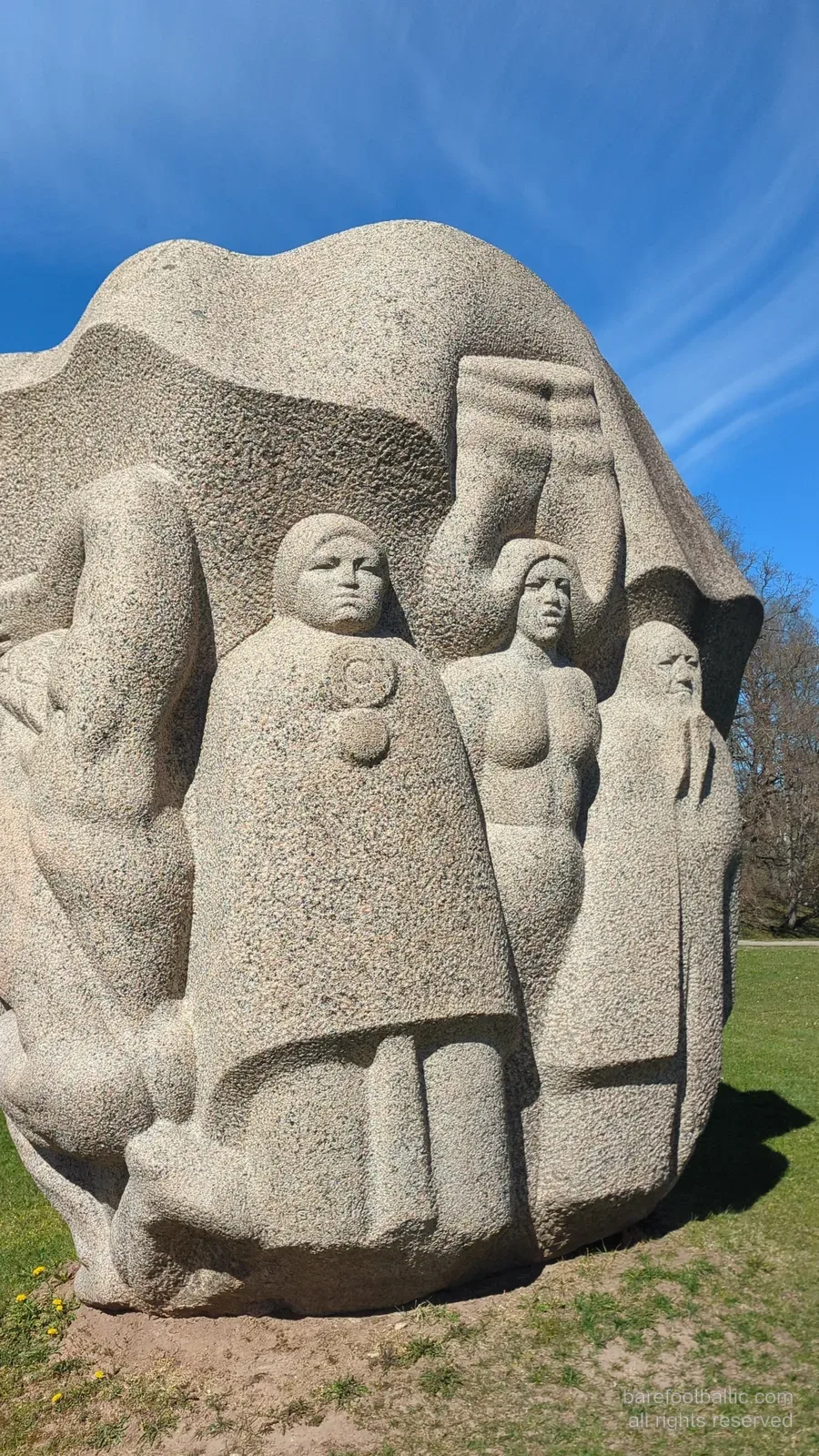
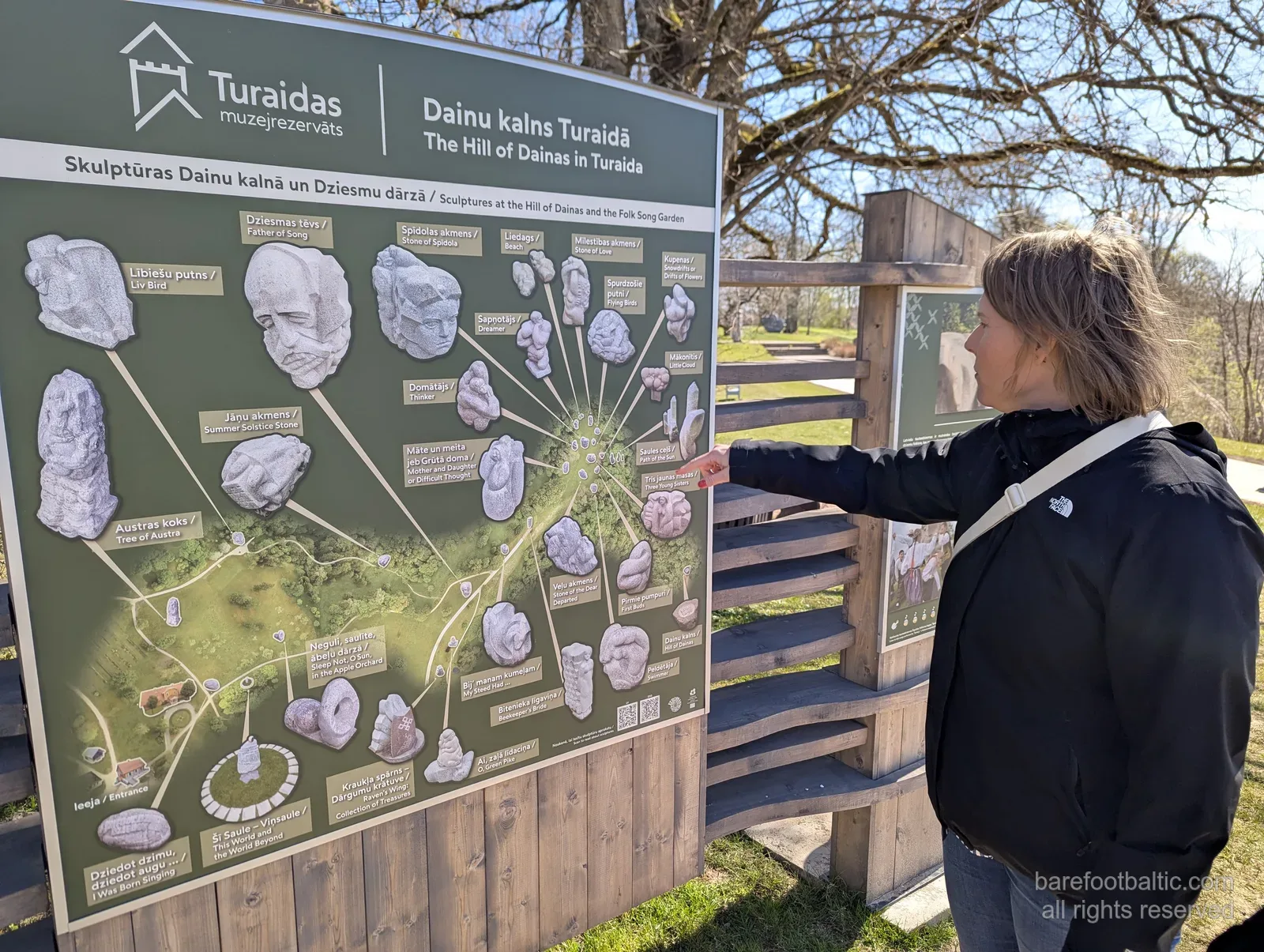
The hill has more than twenty-six sculptures across three hectares of meadow and oak. Walk past quickly and they look like organic granite forms. Spheres, drops, pillars, figures emerging from rock. Slow down with the dainas in mind. They read as a 26-stanza poem about who we are. For a sculpture-by-sculpture field guide with the daina engraved on each stone and the year of placement, see the companion field guide. What follows here is the thematic groupings, not the full catalogue.
The arrangement is choreographed. The hill is laid out so that the paths between the sculptures roughly mirror the structure of the dainas themselves. Birth, work, courtship, marriage, family, ancestors, the gods. There is a logic to the order, even if it is not signposted in English. A few groupings to look for.
The pre-Christian Latvian gods
The dainas keep alive a pantheon of nature-deities the church has never quite been able to scrub out. Several sculptures honour them directly.
Veltījums Saulei, Dedication to the Sun. Saule, the sun, who is feminine in Latvian. She rises from the sea, drives a chariot across the sky, and weeps tears that turn to amber on the Baltic shore. The sculpture is rounded, almost spherical, designed to read against the sky behind it.
Austras koks, The Tree of Auseklis. Auseklis is the morning star. The Austras koks is the daina world-tree, the cosmic axis around which day and night, life and death, are organized. This sculpture, added in 1990 as the country was changing hands, is the most concentrated cosmological piece in the garden. The whole creation in one boulder.
Saules ceļš, Path of the Sun. A daily journey rendered as a procession of forms. The sun’s path through the sky is the basic clock of the agrarian dainas.
The folk calendar
Jāņu akmens, the Midsummer Stone. Jāņi, the night of 23 to 24 June, is the highest-stakes folk holiday in Latvia. Bonfires, oak-leaf wreaths, all-night singing in country houses. Jāņu akmens is the literal centerpiece of the calendar half of the hill. If you visit on Midsummer eve, this is where the local folklore groups gather.
Neguli, saulīte, ābeļu dārzā. The title is a daina line, "Don’t sleep, little sun, in the apple orchard." The sun is addressed as a girl-child, told not to dawdle in the orchard. The sculpture is soft, seated, half-asleep among the apples.
The life cycle
A large group of sculptures tracks the human life as the dainas track it. From cradle to grave, with weddings and labour and motherhood between.
Bitenieka līgaviņa, The Beekeeper’s Bride. A wedding-cycle daina rendered in stone. Beekeeping is one of the deepest occupational layers in Latvian folk culture, and the beekeeper’s bride songs are some of the gentler ones in the repertoire.
Māte un meita, Mother and Daughter. The seated figures lean into each other. Many dainas are sung from a mother to a daughter on the eve of marriage, on the day a baby is born, at the spinning wheel through a long winter. The whole genre of tautasdziesmas is a transmission from one woman to the next.
Trīs māsas, Three Sisters. A daina motif that recurs across hundreds of song variants. The three sisters represent stages of life, the three layers of the cosmos, or simply three women working in a meadow, depending on which daina you have in your head.
Mīlestības akmens, the Stone of Love. Latvian wedding parties bring their bouquets here. It is a quiet tradition, not advertised. If you come on a Saturday in May or June, you may see a bride in white walking up to a granite boulder and laying flowers on it before driving on to her reception.
The Liv layer (the older country underneath)
Turaida means "garden of God" in Livonian, a Finno-Ugric language related to Estonian and now effectively extinct. The last fluent native speaker died in 2013. The Livs (Līvi) lived along the lower Gauja and the Baltic coast for centuries before the Latvians as we know them coalesced as a people. Two sculptures, in particular, mark this older layer.
Veļu akmens, Stone of the Departed. The first sculpture placed on the hill, in 1982, on the site of an actual ancient Liv settlement. The Veļi are the souls of the ancestors. Placing them on a Liv site, not a Latvian one, was a choice.
Lībiešu putns, The Livonian Bird. Added in 1991, the year of independence. A memorial in stone for the indigenous people whose land this was first.
The centerpiece
Dziesmu tēvs, the Father of Songs. The portrait sculpture of Krišjānis Barons, with three generations of singers carved around his head. This is the visual center of the hill and the place to slow down longest. It is also where the banned flag was raised in 1988. No plaque shouts about that, but any Latvian over 50 will tell you if you ask.
If you happen to read Latvian, the on-site plaques carry the daina line each sculpture references. If you don’t, the simplest preparation is to read a small selection of dainas in English translation before you come. Imants Krašnais’s versions are good. The Latvian Literature Centre has free samplers online. Even a dozen dainas in your head, pre-loaded, will change the way the hill reads.
Indulis Ranka, the man with the trailer
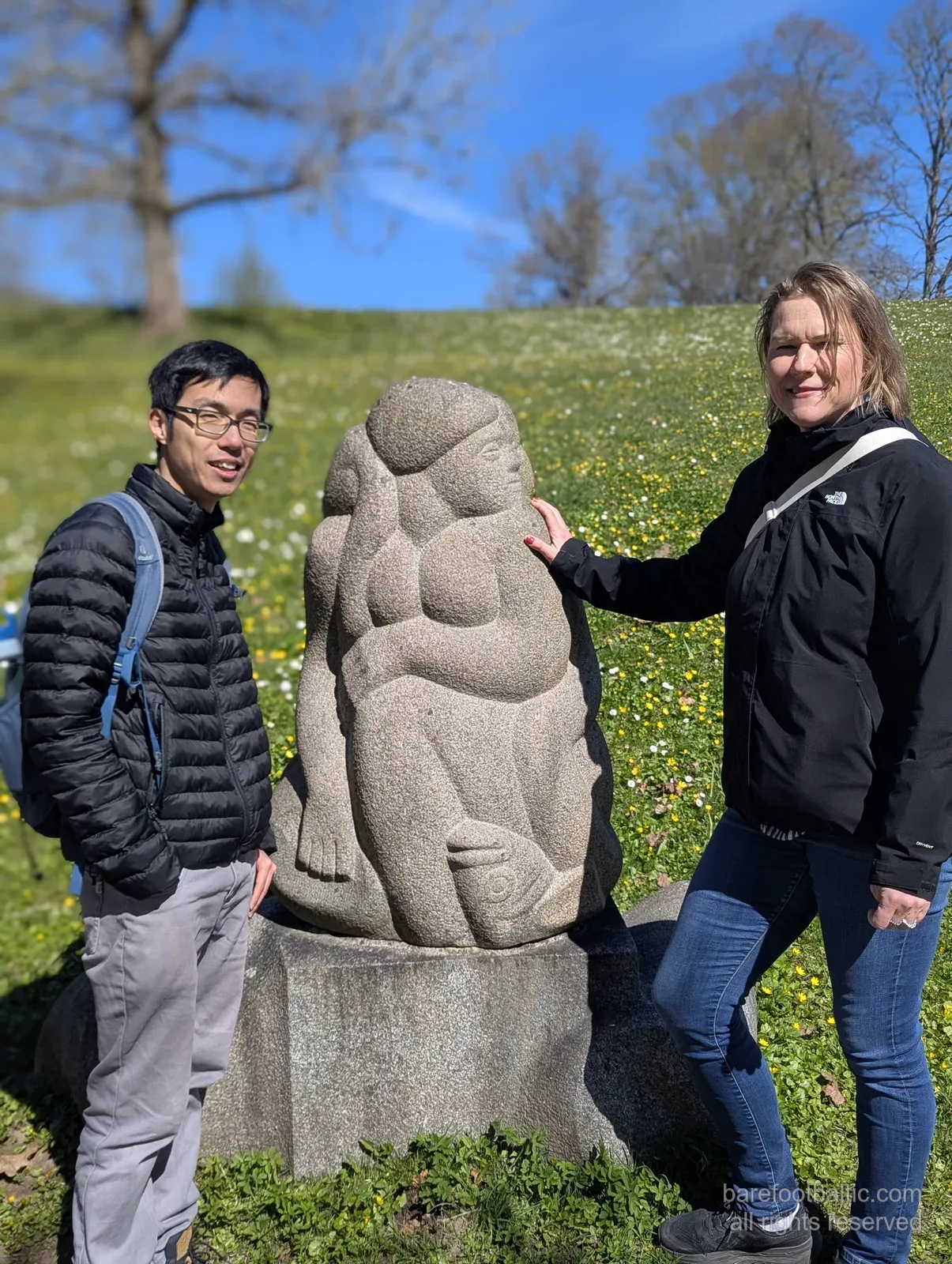
The sculptor of all this, Indulis Ranka, is the kind of figure that travel writing usually struggles with because he resists the grand narrative. He was a painter who became a sculptor in his thirties because the painters’ section of the Artists’ Union was overcrowded. He could not afford professional stone-cutters, so he taught himself to carve granite by hand. He bought a small truck and a portable crane. And then for the next fifty years he located, excavated, hauled, and shaped the boulders himself, often working at night during the long Latvian summer.
Latvian fields are full of granite. Glacial erratics, dragged south by the ice sheets and dropped at random when the climate warmed twelve thousand years ago. Most farmers regard them as a nuisance. Ranka regarded them, in his own words, as "old friends." He spent decades scouting them, one in a meadow near Gulbene, another in a forest in Kurzeme. He brought them to Turaida one truckload at a time. The Hill of Dainas was built, almost literally, one stone at a time, often after midnight, by a man with a small budget and a lot of time.
This matters because it shapes the work. Ranka’s sculptures do not look like neoclassical figures hewn from a quarry slab. They keep the boulder. The form emerges from the rock the way the dainas emerge from the language. Slowly, organically, with the original material always visible. A face in profile, a pair of hands, a back curving into the original surface of the stone. The Ice-Age memory of the granite is part of the piece.
He worked with a small constellation of collaborators. Anna Jurkāne carried the project on the institutional side. She found the volunteers, fended off the bureaucracy, raised donations from across the country. Architects Jānis Rozentāls and Ilgvars Batrags planned the site. Landscape designers Aivars Irbe and Rūta Brice handled the paths and plantings. But the carving was always Ranka, alone, with chisel and stone.
He died on 13 April 2017, two days short of his 83rd birthday. The hill is now, in effect, a fixed text. No new sculptures will be added by him, and none have been commissioned by the museum to extend the work since. The twenty-six (or twenty-seven, depending on how you count) sculptures are the complete set.
How to actually visit it
The Hill of Dainas sits on the south-eastern slope of the Turaida Museum Reserve, about a five-minute walk down from the red-brick castle and the wooden church. The entry ticket to the reserve covers it. You do not pay separately. It is easy to treat it as the last stop on a Turaida loop and give it ten or fifteen minutes between the castle and the car park. That is not enough.
The right minimum is 1.5 to 2.5 hours for the Hill of Dainas plus the adjacent Dziesmu dārzs, separately from the castle and the Rose of Turaida grave. If you want to read every plaque, sit on the bench by the Mīlestības akmens for a while, and walk into the Song Garden amphitheater and stand on the stage where the Baltica concerts have happened, allow three hours.
Best times of year
- 23 to 24 June (Jāņi). Folklore groups gather at Jāņu akmens. Bonfires nearby. The single most loaded night of the Latvian folk calendar. Note the museum has limited hours around the public holiday, so check the schedule.
- 7 July (the anniversary of the opening). Folklore concerts most years. The 40th anniversary fell in 2025.
- The Baltica festival year. The international folklore festival rotates between Latvia, Estonia, and Lithuania every three years. When Latvia hosts, Turaida is consistently a venue. Latvia’s next likely turn is 2028.
- Summer weekends generally. Folklore ensembles, brass bands, and ethnographic groups perform at the Song Garden. The hill is full of live music on those weekends.
- Late September and early October. Autumn color through the oak trees, low light on the granite, almost no other visitors. My personal favorite.
- Winter. The site is open year-round. Snow on the granite changes the reading entirely. Quietest of all.
How to get there
- Self-drive. About 50 km north-east of Riga on the A2 motorway towards Sigulda. Free parking at the Turaida reserve.
- Train. Riga to Sigulda direct, about 90 minutes. From Sigulda station, bus 12 to Turaida (15 minutes), or a 4 to 5 km walk through the Gauja valley.
- Guided day trip. Our Sigulda, Cēsis & the Gauja Valley excursion includes Turaida and gives the full backstory on the drive over. €94 per adult, year-round.
Practical bits
- The hill is a real hill. The terrain is gentle but uneven, with grassy slopes and gravel paths. Sturdy shoes if it has rained.
- The plaques next to each sculpture are mostly in Latvian. The museum’s printed catalogues and the Sigulda mobile app cover the English translations. Pick up a printed map at the reserve entrance.
- There is a small café at the reserve. No food on the hill itself.
- The Dziesmu dārzs amphitheater is downhill from the sculpture garden, a short walk. It is easy to miss. Walk down to it.
Why this hill takes an afternoon
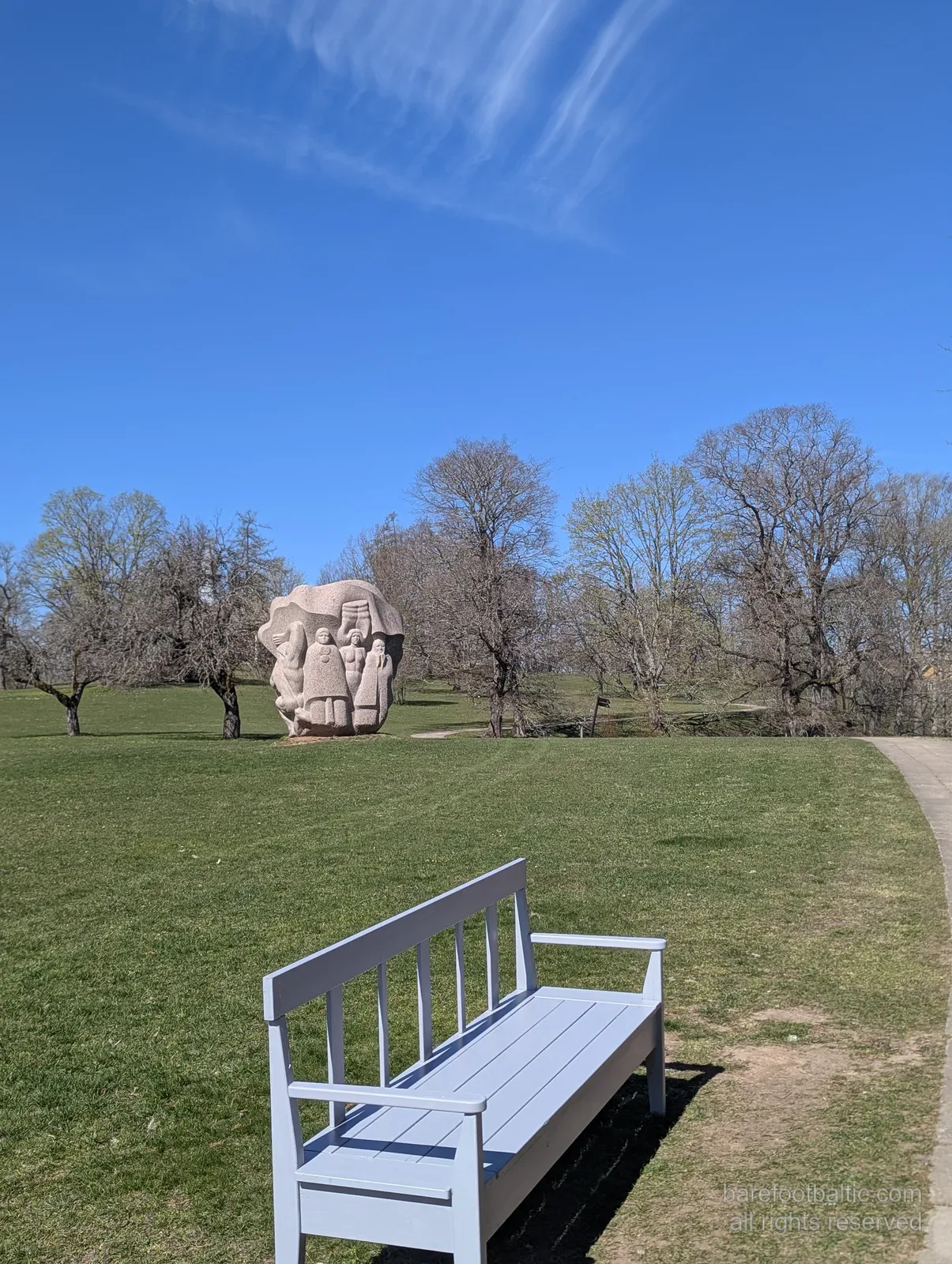
The Hill of Dainas is a folk poem in stone, and that is a different kind of object from a sculpture park. Each stone cites a daina or a daina-cluster, and the ones you can’t place will mean something to the local who walks past you with her grandchildren. The dainas are the deepest thing the country has. Older than the castles, older than the religion, older than the borders. A hill that holds them in granite is a particular kind of place.
The other thing it holds is a quieter story about how empires end. Sometimes with a hill, a sculptor, a museum director, and a crowd that started gathering on Sundays to sing.
If you are coming to Latvia for the castles and the bog and the Art Nouveau, come here too. Bring an extra hour and a few dainas in translation, and sit on the bench by the Stone of Love. The dainas were sung on this hill long before there was a sculpture on it, and they are still being sung on it now.
Daiga Taurīte is a licensed Latvian tour guide and co-founder of Barefoot Baltic. She runs small-group day excursions from Riga. She grew up here, spent two decades in London, came home in 2024. Barefoot Baltic is licensed by Latvia’s Consumer Rights Protection Centre (PTAC), holds ATD passenger transport licence PS-01995, and is insured by BTA Baltic for civil liability.
The full Sigulda day runs as a small-group excursion from Riga year-round, taking in the castle, the Rose of Turaida grave, the Hill of Dainas, the Gauja Valley, and Cēsis on the way back. Get in touch if you’d like us to fold the deeper story of Dainu kalns into your day.